What if two cleaning plans both promise a “standard office clean” but leave you with different expectations? Vague scope descriptions make it difficult to compare services, and shared kitchens, meeting rooms or washrooms can be overlooked when responsibilities aren’t clear. Knowing what’s included in a standard office clean gives you a practical starting point for setting expectations.
Routine cleaning is also easy to confuse with periodic or deep-clean work. This checklist groups common tasks by office area, so you can identify what a regular service should maintain and which details need to be agreed for your workplace.
We’ll cover work areas, shared spaces, kitchens, washrooms and floors, then explain how routine tasks differ from deeper or less frequent cleaning. Because every office has its own layout and patterns of use, the cleaning plan should reflect the premises and clearly define responsibilities. At DLT Cleaning Services, dedicated on-site supervision supports consistent standards across office cleaning contracts.
Key Takeaways
- Understand what’s included in a standard office clean and why the agreed scope should reflect your workplace.
- Use an area-by-area checklist to identify routine tasks for work areas, shared rooms, kitchens, washrooms and floors.
- Distinguish everyday upkeep from periodic tasks and deep-clean work, so expectations are clear.
- Build a practical checklist around how rooms are used, who shares them and which areas need particular attention.
- See how a tailored cleaning plan and dedicated on-site supervision help maintain agreed standards.
What does a standard office clean usually include?
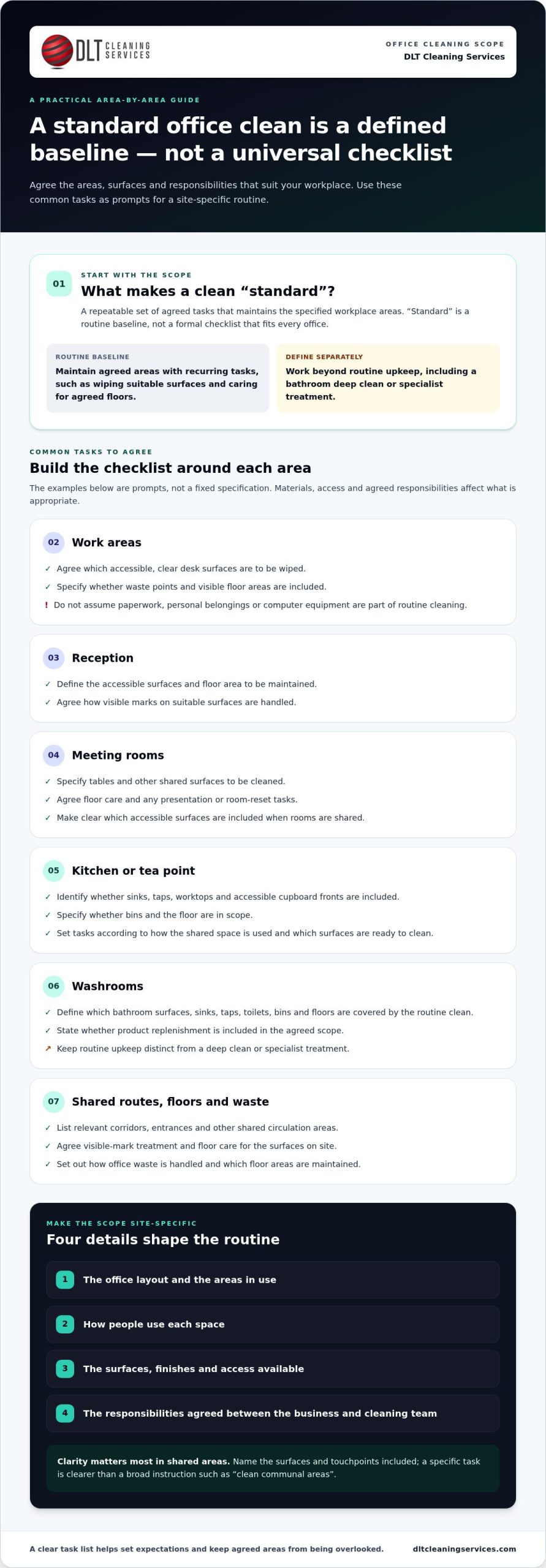
A routine office clean maintains agreed areas through repeatable tasks tailored to the site. If you’re asking what’s included in a standard office clean, start with this: there is no single checklist that suits every workplace. The scope depends on the layout, how people use each space, the surfaces and finishes, and the responsibilities agreed between the business and its cleaning team.
That distinction matters in practice. A lightly used meeting room has different needs from a busy reception or shared kitchen. A clear task list helps keep high-use areas from being overlooked and sets out what routine cleaning is intended to maintain. Commercial cleaning covers a range of duties, but the right routine for an individual office should reflect its premises and agreed scope.
Common tasks to define for each site include:
- Workspaces: wiping agreed, clear desk surfaces and nearby touchpoints, and removing visible marks where suitable.
- Reception: cleaning accessible surfaces, removing suitable visible marks and maintaining the agreed floor area.
- Meeting rooms: wiping tables and other agreed surfaces, with attention to how the room is shared.
- Shared circulation areas: removing visible marks from suitable surfaces and maintaining walkways and other agreed floors.
- Kitchens or tea points: cleaning agreed worktops and accessible surfaces, with tasks set according to how the space is used.
- Washrooms and waste: cleaning agreed bathroom surfaces and handling office waste as set out in the service scope.
Which office areas are commonly covered?
Workspaces, reception areas, meeting rooms and shared routes commonly feature in an office cleaning plan, alongside kitchens, washrooms, floors and waste points. Typical tasks include wiping suitable surfaces, removing visible marks and caring for agreed floor areas. Use these as prompts for a site-specific checklist, not a fixed specification: materials, access and the division of responsibilities all affect what is appropriate.
Be especially clear about shared areas. Staff and visitors may use the same kitchen, meeting room or entrance, so specify the surfaces and touchpoints included. A named task is less likely to be missed than a broad instruction such as “clean communal areas”.
What makes a clean ‘standard’?
“Standard” describes a routine baseline, not a formal universal checklist. It means maintaining agreed areas through recurring tasks, rather than restoring a heavily soiled or neglected space. The condition of the office, its surfaces and the agreed responsibilities all shape that baseline. Work beyond routine upkeep should be defined separately.
A standard office clean is a repeatable set of agreed tasks that maintains the cleanliness of specified workplace areas. Defining the areas and tasks gives everyone a clearer picture of the expected result, while allowing the plan to reflect how the office operates.
What tasks belong in an office clean by area?
A room-by-room checklist makes a cleaning scope easier to understand and review. The examples below are common tasks to agree for each site, rather than a fixed specification. The right selection depends on the surfaces, access and responsibilities in your workplace. For a wider reference on structured cleaning expectations, the ISSA Clean Standard for Institutional & Commercial Facilities sets out cleaning activities and considerations such as tasks, tools and frequencies.
Work areas, reception and meeting rooms
Start with the spaces employees and visitors use during a typical working day. Specify shared surfaces and presentation requirements, while making clear that personal belongings are separate from cleaning tasks.
- Work areas: agree which accessible, clear surfaces are to be wiped, and whether waste points and visible floor areas are included. Don’t assume employees’ paperwork, personal items or computer equipment are part of routine cleaning.
- Reception: define the surfaces and floor area to be maintained, including how visible marks on suitable surfaces are handled. This keeps the entrance presentable without relying on a vague instruction to “tidy reception”.
- Meeting rooms: specify the tables and other shared surfaces to be cleaned, along with floor care and any agreed presentation tasks. If a room is used for client meetings, state what a reset should involve.
Shared rooms can change quickly between uses. Agree which surfaces are accessible, what happens to waste and which floor areas are in scope. This helps prevent missed tasks and avoids uncertainty about personal desks or belongings.
Kitchens, washrooms and shared circulation areas
These spaces see frequent shared use, so a clear task list can make a practical difference. Use the examples below to define the service scope, rather than assuming every task is automatically included.
- Kitchen or tea point: identify whether sinks, taps, worktops, accessible cupboard fronts, bins and the floor are included. Specify which surfaces are shared and ready to clean.
- Washrooms: define the bathroom surfaces, sinks, taps, toilets, bins and floors covered by the routine clean. Distinguish routine upkeep from a bathroom deep clean or specialist treatment, which has a different scope.
- Shared circulation areas: list relevant corridors, entrances and other shared routes, then specify visible-mark treatment and floor care according to the surfaces on site.
- Product replenishment: state whether replenishing washroom or kitchen products is included in the agreed responsibilities, and name the products and locations covered.
An area-based task list turns “clean the office” into clear responsibilities for each shared space. DLT tailors routine office cleaning to office environments, helping businesses in Guildford define a scope that reflects their premises. Explore tailored office cleaning to see how tasks can be shaped around your workplace.
What is usually outside a routine office clean?
A routine clean maintains agreed areas during recurring visits. It is not a programme of restoration, specialist floor treatment or high-level work. This distinction helps clarify what’s included in a standard office clean: routine upkeep, periodic cleaning and deep-clean work have different purposes and scopes.
The comparison below gives examples, not a universal specification. Timing depends on the premises, materials, use and condition of each area. Agree frequencies for the individual site instead of treating examples as industry-wide rules.
Routine upkeep
Maintains the areas and surfaces agreed for recurring visits. Examples include regular attention to accessible surfaces, waste points and specified floors.
Periodic tasks
Less frequent work that can be planned separately around site needs. Examples include carpet extraction or high-level cleaning, depending on the building and surfaces.
Separately scoped deep-clean work
More intensive cleaning for heavy build-up or areas that need attention beyond everyday upkeep. Intensive bathroom cleaning or specialist treatment may fall into this category.
Routine upkeep versus periodic cleaning
Routine work maintains an agreed standard across specified areas as part of recurring cleaning visits. Periodic tasks address needs that don’t arise in the same way every visit and can be planned separately to suit the premises. A carpeted office, for example, may need a different floor-care plan from an office with hard flooring. There is no single weekly, monthly or quarterly timetable that suits every workplace.
Be precise so an example of timing does not become an assumed promise. Name the area and the work required, then show how the task fits into the cleaning plan. Timing can reflect actual use and condition rather than an arbitrary rule.
When does a task need a separate scope?
Consider a separate scope when a task involves heavy build-up, specialist surfaces or intensive restoration. Carpet extraction, high-level work and a thorough clean of a heavily soiled bathroom are examples to distinguish from routine maintenance. These tasks may require different planning or methods, so defining them separately helps set realistic expectations.
Bathroom deep cleans are part of DLT’s hygiene services. They are distinct from routine washroom upkeep, which maintains the areas and tasks agreed for regular cleaning. Separating the two makes clear what each type of work is intended to address.
For broader context on setting expectations for a workplace cleaning service, the office cleaning standards guide explores professional standards and planning. A well-defined scope gives the cleaning team and workplace a shared understanding of routine tasks and separately planned work.
How to build a practical office cleaning checklist
A useful checklist turns a broad expectation into clear, site-specific tasks. Start with the rooms people use, then define what needs attention, who is responsible and how the work can be reviewed. This helps managers work out what’s included in a standard office clean for their own premises, rather than relying on a generic list that may miss important spaces or responsibilities.
Map spaces, use and responsibilities
Walk through the office and record each space, including areas used by visitors or contractors as well as staff. Note how shared spaces are used and flag sensitive areas where access or handling needs particular care. A tailored office cleaning scope can reflect these differences instead of treating every room alike.
- List every room and area. Include workspaces, reception, meeting rooms, kitchens, washrooms, corridors and less frequently used spaces.
- Note who uses each space. Consider staff, visitors and contractors, along with busy periods or shared use that may affect how a room is maintained.
- Identify sensitive areas. Record rooms, surfaces or equipment that need specific access arrangements or should be left untouched.
- Set out responsibilities. Separate cleaning tasks from staff duties, such as clearing personal items from a surface before it can be cleaned.
- Define the agreed tasks. Connect each task to a named area, so “clean shared spaces” becomes a clear instruction about which surfaces or floors are in scope.
Turn expectations into a reviewable checklist
Use plain descriptions that make the expected work easy to understand. “Wipe the clear meeting-room table” is more specific than “clean meeting room”, while “maintain the agreed corridor floor” identifies both the task and location. Keep recurring work distinct from periodic items, so the team can review routine tasks without mistaking a separately planned job for an omission.
- Name the location: identify the room or area rather than using a broad label.
- Describe the task: specify the surface or feature and the action required.
- Record the timing: show whether the item is recurring or planned separately, without assuming one frequency suits every site.
- Make review practical: use the checklist to discuss whether agreed tasks are being completed and whether the scope still fits the workplace.
Review the list when the office layout changes, a room takes on a new purpose or patterns of use shift. For wider context on workplace standards, DLT’s health and safety cleaning guide discusses considerations that can inform planning.
For a cleaning plan shaped around your workplace, explore tailored office cleaning from DLT Cleaning Services.
How DLT makes routine office cleaning fit your workplace
A checklist is most useful when it reflects how your office operates. DLT Cleaning Services provides routine office cleaning tailored to office environments, rather than relying on one fixed package for every site. The agreed scope can reflect the workplace layout, shared areas and priorities, making clear what the cleaning team is responsible for and which tasks sit elsewhere.
That detail matters when deciding what’s included in a standard office clean for your premises. A plan should make routine tasks understandable and manageable, while recognising that the right scope for a reception-led office may differ from one with heavily used meeting rooms or shared facilities.
A tailored cleaning scope with hands-on oversight
DLT’s office cleaning includes dedicated on-site supervision. This provides oversight of the agreed cleaning standards and supports attention to relevant health and safety considerations. It does not mean every workplace needs the same task list: the plan can be tailored to the office and how it is used.
Managers can use their checklist to set priorities, clarify responsibilities and identify areas needing particular attention. DLT’s office cleaning manager’s guide offers wider context on cleaning standards and service management, alongside the room-by-room approach in this article.
Next steps for Guildford and nearby workplaces
Before discussing a cleaning plan, note the spaces in your workplace, how they are used and what matters most to staff and visitors. Highlight shared areas, sensitive spaces and responsibilities that need to be clearly divided. This gives you a practical basis for shaping routine cleaning around the premises instead of trying to fit your office into a generic checklist.
DLT Cleaning Services is a family-run independent company established in 1999, serving Guildford and the wider Surrey, Hampshire and Berkshire areas. Its office cleaning and hygiene services provide local support, while a tailored approach and on-site supervision connect agreed tasks with day-to-day service standards.
If you’re considering routine cleaning for your workplace, discuss your office cleaning needs with DLT. A clear conversation about your spaces, priorities and responsibilities is a practical first step towards a suitable plan.
Make your cleaning plan work day to day
A useful checklist shouldn’t be filed away once it’s agreed. Treat it as a shared working document: it helps staff understand what to expect and gives managers a straightforward way to raise questions when a space or responsibility is unclear. That ongoing conversation helps keep the cleaning plan relevant as the workplace changes.
If you’re still deciding what’s included in a standard office clean for your premises, start with the areas that matter most to staff and visitors. Clear priorities give you a practical basis for shaping a service around how your workplace functions, without relying on assumptions about what “standard” means.
DLT Cleaning Services brings a family-run approach, dedicated on-site supervision and experience established in 1999 to office cleaning across Guildford, Surrey, Hampshire and Berkshire. Discuss a tailored office cleaning plan with DLT to define a clear scope for your workplace.
Frequently Asked Questions
Does a standard office clean include cleaning computer screens and keyboards?
Not automatically. Agree separately whether screens or keyboards are in scope, which equipment must be left untouched and what method is suitable for the devices in your workplace. For example, a desk checklist could specify cleaning the clear desk surface while excluding the monitor and keyboard. Staff can help by identifying sensitive equipment and following the workplace’s guidance on approved cleaning methods.
Should staff clear their desks before an office clean?
Yes. Keeping agreed work surfaces clear makes them easier to clean. Staff should secure paperwork, valuables and personal belongings rather than expect cleaners to move them. For shared desks, a simple end-of-day routine, such as putting away loose items and leaving the agreed surface accessible, can help. The cleaning plan should explain how occupied desks are treated, so nobody assumes personal items will be handled.
Does a standard office clean include inside windows?
Not necessarily. Specify each type of glass separately, such as an internal glass door, a partition or a window, instead of writing “clean windows”. Also define which surfaces are accessible and how often they need attention. This is useful in offices with glass meeting-room walls, where visible marks can affect presentation but internal window cleaning may need a separately agreed scope.
Are cleaning products and washroom supplies included in an office clean?
Clearly allocate product use and replenishment: state which supplies are needed, who provides them and whether restocking is part of the agreed tasks. Cleaning products used by the team and items for staff or visitor use are separate considerations. DLT supplies janitorial products through its hygiene services, supporting workplace arrangements for businesses in Guildford and the wider service area.
How is a standard office clean different from a deep clean?
A standard clean maintains agreed areas through routine work; a deep clean addresses more intensive tasks or areas needing extra attention. The boundary depends on the premises and the work required, rather than a universal checklist. Bathroom deep cleaning, for instance, is distinct from routine washroom upkeep. DLT’s hygiene services include bathroom deep cleans, which can be scoped separately from regular office maintenance.
Can an office cleaning checklist be changed as the workplace changes?
Yes. Review it when teams move, rooms take on new uses or working patterns change. For example, if a meeting room becomes a regular shared workspace, its cleaning priorities may need updating. Keep a current version and note what has changed, so staff and the cleaning team work to the same expectations. Multi-site businesses can use consistent task descriptions while allowing for local differences.