What if a clean office depended as much on knowing where not to go as on knowing what to clean? In workplaces with confidential records, restricted rooms or IT equipment, access and care need to be considered alongside everyday hygiene. Guildford office cleaning for sensitive environments should start with clear boundaries, so staff and cleaners understand what is included and what must be left alone.
It’s reasonable to want clarity about who enters your workspace, how sensitive areas are treated and who oversees the service. This guide explains how to define cleaning zones, set access expectations and prioritise different areas, so your requirements can shape a practical cleaning plan.
DLT Cleaning Services Ltd is a family-run business established in 1999. Its cleaners are directly employed, carefully interviewed, DBS-checked and fully insured, and cleaning contracts have dedicated on-site supervision. This guide also covers how IT Cleaning can support equipment-sensitive workspaces and how to prepare a useful brief for your office.
Key Takeaways
- Guildford office cleaning for sensitive environments works best when cleaning priorities reflect the needs of each area, rather than treating every space alike.
- Set separate instructions for access, confidentiality, equipment care and hygiene so expectations are clear and practical.
- Compare cleaning arrangements by staff vetting, insurance, supervision, task scope and communication, not just by the list of tasks.
- Prepare a concise site brief that identifies restricted areas, excluded items, shared spaces and key cleaning priorities.
- DLT’s family-run experience, directly employed DBS-checked cleaners and dedicated on-site supervision are useful points to consider when planning a cleaning service.
What makes Guildford office cleaning suitable for a sensitive environment?
A sensitive office isn’t defined by one industry or a particular level of cleanliness. It’s a workplace where specific areas, equipment or routines need clear consideration during cleaning. That could mean respecting confidential workspaces, setting boundaries around IT equipment, prioritising shared facilities or defining which rooms are included in the service.
Sensitive-office cleaning is routine commercial cleaning planned around a workplace’s access, confidentiality, equipment-care and hygiene priorities. Those priorities vary between sites. A finance team may want confidential meeting rooms clearly addressed in the brief, while a technology business may need specific instructions for equipment areas. Neither automatically requires clinical cleaning or specialist decontamination.
Consistent office cleaning also helps keep everyday spaces presentable and ready to use. Clean floors, desks and shared facilities support the professional appearance of a workplace, while a well-organised plan can reflect how staff use the premises. These practical basics matter alongside any site-specific sensitivities.
Which office areas may need extra care or clear boundaries?
Start by identifying where people meet, handle confidential material, use equipment or share facilities. Meeting rooms, confidential work areas, IT spaces, kitchens and washrooms can all have different cleaning priorities. Even within one office, a shared desk area may need a different brief from a room used for private discussions.
Identify the boundaries and priorities for your own premises rather than assuming a standard task list will suit every room. For each area, state what needs attention and what falls outside routine cleaning. That gives the service plan a practical starting point and reduces the risk of different people interpreting a broad instruction in different ways.
Sensitive cleaning needs versus specialist decontamination
Careful routine office cleaning is not the same as regulated or clinical decontamination. Most sensitive offices need agreed cleaning boundaries and priorities, not cleanroom conditions. Cleanroom environments are essential in industries highly sensitive to environmental contamination, requiring stringent control over airborne particulates and aseptic practices. Understanding that distinction helps keep expectations appropriate to the workplace.
DLT’s commercial cleaning services include Deep Cleaning and Fogging Service. These services have a distinct scope and do not mean that every office needs specialist treatment. For a routine office plan, focus on the premises, everyday cleaning needs and any areas that call for clearly defined instructions.
For Guildford office cleaning for sensitive environments, describe the workplace as it operates: which spaces are shared, where equipment needs consideration and which areas have specific access or confidentiality priorities. This gives managers and the cleaning team a common basis for planning, without treating every office as a clinical setting.
How cleaning choices affect confidentiality, equipment care and hygiene
Confidentiality, equipment care and hygiene are related, but they are not interchangeable. A room may need to remain outside routine cleaning because of the work carried out there, while a shared kitchen may need regular attention. A clear brief separates these priorities, so the cleaning team understands both the tasks to complete and the boundaries to respect.
Clear task boundaries help align cleaning activity with the site’s priorities. For Guildford office cleaning for sensitive environments, define the scope area by area instead of relying on broad instructions that could mean different things to different people.
Protecting confidential work areas through clear instructions
Identify which rooms, desks or materials should remain outside routine cleaning. For example, a meeting room used for confidential discussions may have different instructions from a general-use room. A written site brief gives the cleaning team a shared reference and helps managers update instructions when workplace needs change.
Keep the brief practical: name the area, state what is included or excluded, and explain any important boundaries. A sample confidentiality clause for janitorial services illustrates how agreements may address information encountered during cleaning. It is not a substitute for clear site instructions or a guarantee about how information will be handled.
Planning cleaning around IT and shared equipment
Identify IT spaces and other equipment-sensitive areas before agreeing the task scope. Distinguish between cleaning the surrounding desk or floor and handling devices, cables, papers or personal work materials. If the brief does not make that distinction, staff and cleaners may have different expectations about what the task involves.
DLT provides IT Cleaning for offices with equipment-sensitive spaces. Begin by describing the areas and priorities, then define which tasks are included in the cleaning arrangement. Avoid vague instructions such as “clean the workstation” if the intention is only to clean the surrounding surfaces.
Give hygiene instructions their own focus. Identify visible surfaces and frequently touched shared points, such as door handles, kitchen worktops and meeting-room tables, then set priorities that reflect how people use them. Washrooms and shared kitchens may need a different routine from private offices. Specific instructions make everyday tasks clearer without implying a clinical standard or a guaranteed health outcome.
Separate instructions for access, equipment and hygiene make a cleaning plan easier to understand and review. DLT supports Guildford workplaces with office cleaning planned around site priorities. Explore DLT’s office cleaning services as you consider how your brief should distinguish sensitive areas from shared spaces.
How to compare Guildford office cleaning services for sensitive workplaces
A broad list of cleaning tasks won’t tell you whether a service suits a sensitive workplace. Look at how clearly the arrangement accounts for access boundaries, equipment and site priorities, and how responsibility is managed. Use the criteria below to assess practical fit, not just the number of tasks listed.
Staff vetting: DLT’s cleaners are directly employed, carefully interviewed and DBS-checked.
Insurance: DLT’s cleaners are fully insured.
Supervision: DLT manages cleaning contracts with dedicated on-site supervision.
Task scope: Cleaning priorities can be defined around the workplace and the areas included in the brief.
Communication: Clear instructions about site needs and task boundaries give the cleaning team a practical reference.
What to assess about people, oversight and accountability
Staffing arrangements matter because cleaners work in the business premises as part of the service. Direct employment, careful interviews and DBS checks are relevant points to consider alongside insurance. DLT’s dedicated on-site supervision provides an oversight feature for its cleaning contracts. These details help managers assess the arrangements without implying a confidentiality guarantee or a particular response time.
Look beyond general assurances. Consider whether the staffing, supervision and scope align with the needs in your site brief. A general task list alone won’t explain how restricted areas or equipment-sensitive spaces are treated.
How to compare service scope without relying on vague promises
Start with the routine work the office needs, then identify any additional priorities. Office Cleaning or Commercial Cleaning can cover the general workplace scope; other services may be relevant when the brief calls for them. Matching each service to a defined requirement keeps the plan focused instead of adding tasks simply because they sound comprehensive.
- Office Cleaning or Commercial Cleaning: Set out the routine areas and tasks required across the workplace.
- Hygiene Services: Consider these when shared facilities or hygiene priorities need specific attention.
- IT Cleaning: Include it in the discussion if the site brief identifies equipment-sensitive spaces.
- Deep Cleaning: Consider it when the premises’ stated needs call for a deeper clean.
Make each service scope concrete: name the areas, state the priorities and explain any boundaries. DLT’s tailored office cleaning services guide offers further planning context. This approach helps managers assess Guildford office cleaning for sensitive environments against actual workplace requirements rather than relying on vague promises of a bespoke service.
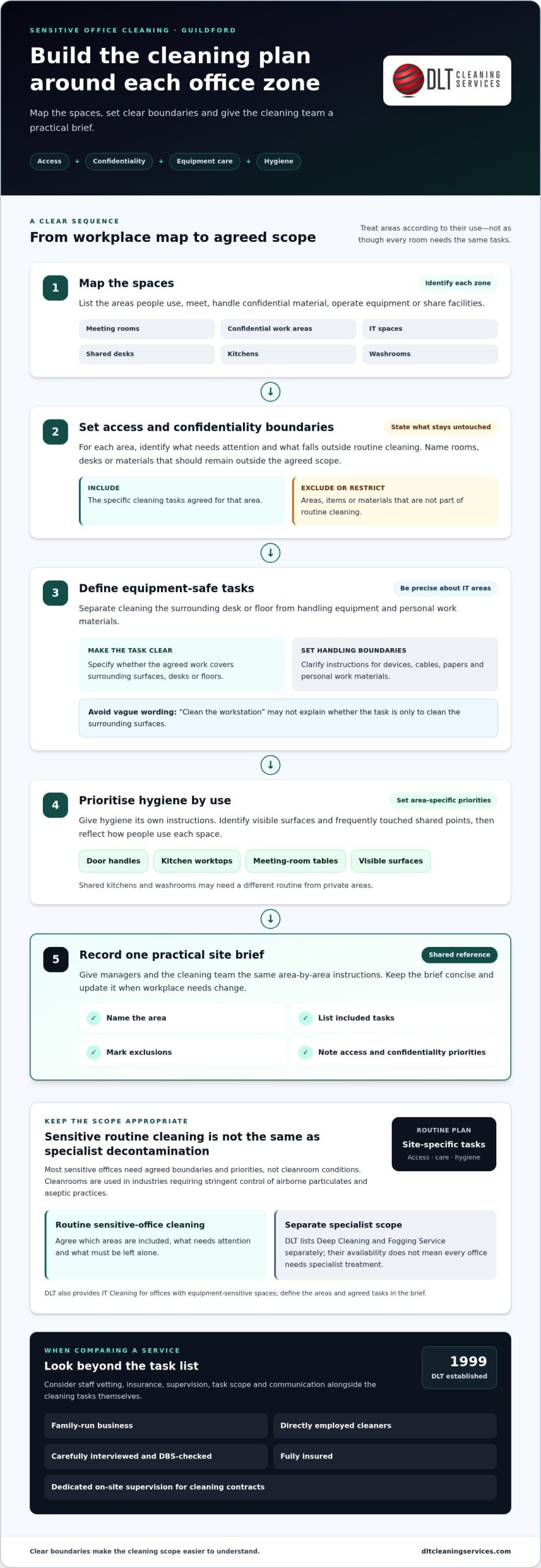
How to brief and prepare a sensitive office for cleaning in Guildford
A useful site brief turns workplace concerns into practical instructions. It explains what needs attention, what must remain untouched and how cleaning should fit around the way the office is used. For Guildford office cleaning for sensitive environments, preparation doesn’t require a complicated rulebook. It requires priorities that are clear enough for everyone involved to follow.
Build the brief in a simple sequence:
- Map the priorities. Note which rooms need regular attention, which facilities are shared and where particular care is needed.
- Mark the boundaries. Identify restricted areas, excluded items and surfaces or equipment that should remain untouched.
- Define the tasks. Describe what cleaning involves in each area instead of relying on broad terms such as “clean the office”.
- Agree communication. Name the relevant site contact and explain how changes to rooms, priorities or instructions will be shared with the cleaning team.
Create a clear site brief before cleaning starts
Be specific and factual. A priority-room list could separate meeting rooms, work areas, IT spaces and shared facilities, with a note beside each explaining what is included. State whether a surface needs attention or should be left alone. Don’t assume the cleaning team will know which desks contain personal work materials or which rooms have access boundaries.
Keep the brief concise and make it available to the relevant site contact and cleaning team. If office use changes, update the instructions so they remain useful. A short, current brief is easier to follow than scattered verbal requests.
Set expectations for routine tasks and specialist cleaning needs
Separate recurring Office Cleaning from occasional Deep Cleaning requirements. This distinguishes everyday tasks from work needed at particular times or to address specific site priorities. Hygiene Services may also suit facilities with their own requirements, such as shared washrooms. Tie each item to an identified need rather than treating every service as necessary for every office.
Consider how rooms are used and the workplace routine when agreeing the cleaning scope. Describe which tasks need to fit around office activity, without assuming a particular schedule. For broader workplace considerations, DLT’s health and safety compliant cleaning guide offers additional planning context.
Site-brief checklist: Record priority rooms, sensitive zones, restricted areas, shared facilities, included tasks, excluded items, equipment boundaries, the appropriate site contact and how changes will be communicated. This gives the cleaning team and site contact a clear working reference.
Once these details are organised, DLT can shape a cleaning arrangement around the office environment and its priorities. Discuss your Guildford office cleaning requirements with DLT and use your brief as the starting point.
Choosing DLT for sensitive office cleaning in Guildford
A sensitive cleaning arrangement depends on more than a task list. Managers also need to understand who will carry out the work, how it is supervised and whether the scope reflects the premises. DLT Cleaning Services Ltd is a family-run company established in 1999, providing cleaning and hygiene services to businesses in Guildford.
What DLT brings to a Guildford office cleaning arrangement
DLT provides Office Cleaning and Commercial Cleaning for business premises. Its cleaners are directly employed, carefully interviewed, DBS-checked and fully insured. These are practical details for decision-makers assessing who will carry out the work and the staffing arrangements behind the service.
DLT also manages cleaning contracts with dedicated on-site supervision. In a workplace with different room priorities, that oversight is relevant alongside a clearly defined task scope. The brief can identify which areas need routine attention, where boundaries apply and whether IT Cleaning, Hygiene Services or Deep Cleaning fits the premises’ needs.
DLT’s established local experience, staff information and supervision give managers concrete points to weigh when considering Guildford office cleaning for sensitive environments. For wider context on evaluating a business cleaning arrangement, DLT’s Office Cleaning in Surrey manager’s guide explores service-selection considerations.
Take the next step with a clear cleaning brief
Start with a short description of your premises and how staff use it. Include the rooms and facilities within scope, any sensitive or restricted areas, items that should remain untouched and the cleaning priorities that matter most. If some spaces need a different approach from shared areas, say so plainly. A well-prepared brief gives the discussion a useful focus.
It can also help to note how cleaning should fit around the office’s working routine. Describe when spaces are in use, meeting patterns and any practical considerations for completing the agreed tasks, without assuming a particular schedule. That context helps shape a plan around the workplace rather than asking the workplace to fit a generic task list.
DLT’s office cleaning and hygiene services provide a practical starting point for Guildford businesses planning these requirements. The aim is a clearly understood arrangement, with the site’s priorities and boundaries informing the cleaning scope. Share your workplace requirements with DLT’s Guildford office cleaning team to discuss an approach for your premises.
Make your next cleaning plan work for your workplace
Turn your priorities into a brief that your team can keep current. As rooms, equipment and working routines change, revisit the instructions so the cleaning scope continues to reflect how the office is used. This gives everyone a clear reference and helps keep sensitive areas and everyday tasks distinct.
For Guildford office cleaning for sensitive environments, a considered plan makes the service easier to understand and manage. DLT can discuss your premises and the cleaning priorities that matter to your team, helping you shape an arrangement around your workplace.
Discuss office cleaning for your Guildford workplace and take the first step towards a plan that fits your needs. A clear brief is a practical place to begin.
Frequently Asked Questions
What does office cleaning for a sensitive environment involve?
It involves routine cleaning planned around the workplace’s particular needs, such as access boundaries, confidential work, equipment care or shared facilities. Priorities depend on the office, not simply its industry. For example, a small Guildford office may need instructions to keep one room outside the cleaning scope while maintaining regular attention to shared kitchens and washrooms. Guildford office cleaning for sensitive environments is about matching the plan to those practical needs.
Can office cleaners enter confidential areas?
Include confidential rooms in the cleaning scope only if that is what your workplace intends. If a room, desk or filing area should remain untouched, make that clear in the written instructions and ensure the site contact and cleaning team have the same information. For example, a manager might specify that a meeting room is cleaned but papers on the table are not handled. Clear scope helps prevent assumptions, but it isn’t a confidentiality guarantee.
How can I protect IT equipment during office cleaning?
Separate cleaning the area around equipment from handling the equipment itself. Identify devices, cables, papers or personal work materials that should not be moved, and state which nearby surfaces are within scope. For instance, a brief might include the desk surface but exclude a monitor, keyboard and connected cables. DLT provides IT Cleaning for equipment-sensitive office spaces, with task expectations based on the agreed requirements rather than assumed methods.
Are DBS checks relevant when choosing office cleaners?
They can be a useful consideration when cleaners work in business premises. A DBS check provides information recorded through the Disclosure and Barring Service, but it should not be treated as a guarantee of confidentiality or a substitute for clear site instructions. DLT’s cleaners are DBS-checked, carefully interviewed, directly employed and fully insured, giving Guildford businesses specific staffing information to consider.
Can office cleaning be arranged around business hours?
A cleaning plan can take account of how and when your office is used. Describe busy periods, meeting patterns, shared-space use and any tasks that could interrupt staff if carried out at the wrong time. This gives the cleaning scope practical context and helps managers discuss a routine suited to the workplace. Set out the operational needs clearly as part of planning the arrangement, rather than assuming a particular cleaning time.
What is the difference between office cleaning and deep cleaning?
Office Cleaning generally refers to routine care of the workplace, while Deep Cleaning is a separate service for requirements that call for a more thorough clean. Which is appropriate depends on the premises and the work needed. For example, regular upkeep of offices may be planned separately from a periodic focus on areas needing additional attention. DLT provides both services for commercial premises, with the scope shaped around the cleaning requirement.
Does DLT provide office cleaning in Guildford?
Yes. DLT Cleaning Services Ltd provides Office Cleaning in Guildford, alongside Hygiene Services for workplaces. Its services support commercial premises, including offices with different room uses and day-to-day priorities. To make a discussion productive, note the areas you want included, any equipment-sensitive spaces and the workplace routine the cleaning plan should take into account. This gives DLT a clear starting point for understanding your requirements.