A cleaner workplace starts with a clearly defined cleaning plan, not simply a new name on the rota. Switching an office cleaning provider in Guildford works best when you specify the tasks, agree how standards will be checked and organise a practical handover. For a service provision change, Regulation 3(3) requires an organised grouping of employees in Great Britain whose principal purpose is carrying out the activities for the client immediately before the change, according to the UK Government.
It’s understandable to expect a new cleaning arrangement to improve consistency without adding work for your team. Clear responsibilities, reliable communication and suitable safety procedures make the change easier to manage, while regular checks help you address missed tasks promptly.
This guide explains what to include in a cleaning specification, how a consistent team and quality checks support dependable service, and which factors shape pricing. It also covers the handover and safety arrangements, helping you assess the practical details and choose a clear next step for your Guildford workplace.
Key Takeaways
- Define cleaning tasks, site priorities and expected standards in a written specification before the handover.
- Agree how dedicated cleaners, supervision and quality checks will help maintain consistent service.
- Understand how the scope, schedule and requirements of your premises shape a cleaning quote.
- Review relevant accreditation evidence and make sure safety procedures fit the work and the site.
- Plan the service-provision handover carefully, including any employee arrangements that may apply.
Ready For A Cleaner Site In Guildford?
A provider change works best when you define the premises, tasks and handover before the new contract starts. For commercial cleaning in Guildford, map each site and agree which spaces need attention.
Guildford commercial cleaning coverage
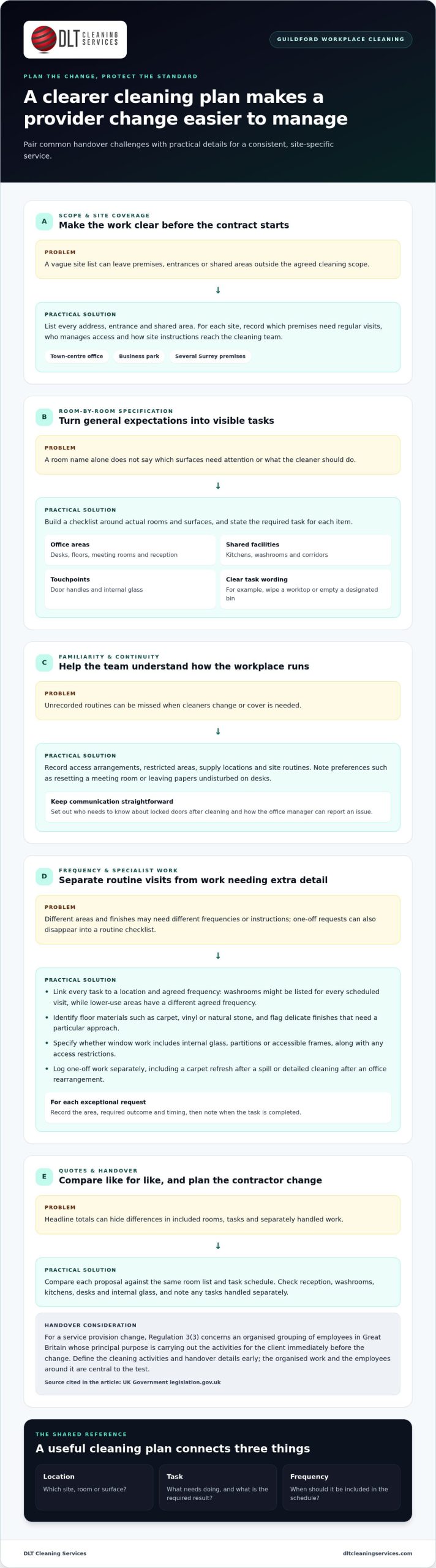
Guildford businesses may operate from a town-centre office, a business park or several premises across Surrey. List every address, entrance and shared area covered so the cleaning schedule reflects how staff and visitors use each location.
For a contract covering sites in Guildford and nearby areas, set out the boundaries clearly. Record which premises need regular visits, who manages access and how site-specific instructions will reach the cleaning team.
Office and commercial premises cleaning
Offices and other commercial premises have different cleaning priorities. An office specification might cover desks, meeting rooms, kitchens, washrooms and reception areas. A shared commercial building may also need its entrances and common corridors cleaned.
Walk through each site and note practical examples, such as a frequently used kitchen or a reception floor that collects dirt. Specific details make the cleaning scope easier to define and review.
Tailored contracts and cleaning schedules
A tailored contract should link each task to a location and frequency. For example, list washrooms for every scheduled visit, then give lower-use areas a different agreed frequency. State whether visits are weekly or follow another pattern suited to the premises.
Before switching office cleaning provider in Guildford, compare the existing task list with your current needs. Add new rooms, remove redundant tasks and record access arrangements, preferred cleaning times and how to report a missed task.
TUPE when changing contractors
For a service provision change, Regulation 3(3) requires an organised grouping of employees in Great Britain whose principal purpose is carrying out the activities for the client immediately before the change, according to UK Government, legislation.gov.uk. This is a key TUPE consideration when an office cleaning contract moves to a new contractor.
Set out the cleaning activities and handover details early. The defined work and the employees organised around it are central to applying the Regulation 3(3) test to a contractor change.
Dedicated cleaners and office-specific specifications
A consistent cleaning team can learn how each workplace is used, from a busy reception to a staff kitchen. Pair that familiarity with a clear specification to help prevent important tasks being overlooked during the change. The written plan should describe the required result, not just name each room.
Dedicated cleaners and site knowledge
When the same cleaners attend regularly, they can become familiar with access arrangements, room layouts and site routines. For example, they can distinguish a meeting room that needs resetting from a desk area where staff leave papers in place. Record these preferences so expectations remain clear if cover is needed.
Set out how cleaners enter the building, which areas have restricted access and where supplies are stored. Reception staff may need to know which doors are locked after cleaning, while the office manager needs a straightforward way to report an issue.
Site-specific specifications and checklists
Build the checklist around actual rooms and surfaces. For a Guildford office, it might list desks, floors, washbasins, kitchen worktops, door handles and internal glass. State the required task for each item, such as wiping a worktop or emptying a designated bin.
Walk through the premises with the specification in hand. Note exceptions, such as equipment that must not be moved or a meeting room used for confidential work. A room-by-room checklist gives cleaners and supervisors a shared reference and helps the office manager flag omissions.
Specialist floor and window cleaning
Floor and window care needs more detail than a general room list. Identify floor materials, such as carpet, vinyl or natural stone, and mark delicate finishes that need a particular approach. For windows, specify whether the work covers internal glass, partitions or accessible frames.
These details define the scope and expected finish. A glass partition beside a meeting room, for instance, may need attention because fingerprints are highly visible. Record any access restrictions and how completed work will be noted.
Specialist and one-off cleaning
Separate routine cleaning from one-off tasks in the specification. Examples include refreshing a carpet after a spill, detailed cleaning after an office rearrangement, or extra attention to a training room after a large session. Record the area, required outcome and timing so exceptional work does not disappear into the regular checklist.
Keep an updated log of requests and completed tasks. This helps distinguish a recurring requirement from a single event and supports a more accurate conversation about the cleaning plan. For a clearer view of the scope, review office cleaning services alongside your site checklist.
Quality control and transparent pricing
Compare the written scope, service checks and contract terms before weighing the cost. A clear mobilisation plan also helps protect daily office operations during a provider change.
Comparing cleaning services and quotes
Compare each proposal against the same room list and task schedule. Check whether reception, washrooms, kitchens, desks and internal glass are included, and note any separately handled tasks. This makes differences between office cleaning services easier to identify than comparing headline totals alone.
Ask what quality control involves in practice. A useful plan names who supervises the work, how completed tasks are recorded and how issues are followed up. For example, a missed washroom clean should have a clear reporting route and an agreed response process.
The price depends on the case and is given after a quote request; the premises, cleaning frequency, task scope, access arrangements and any specialist work shape the cost. For businesses in Surrey, compare like-for-like specifications so the quote reflects the same work at each site.
There is no single UK notice period for every commercial cleaning contract. The written agreement sets the requirements, so review its termination clause, renewal dates and any steps required to end the service.
Reducing risks when switching providers
Common transition risks include missed visits, unclear responsibilities and disruption to staff access. Reduce them with a written mobilisation plan that names the start date, site contact, access arrangements, key instructions and first quality review.
Agree how the new team will learn the building before routine cleaning begins. Walk through each area, identify restricted rooms and explain how keys or alarm procedures are managed. For example, reception may need a specific instruction about setting the alarm after the final clean.
Mobilisation time depends on practical requirements, including site access, the agreed scope and preparation of staff instructions. Set a start date that allows these arrangements to be organised, then confirm who will handle questions during the first visits.
Keep operations running with a simple handover checklist. Record outstanding issues, supply locations, site-specific cleaning instructions and who is responsible for reporting problems. Schedule an early review against the specification, then use the findings to adjust tasks or clarify expectations.
During a provider change, employees also need clear information about site routines and whom to approach. Share relevant operational details with the incoming team and keep staff informed about changes to access or cleaning arrangements. This practical coordination helps limit confusion while the new contract settles into its routine.
Quality, environmental and health and safety accreditations
Accreditations can help structure a provider review, but a badge alone does not explain how cleaning will work at your premises. Compare each certificate’s scope with the contract, then consider how quality, environmental practices and health and safety procedures feature in the day-to-day service.
Cleaning certifications and accreditations
Start by listing the standards or schemes named in a cleaning company’s proposal. For each, record the certificate holder, covered activities, relevant locations and validity dates. This helps distinguish an organisation-wide credential from evidence that applies to the proposed work at your office.
Next, connect credentials to practical contract controls. For example, ask how supervisors record inspections, raise corrective actions and review recurring issues. A quality process is more useful when it links a finding, such as a missed washroom task, to a clear responsibility and documented follow-up.
ISO and SafeContractor accreditations
If a proposal refers to ISO certification or SafeContractor, note the exact claim and its stated scope. Review the certificate or scheme information for the named organisation, covered activities and current validity. Then compare those details with the cleaning work, sites and responsibilities in your draft contract.
Do not treat a logo as a substitute for operational detail. A tailored service specification should identify who conducts checks, how concerns are logged and how the service responds to a failed inspection. For instance, a deep clean may need its own task record rather than being treated as routine office cleaning.
Environmental and safety practices
Environmental commitments should translate into identifiable working practices. Look for details such as how products are selected, how packaging is managed and whether staff receive instructions for correct use. A proposal that describes these steps gives you more to assess than a broad environmental statement.
Review safety information against your premises. A floor-cleaning method, for example, should account for access routes and the risk of leaving a wet surface in a busy corridor. Record relevant site restrictions and responsibilities in the contract documents so cleaners and site contacts can follow the same instructions.
Use a simple comparison sheet before appointing a provider. Include the credential and its scope, relevant sites or activities, quality checks, environmental practices and safety arrangements. Note which details are documented, then identify any gaps that affect your specification. This keeps the decision focused on what the cleaning team will do, rather than accreditation names alone.
Insurance and health and safety procedures
To assess insurance, references and staff vetting, review the documents and processes together. Check that insurance details match the contracted work, speak with named references about comparable premises, and understand how staff identity and suitability are assessed.
Insurance documents should identify the insured business, policy period, cover type and relevant limits. Compare these details with the contract, especially if cleaners will handle keys, enter restricted rooms or work around valuable equipment. Note exclusions that could affect your Guildford premises instead of relying on a certificate headline alone.
References are most useful when they relate to a similar workplace. Ask about practical matters such as consistency, communication and how concerns were resolved. For example, a business with a reception, shared kitchen and meeting rooms can explain whether the cleaning schedule worked around staff use.
Staff vetting should be explained as a process, not a general assurance. Establish how the cleaning company verifies identity, records training and briefs staff on site-specific instructions. For a school or office with restricted areas, agree who can access those spaces and how access is managed.
A health and safety procedure should connect each cleaning task with conditions on site. A wet-floor process, for instance, should explain how cleaners mark the area and keep people away until it is safe to use. Ask how staff handle products, store equipment and report damage or hazards.
Different premises create different practical risks. A retail entrance may have steady footfall, while an industrial site may have restricted zones and equipment. Set out relevant hazards during a site walk-through, then record controls, access limits and reporting contacts in the contract documents.
Before the start date, use a short document review:
- Match the insurance certificate details to the contracting business and work scope.
- Record reference feedback relevant to your premises and cleaning schedule.
- Document staff access arrangements, induction instructions and site contacts.
- Agree how hazards, accidents, damage and missed safety steps are reported.
Keep these records with the cleaning specification so supervisors can use one consistent reference. If your Guildford workplace needs a clearly managed cleaning arrangement, explore office cleaning services as a practical next step.
DLT Cleaning Services: Office Cleaning
DLT Cleaning Services Ltd supports Guildford workplaces with Office Cleaning and Hygiene Services. If your current arrangement needs clearer oversight or a better fit for daily routines, its office cleaning service is a practical next step for discussing your premises and requirements.
Dedicated on-site supervision helps manage each contract and support health and safety compliance. Share your priorities, such as washroom hygiene, kitchen upkeep, reception presentation or agreed cleaning frequencies. These details help shape an arrangement around how your team uses its workplace.
When changing providers, bring your site specification and handover priorities into the conversation. This gives the discussion a clear focus, from routine tasks to hygiene needs, while keeping the standards you want to maintain in view. Contact DLT Cleaning Services Ltd to discuss office cleaning for your Guildford workplace.
Make your next cleaning arrangement work for your team
Changing a cleaning arrangement is an opportunity to make workplace care fit how your business operates now. As you consider switching office cleaning provider in Guildford, think beyond the handover: what would make the working relationship easier to manage and the service more responsive to your priorities?
Set out the outcomes that matter to your staff, from a consistently presentable reception to dependable hygiene in shared spaces. Use those priorities to start a practical conversation about your premises. DLT Cleaning Services provides Office Cleaning and Hygiene Services for businesses seeking a considered service relationship for their workplace.
A useful first step is to discuss the areas that need attention and the standards your team expects. This helps establish whether the service fits your needs and how to move towards a new arrangement with clarity.
Contact DLT Cleaning Services to discuss your workplace cleaning needs. A clear starting point can help you move forward with confidence.
Frequently Asked Questions
How do businesses switch office cleaning providers in Guildford?
Businesses can switch providers by aligning the new service start with the existing contract’s end date. First, review the current agreement and list the required tasks, access arrangements and site contacts. Then agree the new start date and handover responsibilities, including how staff will be informed about changes. For a Guildford workplace, a short briefing for reception and facilities staff can prevent confusion over keys, alarms and reporting routes.
What office cleaning companies serve Guildford and Surrey?
DLT Cleaning Services Ltd provides Office Cleaning and Hygiene Services in Guildford and across Surrey. Its work suits both small independent businesses and large national chains, so compare whether the proposed service matches your premises and contract needs. Consider whether your workplace needs routine office maintenance, hygiene support or both, and whether the arrangement fits how staff use the building.
How much does office cleaning cost in Guildford per hour or per square metre?
Office cleaning costs in Guildford depend on the premises and agreed service, not area alone. Factors include floor area, room layout, washroom numbers, cleaning frequency, task scope and access arrangements. Per-square-metre comparisons can miss differences such as a busy kitchen or several meeting rooms, so assess the quoted work alongside the measurement basis and schedule.
What should a Guildford office cleaning contract include?
A Guildford office cleaning contract should identify the premises, agreed tasks, cleaning schedule, start date, payment terms and points of contact. It should also explain how changes to the scope are handled, how concerns are raised and what notice applies to ending the agreement. If staff or access arrangements affect the work, record practical details such as key control and alarm instructions so responsibilities are clear from the outset.
How can a business ensure a smooth handover between cleaning providers?
Give the incoming team a practical handover pack with building access instructions, site contacts, restricted areas and the location of essential supplies. Add unresolved maintenance or cleaning issues so the new team can distinguish existing problems from new ones. A facilities manager can also brief reception and department leads on the changeover date and the right route for questions, helping staff know whom to approach during the first days.
How can a business assess cleaning quality and resolve problems with a new provider?
Assess the service using observable results in specific areas, such as clean washbasins, empty bins and tidy meeting rooms. Keep a dated record of any missed task, its location and when it was reported. Raise the concern through the agreed contact route, then record the action taken and whether the issue recurs. Reviewing patterns helps distinguish a one-off oversight from a specification or communication problem that needs attention.