A dependable cleaning arrangement depends not only on the task list, but on how standards are defined, delivered and checked. The questions to ask a commercial cleaning company should go beyond what gets cleaned. They should help you understand who oversees the work, how communication is handled and whether the service fits the way your workplace operates.
Before agreeing to a routine, clarify the details that can otherwise be left unstated. Without clear supervision, standards may vary, while hygiene and safety need to reflect how people use shared areas, washrooms and other parts of the workplace. A focused first conversation makes it easier to agree expectations from the outset.
This practical checklist covers questions about cleaning scope, supervision, communication, hygiene, safety and service fit, with guidance on what to listen for in the answers. At DLT Cleaning Services, dedicated on-site supervision supports office cleaning contracts. Hygiene services can also address connected needs such as bathroom deep cleans and janitorial product supply for businesses in Guildford.
Key Takeaways
- Start with how your workplace is used and which areas need attention, then distinguish regular office cleaning from occasional deep cleaning.
- Agree how cleaning standards will be communicated, who will oversee the work and how concerns can be raised.
- Discuss how workplace health and safety, washroom cleaning and hygiene supplies should fit your site’s needs.
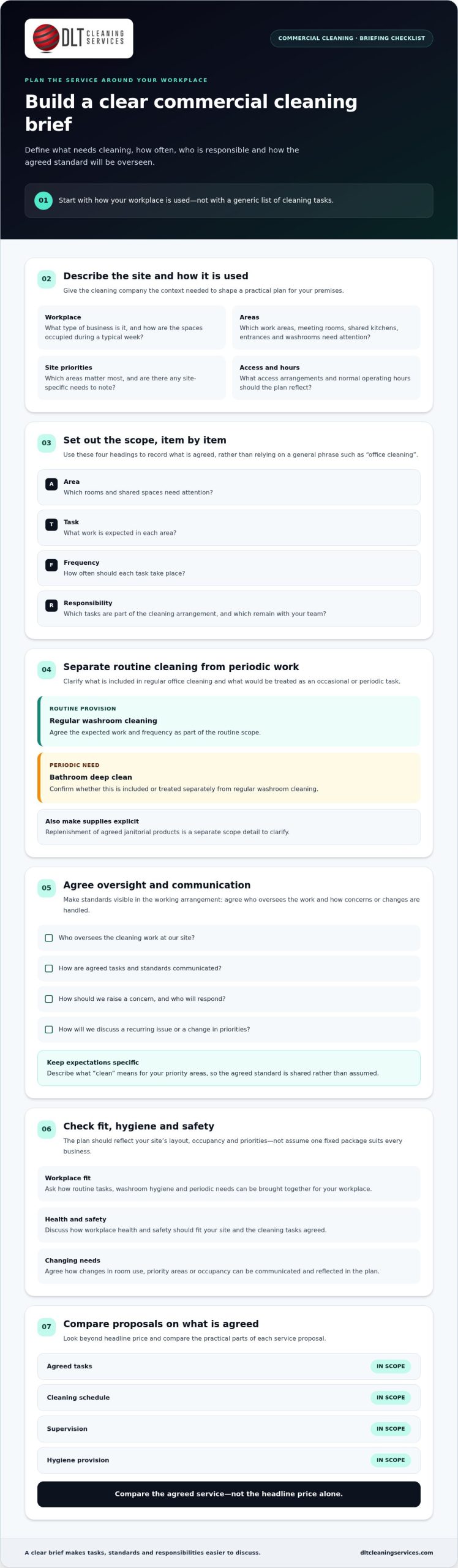
- Compare service proposals by their agreed tasks, schedule, supervision and hygiene provision, rather than headline price alone.
- Use these questions to ask a commercial cleaning company to shape a clear briefing. DLT Cleaning Services is a family-run business founded in 1999.
Questions to ask a commercial cleaning company about service scope
A useful cleaning brief starts with how your workplace is used, not with a standard list of tasks. Note the type of business, how spaces are occupied during a typical week and which areas need the most attention. The Commercial cleaning overview provides background on the wider field, but your discussion should focus on the day-to-day needs of your own site in Guildford.
What should a commercial cleaning brief include?
Describe the premises so the proposed scope reflects what happens there. List work areas, meeting rooms, shared kitchens, entrances and washrooms, and note any site-specific priorities. Explain occupancy patterns, access arrangements and normal operating hours. These details help shape a practical plan around the workplace rather than a generic task list.
Ask which tasks are included in routine office cleaning and which would be treated as periodic work. For example, regular washroom cleaning and replenishment of agreed janitorial products are different from a bathroom deep clean. Clarifying the distinction helps prevent assumptions about what the service includes.
- Area: Which rooms and shared spaces need attention?
- Task: What work is expected in each area?
- Frequency: How often should each task take place?
- Responsibility: Which tasks sit within the cleaning arrangement, and which remain with your team?
Use these headings to record the agreed scope instead of relying on a general description such as “office cleaning”. For example, specify which shared areas need regular attention, what washroom work is expected and who is responsible for any supplies. The resulting checklist gives everyone a clear reference for discussing the service.
How can a cleaning service fit a particular workplace?
A small independent office and a larger organisation may use their spaces differently. A useful scope reflects the site’s layout, occupancy and priorities rather than assuming one fixed package suits every business. Ask how routine tasks, washroom hygiene and periodic needs can be brought together in a plan that fits your workplace.
DLT Cleaning Services Ltd provides office cleaning with dedicated on-site supervision, alongside hygiene services that include bathroom deep cleans and janitorial product supply. These connected needs can be considered together when planning office maintenance in Guildford. For more detail on planning standards for local workplaces, read the complete office cleaning guide for Surrey managers.
Among the questions to ask a commercial cleaning company, ask how the agreed scope will reflect your site’s actual use. A clear brief establishes what routine cleaning covers, where periodic tasks fit and how responsibilities are understood from the outset.
Questions to ask about cleaning standards, supervision and accountability
A task list is useful only if everyone understands the agreed standard and who is responsible for maintaining it. Ask how expectations are shared with the people overseeing the work, who your day-to-day contact is and how to raise a concern if something has been missed. These questions turn general promises of quality into a practical working arrangement.
How is cleaning quality overseen?
Ask who oversees delivery at your workplace and how they help keep agreed tasks on track. DLT Cleaning Services Ltd includes dedicated on-site supervision for cleaning contracts, providing a clear point of oversight within the arrangement. Be specific about priority areas too: describe what “clean” means for spaces that matter most, so expectations are shared rather than assumed.
On-site supervision helps keep agreed cleaning standards visible, understood and consistent in daily delivery.
Useful questions include:
- Who oversees the cleaning work at our site?
- How are agreed tasks and standards communicated?
- How should we raise a concern, and who will respond?
- How will we discuss a recurring issue or a change in priorities?
These prompts focus on accountability without assuming every company uses the same inspection schedule or reporting system. Agreeing how concerns will be raised and followed up gives the working relationship a straightforward basis for communication.
How are communication and service changes handled?
Explain how your workplace shares day-to-day requirements. Consider who should communicate a change in room use, a new priority area or a shift in occupancy. Ask how updates to the agreed plan can be discussed and reflected in the cleaning arrangement. A tailored approach lets office maintenance respond to the workplace’s changing needs.
The guide to tailored office cleaning services explores how a bespoke approach can support workplace hygiene. For UK-specific health and safety guidance relevant to cleaning work, the Health and Safety Executive (HSE) provides information for employers and businesses.
Include communication when needs change among the questions to ask a commercial cleaning company, not only how the initial plan is set. To see how DLT Cleaning Services Ltd approaches office cleaning, visit DLT Cleaning Services Ltd.
Questions to ask about commercial cleaning health, safety and hygiene
Health, safety and hygiene needs vary with the site, the work taking place and the tasks agreed. A useful discussion makes those factors clear instead of relying on broad assurances. Ask how cleaning methods and products are considered for your workplace, how relevant safety information is communicated, and what arrangements apply to washrooms and shared areas.
What safety information belongs in the conversation?
Raise site-specific considerations such as busy walkways, shared kitchens, access restrictions and areas that need particular care. Ask how the cleaning plan accounts for these conditions and how staff are made aware of the agreed tasks. In the UK, the Health and Safety Executive (HSE) provides guidance on COSHH, the Control of Substances Hazardous to Health Regulations, which concerns risks from hazardous substances. Discuss how relevant product information and safe handling are addressed for the work involved.
Useful questions include:
- How are cleaning methods chosen for the areas and tasks at our site?
- How is relevant safety information about cleaning products communicated?
- Are there workplace access or use considerations that should shape the plan?
- How should we raise a safety concern or report a change in site conditions?
Routine office cleaning covers agreed day-to-day tasks. Suspected mould, asbestos or biological contamination may require specialist assessment and remediation rather than ordinary cleaning. For broader industry context, ISSA, the worldwide cleaning industry association, provides information about the professional cleaning sector.
How should workplace hygiene needs be described?
Explain how washrooms and shared spaces are used, including whether employees, visitors or both rely on them. Note the facilities that need regular attention and whether you want to discuss periodic work separately. Describe the practical need, such as washroom cleaning or keeping agreed janitorial supplies available, rather than assuming a standard arrangement will suit every site.
DLT Cleaning Services Ltd’s hygiene services include bathroom deep cleans and janitorial product supply, which can be considered alongside office cleaning as part of workplace maintenance. The manager’s guide to health and safety compliant cleaning offers further guidance for planning workplace standards.
The questions to ask a commercial cleaning company should help you explain the risks, routines and hygiene priorities specific to your premises. Clear information gives the cleaning plan a sound basis without assuming every office has the same requirements.
Questions to ask about cleaning schedules, contract fit and service costs
A proposal is easier to assess when it reflects how your workplace runs, rather than presenting a price without context. Before comparing costs, describe your operating patterns and the service times that would work for your business. Ask how the proposed schedule relates to the agreed tasks, site use and cleaning priorities, and how supervision and hygiene provision fit into the arrangement.
Which schedule and contract questions help clarify fit?
Consider when different areas are occupied and whether some spaces have busier periods than others. Then ask how the cleaning schedule can accommodate those patterns and the priorities in your brief. The right frequency should follow the site’s use and agreed tasks, not an arbitrary routine. DLT tailors office cleaning to the business and its premises, helping align the proposed arrangement with the workplace.
Useful questions include:
- How does the suggested schedule reflect our normal operating patterns?
- Which agreed tasks will take place at each visit?
- How does supervision fit into the proposed arrangement?
- How are washroom hygiene and janitorial supplies addressed?
Keep the discussion centred on what your organisation needs and how those needs translate into a workable service. This gives you a clearer basis for comparing proposals without assessing cost in isolation.
How can a business compare proposals fairly?
Put the main details side by side. A simple comparison table can show whether proposals cover the same requirements, or whether a lower headline price reflects a different scope or schedule.
- Scope: Which agreed areas and tasks are covered?
- Frequency and schedule: How often will cleaning take place, and when?
- Supervision: How is oversight included in the arrangement?
- Hygiene provision: How are washroom needs and janitorial supplies handled?
- Responsibilities: What is expected from your workplace as well as the cleaning service?
A useful comparison makes inclusions and responsibilities easy to understand. If details are unclear, record them for discussion so you’re comparing like with like. The questions to ask a commercial cleaning company should help you understand what each proposal delivers, not just what it costs.
For office cleaning shaped around your premises and priorities, discuss your office cleaning requirements with DLT.
Questions to ask a commercial cleaning company before taking the next step
Before moving from research to a service discussion, bring the key points together in a short briefing. A clear picture of your site and priorities keeps the conversation practical and helps prevent important details from being lost among broader questions.
What information should a business prepare for a first discussion?
Note the type of workplace, the areas that need cleaning and how the premises are used. Include your main priorities, preferred service times, current washroom and hygiene needs, and any operational constraints that could affect the arrangement. You don’t need every detail settled in advance, but a concise outline gives the discussion a useful starting point.
- Site: Where is the workplace, and how is it used?
- Scope: Which work areas, shared spaces and washrooms need attention?
- Schedule: What service times and frequency would suit your operating patterns?
- Supervision: What kind of oversight would help maintain agreed tasks?
- Hygiene: What washroom cleaning or janitorial product needs should be considered?
Use this as a briefing, not a pre-set package. The right questions to ask a commercial cleaning company are those that help define the scope around your premises, rather than assuming every office needs the same arrangement. Explain which requirements are essential and where the plan may need to reflect the way your team works.
How does DLT approach commercial office cleaning?
DLT Cleaning Services is a family-run company founded in 1999, providing office cleaning and hygiene services for businesses in Guildford and across Surrey, Hampshire and Berkshire. Dedicated on-site supervision forms part of its office cleaning contracts. Hygiene services include bathroom deep cleans and janitorial product supply, so these workplace needs can be considered alongside office maintenance.
In your first discussion, share the priorities that matter most, whether that’s the areas to be maintained, how the workplace operates or the hygiene needs of its washrooms. A focused conversation helps shape an arrangement around the business and its premises, with the expected scope and service requirements clearly in view.
Ready to discuss a tailored office cleaning arrangement? Talk to DLT about your office cleaning requirements.
Start your cleaning discussion with confidence
The right questions to ask a commercial cleaning company help turn workplace needs into a clear service brief. Set out the areas and tasks required, agree how supervision and communication will work, and discuss hygiene and safety needs alongside a schedule that suits how your site is used. Compare proposals by their scope, frequency, oversight and hygiene provision, not headline price alone.
DLT Cleaning Services is a family-run independent cleaning company founded in 1999. Its office cleaning contracts include dedicated on-site supervision, and its office cleaning and hygiene services support businesses in Guildford and across Surrey, Hampshire and Berkshire. A clear discussion can help shape an arrangement around your premises and priorities.
Take the next step with a practical outline of your requirements. Discuss your office cleaning requirements with DLT and move towards a service arrangement that fits your workplace.
Frequently Asked Questions
What questions should I ask a commercial cleaning company?
Ask what routine cleaning covers, how often tasks will be completed, who oversees the work and how concerns are handled. Include questions about washroom hygiene, supplies, safety considerations and how the schedule can suit your workplace’s operating patterns. The questions to ask a commercial cleaning company should help you define the service clearly rather than rely on broad promises. Share your site’s priorities so the discussion can focus on practical requirements.
How do I compare commercial cleaning companies fairly?
Compare proposals against the same requirements, not just their headline prices. Check whether each one includes the areas and tasks you need, the proposed schedule, supervision arrangements and any hygiene provision. Make responsibilities clear too, including what your workplace must provide or manage. A simple table can reveal differences in scope and help you assess which arrangement best fits your premises and priorities in Guildford.
What should an office cleaning specification include?
An office cleaning specification should describe the premises, areas to be cleaned, required tasks and their frequency. Include shared spaces and washrooms, any site-specific priorities, access arrangements and normal operating patterns. Separate regular cleaning from periodic requirements, such as a bathroom deep clean, so the scope is easy to understand. Record who is responsible for each task, including any hygiene supplies, to reduce misunderstandings once the arrangement begins.
Why is on-site supervision important in commercial cleaning?
On-site supervision gives a cleaning contract dedicated oversight and helps keep agreed tasks and expectations clear. It also gives the arrangement a defined point of responsibility for day-to-day delivery. Ask who oversees the work and how your team can raise a concern or discuss a change in priorities. DLT Cleaning Services includes dedicated on-site supervision in its office cleaning contracts, supporting a clear, accountable approach for workplaces in Guildford and across its service area.
What health and safety questions should I include?
Ask how the cleaning plan takes account of your site, agreed tasks, access arrangements and any relevant product information. Explain workplace conditions that could affect cleaning, such as busy walkways or shared kitchens, and ask how safety concerns can be communicated. In the UK, HSE guidance on COSHH covers risks from hazardous substances. Discuss how relevant information and safe handling are addressed for the cleaning work planned at your premises.
How much does commercial office cleaning cost?
Commercial office cleaning costs depend on the requirements of the workplace, so a useful proposal needs to reflect the premises and agreed service. Discuss the areas and tasks required, cleaning frequency, schedule, supervision and any hygiene provision, then compare proposals on that basis. DLT Cleaning Services tailors office cleaning to the business and its premises. A clear scope makes it easier to understand what an arrangement covers without relying on a headline figure alone.
Can a commercial cleaning service include hygiene supplies?
Yes, hygiene services can include janitorial product supply as well as washroom-related cleaning, depending on the workplace’s needs. Describe how washrooms and shared areas are used, who relies on them and which supplies your team needs to plan for. DLT Cleaning Services provides hygiene services that include bathroom deep cleans and janitorial product supply. These can be considered alongside office cleaning for businesses in Guildford, Surrey, Hampshire and Berkshire.