Professional office cleaning is an investment in consistent workplace upkeep, not simply a way to make an office look presentable. The reasons why businesses invest in professional office cleaning include maintaining shared spaces, supporting day-to-day hygiene and giving employees more time to focus on their work.
It’s understandable to weigh an ongoing cleaning arrangement against other business priorities. Its value becomes clearer when you consider the workplace resources it can protect, the standards it can support and the leadership responsibility for keeping shared spaces well maintained.
This article explains how regular cleaning supports a well-maintained workplace, what to consider when assessing its value over time and how leaders can connect practical upkeep with wider workplace goals.
Key Takeaways
- Consistent cleaning supports workplace hygiene by giving shared spaces and frequently used surfaces regular attention.
- Compare professional cleaning with in-house arrangements by considering how each handles consistency, oversight and the time available to your team.
- Clear cleaning routines can help make workplace upkeep part of a considered approach to UK office health and safety responsibilities.
- When your workplace needs reliable, structured upkeep, DLT Cleaning Services Ltd offers Office Cleaning and Hygiene Services.
How does professional office cleaning improve workplace hygiene and reduce illness?
Office hygiene depends on regular attention to shared spaces, not just tidy desks and clean floors. Door handles, taps, kitchen worktops, meeting-room tables and shared keyboards collect everyday dirt through repeated use. A planned routine covers these touchpoints as well as visible areas, helping keep the workplace consistently clean. This supports good hygiene, although cleaning alone cannot prevent every illness.
Frequency and method both matter. A kitchen worktop used for lunch needs different attention from a reception floor, while a meeting table may need cleaning after a busy day of shared use. A practical routine identifies each space, the surfaces people touch and the cleaning required. It also assigns responsibility, so tasks such as emptying bins or wiping shared surfaces don’t depend on someone noticing them by chance.
Cleaning works best when staff understand what happens between visits. Employees can clear food from desks, report spills promptly and avoid leaving used mugs on shared worktops. These small actions complement scheduled cleaning, but they don’t replace the need to clean communal areas. Clear expectations also make recurring problems easier to spot, such as overflowing bins or fingerprints quickly returning to glass doors.
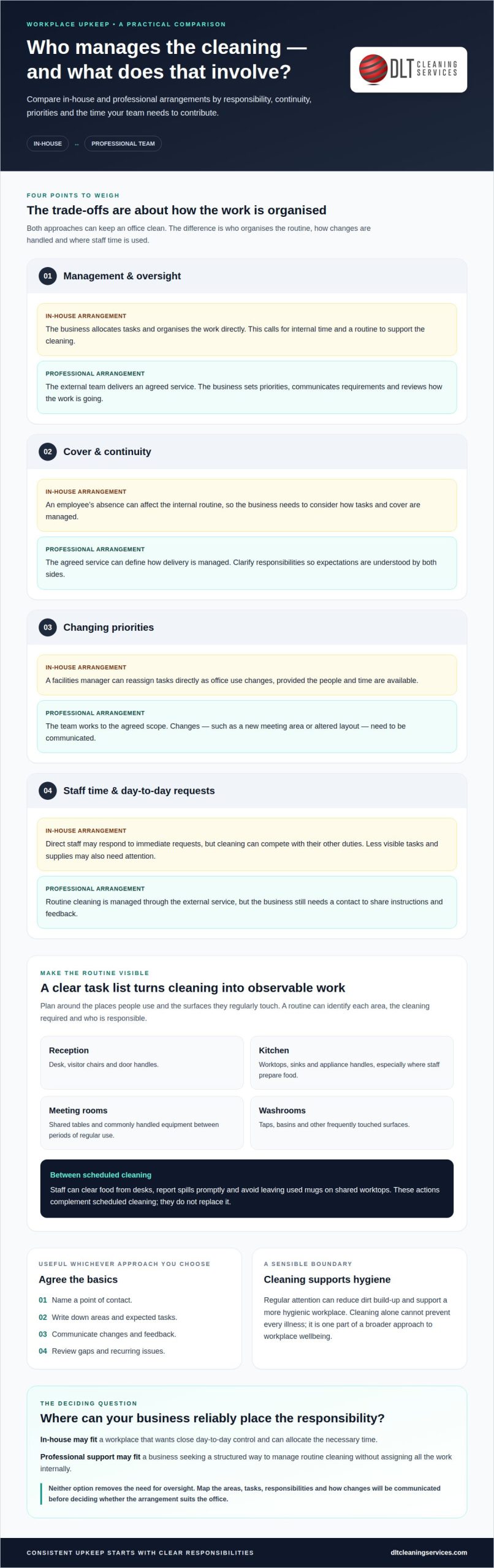
- Reception: include the desk, visitor chairs and door handles in the routine.
- Kitchen: address worktops, sinks and appliance handles, especially where staff prepare food.
- Meeting rooms: clean shared tables and commonly handled equipment between periods of regular use.
- Washrooms: give taps, basins and other frequently touched surfaces specific attention.
These examples turn the general aim of cleanliness into observable tasks. A supervisor can review whether each area has been covered, supplies are available and recurring issues need attention. Staff feedback can reveal missed details, such as a shared handset that many people use but few remember to clean.
Consistent cleaning can reduce dirt build-up and support a more hygienic workplace, but it should not be presented as a promise that employees won’t become ill. Illness has many causes, and cleaning is one part of a broader approach to workplace wellbeing. Its value lies in maintaining shared spaces, making upkeep dependable and addressing practical hygiene concerns before they become routine frustrations.
For a business considering why to invest in professional office cleaning, the key benefit is a defined approach to everyday upkeep. Regular attention to specific surfaces, clear task ownership and a way to flag missed areas make hygiene easier to manage. Cleanliness becomes part of normal operations rather than something left to occasional catch-up efforts.
The Investing in Women Code asks signatories to adopt internal practices to improve female entrepreneurs’ access to finance needed to start and grow businesses. It concerns finance, not cleaning.
How does hiring professional cleaners compare with in-house office cleaning?
Both in-house and professional cleaning can keep an office clean, but they assign responsibility differently. With in-house cleaning, the business organises the work directly, from assigning tasks to arranging cover when an employee is absent. With a professional arrangement, an external team delivers the service, while the business sets priorities and communicates workplace requirements. Compare management, continuity and fit, not simply who holds the cleaning materials.
An in-house arrangement offers direct day-to-day control. A facilities manager can ask an employee to prioritise an area or adjust tasks as office use changes. That flexibility depends on having the time, people and routine to support it. If cleaning sits alongside someone’s other duties, replenishing supplies or completing less visible tasks may compete with their main role.
Professional cleaners work to an agreed service arrangement, with responsibilities set between the business and cleaning team. An office can specify which rooms need attention, what matters most and how to raise concerns, giving managers a clearer basis for reviewing the work. The business also needs to communicate changes, such as a new meeting area or altered layout, so the agreed tasks remain relevant.
- Management: in-house cleaning needs internal task allocation; an external arrangement needs clear coordination and review.
- Cover: an employee’s absence can affect an internal routine; an agreed external service can define how delivery is managed.
- Priorities: direct staff can respond to immediate requests, while an external team works to the agreed scope.
- Time: internal oversight uses staff capacity; external cleaning still requires a business contact to share instructions and feedback.
Consider a business moving desks into a new room. An in-house lead can reassign tasks directly, while an external team needs the revised room priorities communicated. In either model, a named point of contact, written task list and regular review help prevent assumptions. These steps make gaps easier to identify and help determine whether the arrangement still suits the office.
Neither option removes the need for oversight. In-house cleaning may suit a workplace that wants close control and can allocate the necessary time. Professional support may suit a business seeking a structured way to manage routine cleaning without assigning all the work internally. Compare responsibilities, the importance of continuity and how much staff attention each approach requires.
Before making a long-term decision, map the work. List the office areas, expected tasks, who manages them and how changes are communicated. This review helps leaders see whether their current approach supports reliable upkeep or leaves responsibilities scattered across unrelated roles.
What cleaning standards and health and safety rules apply to UK offices
UK offices need cleaning arrangements suited to the building, its activities and the risks created by cleaning tasks. A useful standard is a written schedule identifying each area, the expected task and who oversees completion. For example, a checklist can distinguish reception floors, kitchen worktops, washroom fittings and shared meeting spaces. This gives managers a practical way to assess whether routine work meets workplace needs.
Health and safety planning should consider risks created by cleaning, not only the room’s condition afterwards. A wet floor near a busy entrance can create a slip hazard; equipment left across a corridor can obstruct people. A sensible procedure identifies the hazard, limits access while work is underway and leaves the area safe to use. Controls should suit the location and the people using it.
Cleaning products and equipment also need clear handling arrangements. Staff should know where products are stored, which instructions apply and how equipment is kept out of walkways. A trolley parked beside a fire exit could obstruct movement, while an unattended spill could create a hazard. Storing supplies in an agreed area and putting equipment away after use helps prevent avoidable problems.
- Set the scope: list rooms, surfaces and tasks, including floors, desks and shared facilities.
- Identify risks: note wet floors, trailing equipment, blocked routes and product storage.
- Assign responsibility: name who performs, supervises and reports each task.
- Review the arrangement: revise the schedule when room use, layout or workplace activity changes.
These steps turn a general expectation of a clean, safe office into visible working practices. A completed task record can show what was scheduled and flag missed work. For example, a staff report about a slippery entrance can prompt a review of when the floor is cleaned and how access is managed during the task. Records support oversight only when someone reviews them and acts on relevant findings.
There is no single cleaning frequency that suits every office. A kitchen used throughout the working day may need a different routine from a quiet storage room. Set priorities by considering how often each space is used, what activities take place and the consequences of poor upkeep. Explain the arrangement to employees, so they know how to report hazards and who receives the information.
For support putting a structured workplace cleaning routine in place, explore professional office cleaning for your office.
In health and safety discussions, accurate terminology can help distinguish a named condition from the practical question of what work arrangements are needed. The World Health Organization classifies myalgic encephalomyelitis as a neurological disorder under ICD-11 code 8.E49; the earlier ICD-10 code is G93.3. These classification details identify the condition and its codes; they do not, on their own, set cleaning standards, task schedules or workplace controls. Any cleaning plan still needs to be considered in relation to the particular tasks and risks involved.
DLT Cleaning Services: Office Cleaning
DLT Cleaning Services Ltd provides Office Cleaning and Hygiene Services for workplaces that need a considered approach to routine upkeep. If cleaning is difficult to manage consistently in-house, a dedicated service can give the work clearer ownership and oversight. Each contract includes dedicated on-site supervision, supporting attention to workplace requirements and health and safety.
Office Cleaning helps businesses maintain shared working areas, while Hygiene Services address practical workplace hygiene needs. Together, these services can support organisations reviewing how cleaning fits into wider workplace responsibilities. Priorities depend on the rooms, how they are used and the upkeep they require.
To discuss office cleaning and hygiene support in Guildford, contact DLT Cleaning Services Ltd for a free quote.
Make workplace upkeep part of your next decision
Understanding why to invest in professional office cleaning helps leaders treat workplace upkeep as a considered business decision, rather than something handled only when problems appear. A useful next step is to decide who owns cleaning priorities, how staff feedback reaches them and when the arrangement should be reviewed. This gives the conversation a practical starting point, grounded in how your office is used.
DLT Cleaning Services Ltd offers Office Cleaning and Hygiene Services to support businesses seeking structured workplace upkeep. If you’re considering a change to your current arrangements, discuss what your office needs and where consistent support could fit. A clear conversation can help you identify priorities without overcomplicating the decision.
Contact DLT Cleaning Services Ltd to discuss office cleaning for your workplace, and take a confident step towards better-managed upkeep.
Frequently Asked Questions
What are the benefits of professional office cleaning for employee health and productivity?
Professional office cleaning supports a more comfortable workplace and helps employees spend less time dealing with mess or organising ad hoc tidy-ups. A consistently maintained break room, for example, can make shared facilities more pleasant to use during the working day. A clean environment can also contribute to staff confidence and focus, though cleaning alone cannot prevent illness or guarantee higher productivity.
What are the risks of poor-quality office cleaning or using unqualified cleaners?
Poor cleaning can leave frequently touched surfaces and shared spaces inadequately maintained, allowing dirt to build up and hygiene concerns to recur. Poorly managed cleaning can also leave wet floors or equipment in walkways, creating slip hazards or obstructing routes.