A clean office shouldn’t depend on who happens to be on shift. Four signs you need a new office cleaning company are a service that misses your workplace’s needs, dust that keeps returning, inconsistent results and employees spending time cleaning instead of doing their usual work. If these problems persist, it may be time to review whether your current arrangement is working.
It’s reasonable to expect cleaning to be dependable and suited to the way your office is used. A single missed task doesn’t necessarily mean the whole service is failing; recurring issues and a lack of improvement are more telling. This article explains how to spot those patterns, what they may mean for your workplace and when a change could make sense. Mismatched tasks, lingering dust, uneven standards and staff taking on cleaning duties can all suggest that the service no longer fits.
Key Takeaways
- Look for a gap between the cleaning provided and the areas your workplace actually needs covered.
- Notice whether dust and dirt keep returning, particularly in shared spaces and on frequently used surfaces.
- Consistent results depend on clear instructions, suitable training and a reliable process when cleaners change.
- Recurring complaints or staff taking on cleaning tasks are reasons to review whether the current arrangement is working.
2. Dust, contaminants and equipment maintenance
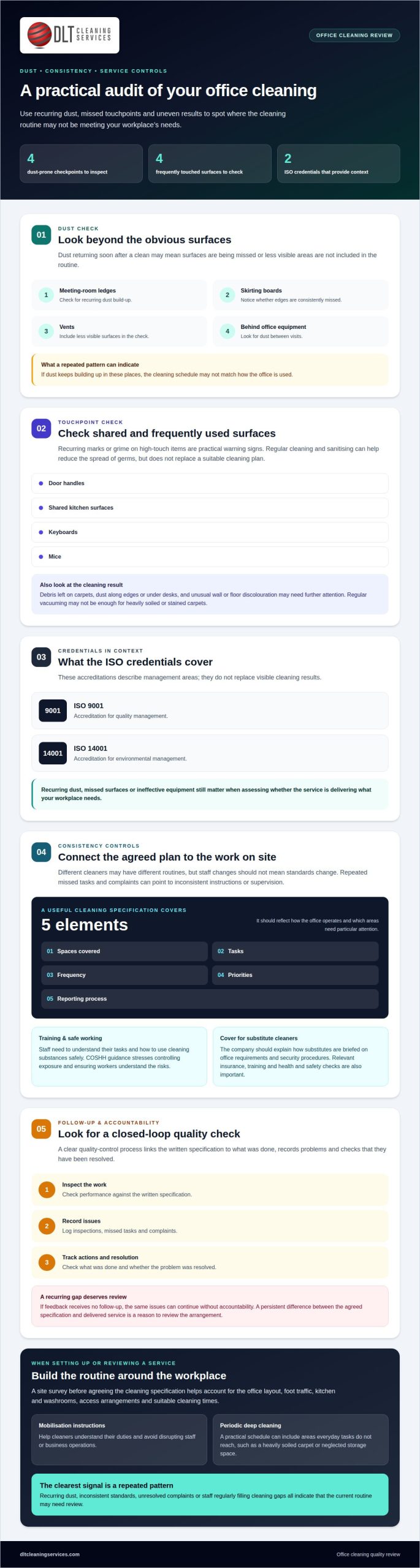
Dust returning soon after a clean can mean surfaces are being missed or tasks aren’t reaching less visible areas. Check meeting-room ledges, skirting boards, vents and spaces behind office equipment. If dust repeatedly builds up in these places between visits, the cleaning schedule may not match how your office is used.
Dust can affect more than appearance. In an office, it can cause health issues, particularly for the respiratory system, while mould can also build up in buildings. Poor cleaning can therefore affect workplace hygiene and staff wellbeing; it can also put compliance at risk. UK legislation requires workplaces, furniture, furnishings and fittings to be kept sufficiently clean.
High-touch surfaces need attention alongside visible floors and desks. Door handles, shared kitchen surfaces, keyboards and mice can collect contaminants, so recurring marks or grime on these items are a practical warning. Regular cleaning and sanitising of frequently touched surfaces can help reduce the spread of germs, but it doesn’t replace a suitable cleaning plan.
The cleaning process should be effective for the surfaces and areas being treated. If vacuuming leaves debris on carpets, or dust remains along edges and under desks, those areas may need more attention. Regular vacuuming may not be enough for heavily soiled or stained carpets. Unusual discolouration on a wall or floor can also signal stains, burns or mould, or other damage such as a problem with a water-supply pipe.
Quality and environmental management credentials can provide useful context when reviewing a provider’s approach. The International Organization for Standardization identifies ISO 9001 as an accreditation for quality management and ISO 14001 as an accreditation for environmental management. These credentials don’t replace visible results: recurring dust, missed surfaces or ineffective equipment are still reasons to review whether the cleaning service is delivering what your workplace needs.
3. Cleaner turnover, training and service consistency
Different cleaners may have different routines, but changes in staff shouldn’t mean standards change. If the kitchen is cleaned thoroughly one visit and overlooked the next, instructions or supervision may be inconsistent. Repeated complaints and missed tasks are signs you need a new office cleaning company, particularly when staff changes repeatedly affect the results.
A suitable cleaning specification sets out the spaces covered, tasks, frequency, priorities and reporting process. It should reflect how the office operates, including busy shared areas and rooms that need particular attention. A persistent gap between the agreed specification and the service delivered is one of the signs you need a new office cleaning company.
Training matters too. Cleaning staff need to understand their tasks and how to use cleaning substances safely. The Health and Safety Executive’s COSHH guidance stresses controlling exposure to cleaning substances and ensuring workers understand the risks. A company should explain how it briefs substitute cleaners on office requirements and security procedures. Relevant insurance, staff training and health and safety checks are also important parts of a professional service.
Quality checks should link the written specification to the work carried out on site. A clear process records inspections, missed tasks, complaints, actions taken and whether problems have been resolved. If feedback receives no follow-up, the same issues can continue without accountability.
A new service should begin with a site survey before the cleaning specification is agreed. This helps account for the office layout, foot traffic, kitchen and washrooms, access arrangements and suitable cleaning times. Clear mobilisation instructions then help cleaners understand their duties and avoid disrupting staff or business operations. A practical schedule can also include periodic deep cleaning for areas everyday tasks don’t reach, such as a heavily soiled carpet or neglected storage space.
A professional office cleaning company can provide trained cleaners and equipment for the cleaning work. Cleaning staff should be adequately trained to complete their tasks. BICSc-accredited training is the industry benchmark for cleaning staff.
A cleaning company should use quality-control checks to support reliability and accountability, helping managers assess performance and address shortfalls.
4. Employees cleaning instead of doing their jobs
An occasional tidy-up doesn’t necessarily mean your cleaning arrangement has failed. But if employees regularly empty bins, wipe kitchen surfaces or clean washrooms because those tasks are missed, the routine may not be working. Employees hired for other responsibilities are spending work time cleaning instead, taking attention away from their usual duties. Repeatedly relying on staff to fill service gaps is a strong reason to review the arrangement.
Pay attention to complaints and what they describe. Several employees reporting dirty floors, unpleasant odours, untidy communal spaces or dusty workstations may point to a recurring problem rather than individual preferences. Note whether the same areas keep coming up, such as the kitchen after busy lunches or a washroom used throughout the day. If concerns persist after being reported, the schedule or follow-up process may not be addressing the cause.
Cleanliness also shapes the experience of people using the workplace. Employees may feel less comfortable in shared spaces that are regularly left untidy. Visitors entering a dirty reception area or meeting room may see an unprofessional environment. These examples show why cleaning standards matter beyond appearance: an office’s condition affects the working day and the impression made on visitors.
Review your commercial cleaning arrangements if staff have taken on regular cleaning duties or complaints keep returning. Check whether the routine covers the areas employees use most, including shared kitchens, washrooms and meeting spaces. A professional service can take recurring cleaning tasks off employees’ plates, allowing them to focus on their usual responsibilities. The clearest sign of a mismatch is a continuing gap between the cleaning expected and what staff experience at work.
Repeated complaints about dusty workstations, dirty floors, untidy communal areas, unpleasant odours or poorly maintained washrooms can indicate that cleaning arrangements need reviewing. Consider professional cleaning when employees who weren’t hired for cleaning are doing that work. Taken together, these signs give you a practical basis for checking whether the current arrangement is working, rather than leaving staff to absorb cleaning tasks alongside their usual responsibilities.
4. What are the signs an office cleaning company is doing a poor job?
A single missed task can happen, but repeated problems suggest standards may be slipping. Notice whether cleaning happens only after somebody reports an issue, rather than following a consistent schedule. If the meeting room is tidied only before visitors arrive, for example, everyday cleaning may not be keeping the space presentable.
Recurring complaints are another signal. Staff may keep reporting overflowing bins, dirty upholstery, unpleasant odours or poorly maintained washrooms. Overfilled bins and mould in humid areas can contribute to office smells. If complaints increase or the same concerns remain unresolved, the reporting process may be weak, attention insufficient or the cleaning plan unsuited to the workplace.
Missed work is especially noticeable in shared facilities. Visitors may quickly notice whether an office washroom is clean, stocked and cared for. A lingering smell, empty dispensers or visibly dirty fittings can affect their impression of the workplace. In kitchens, neglected surfaces or overflowing waste can make the space uncomfortable to use. These examples help distinguish an isolated oversight from a pattern across the office.
Pay attention to what happens after you raise an issue. A reliable process should record the concern, identify the cleaning task involved, address it and follow up to establish whether it has been resolved to your satisfaction. If you have to report the same missed task repeatedly, or receive no clear update, accountability may be lacking.
Keep a simple record of recurring issues, noting the area, task and whether the problem returns after cleaning. This makes patterns easier to discuss and helps clarify whether the specification is being followed. Before changing arrangements, review your current contract, as termination options depend on its terms. A clear record supports a practical conversation about standards, reporting and whether the service still meets your needs.
DLT Cleaning Services: Office Cleaning
DLT Cleaning Services Ltd provides office cleaning and hygiene services for workplaces that need consistent standards or better task coverage. If recurring issues show that your current arrangement no longer fits, DLT can help maintain your workplace and allow staff to focus on their usual responsibilities.
Every DLT contract has dedicated on-site supervision, providing oversight of the cleaning work and attention to workplace requirements. This can suit businesses looking for a more considered, consistent approach to office cleaning.
For office cleaning support, contact DLT Cleaning Services Ltd.
Set a better standard for your workplace
Choosing what happens next starts with deciding what a dependable cleaning arrangement should make easier for your team. The signs you need a new office cleaning company matter most when they reveal a recurring gap between what your workplace needs and what gets done. Use that insight to set clear priorities for the spaces, routine and hygiene support your business relies on, rather than carrying the same frustrations into a new arrangement.
Before making a change, identify which outcomes matter most, such as more reliable standards, better hygiene in shared areas or less reliance on employees to fill service gaps. That gives a conversation about your workplace needs a practical starting point.
DLT Cleaning Services Ltd provides Office Cleaning and Hygiene Services. If you’re ready to discuss a service that suits your office, contact DLT Cleaning Services Ltd today. A considered next step can help you move towards a workplace where your team can focus on its work.