A cleaning budget is easier to justify when it’s tied to clear workplace needs rather than presented as a routine overhead. Presenting a business case for office cleaning services means showing what the service covers, how experienced and trained staff deliver it, and which relevant health and safety checks support the work. Set out these points plainly so senior management can see what the budget is intended to achieve.
A useful proposal explains more than the cleaning tasks. Decision-makers also need to understand how service standards will be maintained and how the arrangements suit the workplace.
This guide shows you how to build that case, from defining the scope and assessing provider experience to considering staff training, contract details and compliance checks. You’ll have a practical structure for explaining the need, the value and the safeguards behind the proposed budget.
Key Takeaways
- Connect the budget to a clear cleaning scope, including the areas and tasks that need consistent attention.
- Show how provider experience, staff training and supervision can support dependable service standards.
- Include contract details, insurance and relevant health and safety checks to give decision-makers a practical basis for review.
- Use a defined service plan to explain how office cleaning and hygiene needs will be addressed and monitored.
Cleaning company experience and staff training
In-house cleaning gives a business direct responsibility for recruitment, training and supervision. Outsourcing places those staffing arrangements with a cleaning company, while the business defines its workplace requirements and monitors the agreed service.
- Describe the experience the work requires and match it to the premises. Cleaning shared kitchens, washrooms and desk areas, for example, calls for clear methods to prevent the same cloth being used across different zones. Ask the cleaning company to explain how staff follow the agreed cleaning specification.
- Describe training in relation to the tasks involved. Staff handling cleaning chemicals need training in COSHH, while manual handling training is relevant to moving equipment or supplies. Include these areas alongside induction on site-specific procedures. This makes training a defined part of the service, rather than an assumption.
- Consider vetting in context. A DBS check is not a legal requirement for most cleaners in the UK, so do not present it as a universal compliance duty. Where access to sensitive areas makes vetting relevant, explain why and how it supports the workplace’s requirements. Keep the reasoning proportionate to the role.
- Explain how staff performance will be supported after induction. Repeatedly missed tasks may point to a need for additional training or closer supervision. For example, if dust keeps appearing on desk areas, record the issue, agree the expected standard and use follow-up supervision to assess whether the cleaning method has improved.
- Make recruitment and training arrangements visible in the proposal. State who manages recruitment, how new starters learn the site’s cleaning schedule and how changes are communicated. For an outsourced arrangement, include the provider’s approach to training and supervision; for in-house staffing, identify the responsible manager. These details help senior management assess accountability.
Contract, insurance and accreditation checks
Ask how the contract defines tasks, frequency, site access, supervision and issue reporting. Also ask what insurance and accreditation evidence is available, and how site-specific hazards are controlled.
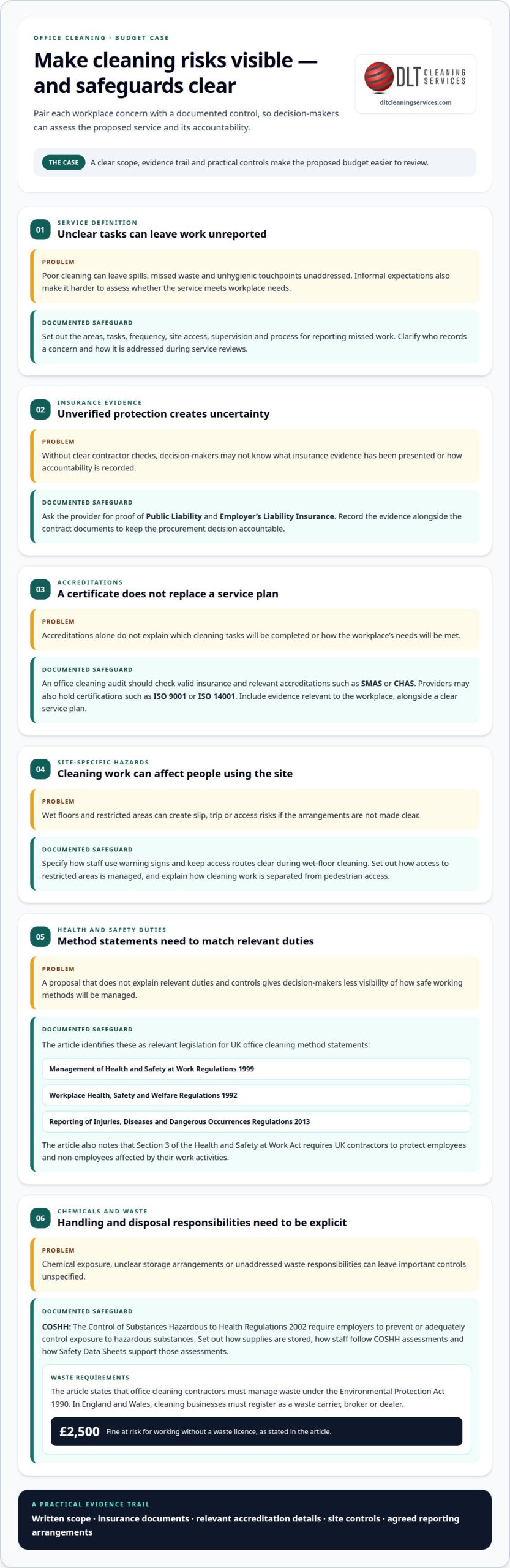
Poor cleaning can leave spills, missed waste and unhygienic touchpoints unaddressed. Without clear contractor checks, there may also be uncertainty about insurance, safe working methods and accountability if an incident occurs.
- Set out contract requirements before reviewing proposals. Specify the areas, tasks, frequency, access arrangements and process for reporting missed work. Clarify, for example, who records a concern and how it is addressed during service reviews. This gives senior management a practical basis for assessing whether the proposed contract meets workplace needs.
- Review insurance evidence as part of the decision. Cleaning providers should show proof of Public Liability and Employer’s Liability Insurance. Record the evidence alongside the contract documents, so the business can see what protection has been presented and keep the procurement decision accountable.
- Consider relevant accreditations without treating them as substitutes for a clear service plan. An office cleaning audit should check whether the provider has valid insurance and accreditations such as SMAS or CHAS. Providers may also hold certifications such as ISO 9001 or ISO 14001. Include only evidence relevant to the workplace’s requirements.
- Include site-specific hazards and controls in the contract arrangements. For wet floors, specify how staff use warning signs and keep access routes clear during cleaning. For restricted areas, set out how access is managed. These practical examples show how slip, trip and access risks will be handled.
- Make the evidence trail part of the procurement process. A business seeking a reliable cleaning contract can use a written scope, insurance documents, accreditation details and agreed reporting arrangements to assess proposals consistently. The same documents clarify expectations after the contract begins, rather than leaving important tasks to informal discussions.
For a workplace reviewing its requirements, office cleaning arrangements can be shaped around the agreed scope and site needs.
Licences, insurance and health and safety
Include documented legal duties, insurance and practical controls in the budget case. These show how hygiene standards and contractor accountability will be managed.
- Review the method statement against relevant legislation. According to the UK legislation register, the Management of Health and Safety at Work Regulations 1999 are among the statutory requirements with which UK office cleaning method statements must align. The Workplace Health, Safety and Welfare Regulations 1992 and the Reporting of Injuries, Diseases and Dangerous Occurrences Regulations 2013 are also listed as relevant legislation.
- Address chemical handling explicitly. According to the UK legislation register, the Control of Substances Hazardous to Health Regulations 2002 require employers to prevent or adequately control exposure to hazardous substances. Include how supplies are stored, how staff follow COSHH assessments, and how Safety Data Sheets support those assessments.
- Explain responsibility for people affected by cleaning work. According to the UK legislation register, Section 3 of the Health and Safety at Work Act requires UK contractors to protect employees and non-employees affected by their work activities. For example, explain how staff separate a wet-floor cleaning task from pedestrian access.
- Set out waste responsibilities and any relevant licence requirements. According to the UK legislation register, UK office cleaning contractors must manage waste under the Environmental Protection Act 1990. In England and Wales, cleaning businesses must register as a waste carrier, broker or dealer; working without a licence risks a £2500 fine.
- Connect insurance evidence to accountability. Ask for proof of Public Liability and Employer’s Liability Insurance, then record it with the contract documents. Also specify how incidents are reported and escalated, so a spill in kitchens or a damaged access route has a clear reporting path.
- Make controls visible in the proposed work arrangements. For wet floors, include warning signs and safe access routes; for chemicals, define storage and handling procedures. These examples help senior management see how health and safety measures support routine cleaning as part of the service plan.
Commercial and office cleaning services
A useful framework for presenting a business case for office cleaning services is to connect the proposed scope with the premises’ daily needs. Define the intended outcomes and how the service will be reviewed.
-
Set out the cleaning services
List the spaces and tasks, then match their frequency to how each area is used. Busy desks, bins and toilets may need daily attention, while deeper cleaning can be scheduled weekly or monthly. Professional commercial contractors such as Indlovu Hygiene Solutions illustrate how defined service schedules—covering sanitised door handles, wiped desk surfaces, clean kitchen appliances and well-stocked washrooms—ensure expectations remain clear. Avoid a broad scope that leaves staff unsure which tasks are covered.
-
Identify business benefits
Presenting a business case for office cleaning services is clearer when each expected benefit is linked to an observable workplace standard. Scheduled bin emptying, for example, helps prevent waste from accumulating, while clean communal walkways support an orderly premises. Include the current need, proposed scope, service standards and reporting process so decision-makers can assess the request against practical outcomes.
-
Link cleaning to wellbeing and productivity
Explain how consistent cleaning can support a more comfortable workplace without promising a measurable productivity gain. Clean washrooms, kitchens and shared desks help maintain everyday hygiene, while sanitising high-touch points addresses frequently used surfaces. Set out how employees can report missed tasks and how those reports inform service reviews. This connects the plan to staff experience and gives managers a practical way to monitor standards.
To shape a practical plan around your workplace, discuss your office cleaning requirements.
An office cleaning audit should check that bins are emptied, relined and waste removed as scheduled; door handles, switches and taps are sanitised; desks are dust-free and computer peripherals wiped; and floors and communal walkways are free of debris, dust and marks after vacuuming or mopping. It should confirm that washrooms are sanitised and stocked with soap and tissues, and identify the risk of cross-contamination if cloths are used across zones.
DLT Cleaning Services: Office Cleaning
DLT Cleaning Services Ltd provides Office Cleaning and Hygiene Services for businesses building a clear, practical cleaning budget. Turn to the team when your proposal needs to connect the agreed scope with consistent workplace standards and health and safety oversight.
A useful next step is to list the areas requiring attention, the tasks expected and how the service should fit your premises. Dedicated on-site supervision helps manage each contract and maintain attention to health and safety requirements. This gives your budget discussion a practical service framework, rather than a list of cleaning tasks alone.
If your workplace is considering a cleaning service or reviewing its current arrangements, contact DLT Cleaning Services Ltd to discuss your requirements.
Move your proposal towards a decision
Turn the budget proposal into a working plan by identifying who will approve it, what information they need and when they will review it. A short decision brief can explain the operational reason for the spend, the intended scope and how service performance will be assessed. This keeps presenting a business case for office cleaning services connected to a clear management decision, rather than leaving it as a general request for more funding.
When you’re ready to discuss how a cleaning arrangement could work in your workplace, DLT Cleaning Services provides Office Cleaning and Hygiene Services. Bring your priorities and the areas you want covered to start a practical conversation about the next step.
Discuss your workplace cleaning requirements with DLT Cleaning Services Ltd, and take the next step with confidence.
Frequently Asked Questions
How do I justify a cleaning budget to senior management?
Present the request as an operational decision, supported by evidence of the current need and a clear expected outcome. For example, explain how unresolved cleaning issues affect staff feedback, visitor impressions or the use of shared spaces. Link the requested budget to a practical measure management can review later, such as fewer reported concerns or more consistent service records.
What evidence helps get a cleaning budget approved?
Use evidence that shows both the problem and how the proposed spend will address it. Dated photographs, employee feedback, records of recurring complaints and workplace inspection notes can make the need tangible. Add a concise comparison of current arrangements and the proposed approach, then identify who will review results and how they will report progress to decision-makers.
What factors affect office cleaning quotes and pricing?
Quotes depend on the property’s size and condition, the requested task list and its location. For a Guildford office, describe the premises accurately and note areas needing particular attention, such as a heavily used kitchen or washroom. This helps the quote reflect the work required. DLT Cleaning Services provides free, no-obligation quotes for its services.
How can you calculate the return on investment of outsourced office cleaning?
Compare the full cost of outsourcing with the costs the business would otherwise carry for in-house cleaning. Include staffing administration, supplies, equipment and management time, using actual internal records rather than assumptions. Then assess measurable changes, such as reduced time spent coordinating cleaning or fewer recurring service complaints. If benefits cannot be reliably expressed in money, report them separately rather than overstating financial returns.