Your office cleaning cupboard is no longer just a storage space for bleach and cloths; it is a frontline defence for your business’s operational continuity. With the global market for hygiene services expanding rapidly through 2026, the way you manage your janitorial supplies office inventory has become a high-stakes strategic decision. It’s understandable if you feel overwhelmed by the shifting landscape of chemical regulations or the rising costs currently impacting the UK service sector.
We know that keeping up with health and safety requirements whilst trying to reduce employee sick days often feels like a difficult balancing act. You want a workplace that is safe and inviting without overspending on unnecessary products or complex chemicals. This guide will show you exactly how to select the right essentials to improve workplace health and ensure your business remains compliant with the latest standards. We’ll provide a clear checklist of must-have supplies, explain how to streamline your procurement, and demonstrate how a proactive hygiene strategy can directly boost your team’s productivity.
Key Takeaways
- Understand why high-quality supplies are a foundational investment in employee health that directly reduces workplace absenteeism.
- Access a comprehensive zone-by-zone checklist to ensure your washrooms, kitchens, and desk areas are equipped with the right janitorial supplies office essentials.
- Learn how to balance procurement costs with sustainability by choosing eco-friendly chemicals that offer better long-term value than the cheapest alternatives.
- Discover a practical framework for organising your cleaning inventory to ensure full compliance with UK COSHH regulations and workplace safety standards.
- Explore the advantages of professional hygiene services to eliminate the risk of running out of critical supplies whilst streamlining your office operations.
Beyond the Cupboard: Why Office Janitorial Supplies Matter in 2026
Managing janitorial supplies office inventory is often viewed as a back-office chore; however, it is a critical component of modern risk management. These supplies encompass everything from the high-level chemical detergents used to sanitise desks to the essential paper products in your washrooms. By 2026, the link between workplace hygiene and business resilience has never been more evident. When you choose high-quality products, you aren’t just buying soap. You’re investing in a proactive strategy to reduce employee absenteeism and protect your most valuable asset: your people.
A clean office directly influences the physical health of your team. Surfaces like keyboards, door handles, and kitchen taps are notorious for harbouring bacteria. Using professional-grade disinfectants ensures these high-touch points are properly treated, which helps keep your workforce healthy and productive. Beyond the physical, there is a profound psychological benefit. A well-stocked, fresh-smelling office signals to your staff that their well-being is a priority. This fosters a sense of pride and stability that domestic-grade products simply cannot replicate.
The Role of Hygiene in Modern Office Productivity
Hygiene is a ‘silent’ factor in employee satisfaction. You might not notice when the air is fresh and the surfaces are gleaming, but your team will certainly notice when they aren’t. Adhering to Commercial cleaning industry standards through the right air fresheners and sanitisers creates a professional first impression. This is particularly vital in high-traffic environments, such as Guildford business centres, where the volume of people requires consistent supply availability. If a washroom runs out of soap mid-morning, the professional image of the entire organisation is compromised.
Commercial vs. Domestic: Why Supermarket Brands Often Fail
It is often tempting to pick up cleaning products during a supermarket run, but domestic brands are rarely suited for the rigours of a busy office. Commercial detergents contain significantly higher concentrations of active ingredients. They cut through grease and grime much faster than retail alternatives, saving time for your cleaning staff.
The cost-per-use benefit is also substantial. Whilst a supermarket spray seems cheap, you’ll use much more of it to achieve the same result as a professional concentrate. Professional systems allow for precise dilution, which stretches your budget further and reduces plastic waste. The durability of commercial hardware is another factor. Industrial-grade microfibre cloths and heavy-duty mops are designed for daily use and frequent laundering. They provide a more sustainable and reliable solution than the disposable options found in the local supermarket.
The Essential Janitorial Supplies Office Checklist: Zone by Zone
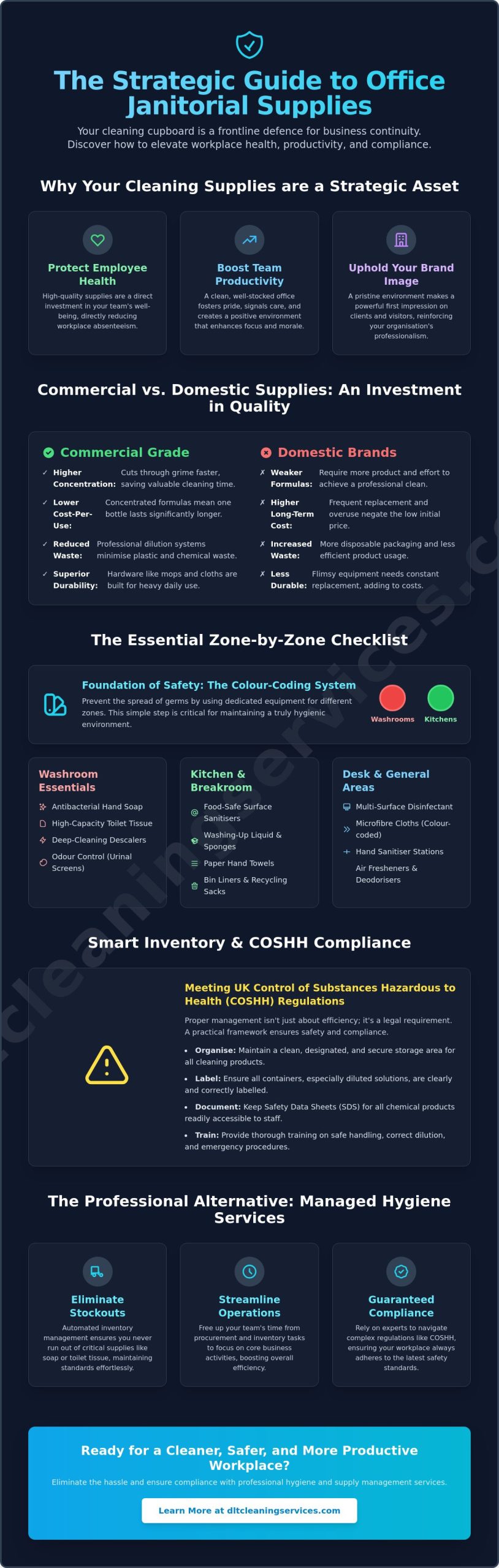
Effective management of your janitorial supplies office inventory starts with a zone-based strategy. Instead of a one-size-fits-all approach, each area of your workspace requires specific tools to maintain safety and hygiene. A critical element of this is a strict colour-coding system. Using separate cloths and mops for kitchens (green) and washrooms (red) is the only way to prevent cross-contamination and ensure your office remains a healthy environment for everyone. This methodical approach ensures that bacteria from high-risk areas never reach the desks where your team spends their day.
Washroom Essentials: Maintaining Sanitary Standards
The washroom is the most demanding zone in any building. To meet professional Office Bathroom Hygiene Services standards, you must look beyond basic soap. High-capacity dispensers for antibacterial hand soap and luxury toilet tissue are essential because they reduce the frequency of refills and ensure supplies don’t run out during peak hours. Don’t forget urinal screens and deep-cleaning descalers to manage odours and prevent long-term plumbing issues. Many UK managers now look to international best practices, such as OSHA and CDC cleaning guidelines, to benchmark their sanitisation protocols for high-traffic facilities. For a complete overview of what a compliant washroom requires, our guide to office bathroom hygiene services covers everything from sanitary waste disposal to dispenser management.
Kitchen and Breakroom Hygiene
In shared kitchens, food safety is paramount. You need food-safe sanitisers that kill bacteria without leaving harmful residues on preparation surfaces. Heavy-duty degreasers are necessary for microwave interiors and hobs, whilst eco-friendly washing-up liquids provide a sustainable way to handle staff crockery. For quick spills, high-absorbency centrefeed rolls are more efficient than standard kitchen towels. Waste management is equally vital; using the correct gauge of bin liners prevents the leaks and odours that can quickly ruin a breakroom’s atmosphere. It’s these small details that keep a shared space inviting and functional.
Desk and Common Area Maintenance
Modern offices are filled with sensitive IT equipment that requires specialised care. Microfibre cloths are superior for dust removal because they trap particles rather than just moving them around. For workstations, ensure your kit includes:
- Screen-safe wipes: Alcohol-free formulas that won’t damage monitor coatings.
- Air dusters: Essential for removing debris from keyboards and PC vents.
- Multi-surface cleaners: Neutral pH solutions that protect the finish of wooden or laminate desks.
- Desk-friendly sanitisers: Small, accessible bottles that encourage personal hygiene amongst staff.
If managing this inventory feels like a distraction from your core operations, our team at DLT Cleaning Services is on hand to help you maintain a consistently professional environment through our dedicated hygiene support.
Strategic Procurement: Balancing Cost, Quality, and Sustainability
Procuring janitorial supplies office managers can rely on involves more than simply finding the lowest price point. Whilst a budget-brand detergent might seem like a saving on paper, it often requires twice the volume to achieve a professional result. This leads to higher long-term costs and increased labour time. Strategic procurement focuses on the total cost of ownership, looking at how concentrated formulas and high-performance tools reduce the overall spend by lasting longer and working more effectively.
When you evaluate a supplier in the Surrey area, reliability and delivery speed are paramount. A local expert who understands the unique logistical challenges of the South East can ensure your cupboards are never empty. This consistency is a cornerstone of office cleaning best practices, ensuring that your team has the right tools exactly when they need them. Managing your janitorial supplies office inventory through a trusted partner allows you to benefit from bulk savings whilst maintaining a streamlined workspace.
The Shift Toward Sustainable Janitorial Products
Green cleaning is no longer a niche preference; it is a commercial necessity. For Hampshire office firms, plant-based surfactants are becoming the standard. These biodegradable chemicals are just as effective as traditional solvents but are much safer for both the environment and your employees. You can significantly reduce plastic waste by switching to concentrated refills and reusable dispensers. This approach doesn’t just help the planet; it demonstrates a commitment to corporate social responsibility that resonates with staff and clients alike.
Bulk Buying vs. Just-in-Time Inventory
Deciding between bulk buying and just-in-time inventory requires a careful look at your physical space. In expensive South East office locations, every square metre of storage has a high “storage cost.” It’s often wise to prioritise bulk purchases for high-volume paper goods, like toilet tissue and hand towels, which don’t expire. For specialised chemicals, a just-in-time approach prevents “supply creep,” where unused bottles accumulate and create a disorganised, potentially hazardous environment. Balancing these two methods keeps your inventory lean and your cleaning operations efficient.
Organising and Managing Your Office Cleaning Inventory
A disorganised cleaning cupboard is more than just a nuisance; it’s a significant health and safety risk. Once you have procured your janitorial supplies office essentials, the next step is establishing a management framework that ensures both efficiency and compliance. Proper storage prevents accidental chemical reactions and ensures that your cleaning team can find the right tools for the job without delay. It’s about creating an environment where safety is baked into the daily routine through methodical organisation and clear labelling.
Maintaining an up-to-date inventory log is the most effective way to prevent the frustration of unexpected stockouts. By tracking usage rates, you can predict exactly when you’ll need to reorder, avoiding the panic of a Monday morning with no hand soap or surface sanitiser. This level of oversight also helps identify “supply creep,” where unnecessary or duplicate products begin to clutter your storage space. Keeping your inventory lean and well-documented ensures that your budget is spent only on what is truly needed to keep the office running smoothly.
COSHH Compliance for Office Managers
COSHH is the primary UK regulation for chemical safety, standing for the Control of Substances Hazardous to Health. For a compliant office, your storage area must be more than just a shelf. A COSHH cupboard should be lockable to prevent unauthorised access and properly ventilated to avoid the build-up of potentially harmful fumes. Every chemical on-site must have a corresponding Safety Data Sheet (SDS) readily available. These documents provide vital information on first aid and spill management, ensuring your team is protected whilst using professional-grade cleaners.
Implementing a Colour-Coded Cleaning System
To maintain a hygienic workspace, you should adopt the standard UK colour-coding system. This method uses Red for washrooms, Blue for desks and general areas, Green for kitchens, and Yellow for clinical areas or washbasins. By strictly separating mops, cloths, and buckets by colour, you virtually eliminate the risk of cross-contamination. This simple system prevents bacteria from a high-risk zone being inadvertently transferred to a communal desk or lunch table. For a deeper look at setting these standards, our Workplace Hygiene Guide provides actionable implementation tips for your facility.
Managing these logistics requires time and attention to detail that many busy managers simply don’t have. If you want to ensure your cupboard is always compliant and your supplies are perfectly managed, you can book a professional hygiene audit with DLT Cleaning Services to streamline your entire operation.
The Professional Alternative: Managed Hygiene and Supply Services
Many office managers find themselves trapped in a cycle of reactive ordering. This DIY approach to janitorial supplies office management often leads to midday stockouts and frustrated staff. By contrast, a managed service takes the burden off your shoulders entirely. You no longer need to worry about whether there is enough toilet tissue for the week or if the kitchen sanitiser is running low. It’s a shift from being a stock controller to being a strategic leader who prioritises a healthy workplace.
A managed service provides more than just deliveries. Having a dedicated supervisor ensures that your janitorial supplies office inventory is used correctly and safely. They monitor consumption patterns and ensure that the colour-coded systems and COSHH standards discussed earlier are strictly followed. This proactive oversight is why many leading firms in Woking and Guildford have moved away from manual ordering in favour of a professional partnership. It allows your team to focus on their core operations whilst we take ownership of the environment.
Why DLT Cleaning Services Ltd is Your Ideal Partner
DLT Cleaning Services Ltd brings over 25 years of experience as a family-run enterprise in Surrey. We pride ourselves on a hands-on approach that larger, impersonal vendors often lack. By combining professional office cleaning with seamless supply replenishment, we offer a single point of accountability. You get the stability of a seasoned professional with the approachability of a local expert who truly cares about your workspace. We don’t just drop off boxes; we ensure your hygiene standards are met every single day through dedicated, amicable service.
Next Steps for a Cleaner Office in 2026
Transitioning to a structured hygiene contract is simpler than it sounds. It begins with a comprehensive hygiene audit of your current supply levels and usage rates. This identifies gaps in your current setup and creates a roadmap for a more efficient, cost-effective future. Moving away from ad-hoc buying allows you to stabilise your costs and ensure your staff always have the essentials they need to stay healthy and productive. If you’re ready to streamline your facility management, you can enquire about our hygiene and supply services today to see how we can support your business goals.
Elevating Your Workplace Standards for 2026
A well-managed inventory of janitorial supplies office essentials is more than a logistical necessity; it is a commitment to the health and morale of your workforce. By moving from reactive buying to a strategic, zone-based approach, you ensure your workspace remains compliant with UK safety regulations whilst significantly reducing the risk of cross-contamination. Every choice you make, from implementing a strict colour-coded system to transitioning to sustainable chemicals, contributes to a more resilient and professional business environment.
Managing these complex requirements doesn’t have to be a solo endeavour. DLT Cleaning Services Ltd has been a family-run partner to businesses since 1999, providing dedicated on-site supervision to ensure every supply is used effectively and safely. We take pride in serving clients across Surrey, Hampshire, and Berkshire with a hands-on approach that prioritises your peace of mind. If you’re ready to stop worrying about stock levels and start focusing on your core operations, we’re on hand to help.
Request a managed hygiene and supply quote from DLT Cleaning Services Ltd and take the first step toward a more consistent, high-standard workplace today.
Frequently Asked Questions
What are the most essential janitorial supplies for a small office?
The most essential janitorial supplies office managers should prioritise include antibacterial hand soap, surface sanitisers, luxury toilet tissue, and high-quality microfibre cloths. You should also stock a neutral pH floor cleaner and a dedicated glass cleaner for mirrors and partitions. Focusing on high-concentration, professional-grade products ensures that even a small cupboard can hold enough stock to maintain high hygiene standards for several months.
How should I store cleaning chemicals to remain COSHH compliant?
To remain compliant with UK law, you must store all cleaning chemicals in a secure, lockable cupboard that is well-ventilated and kept away from heat sources. Products should always stay in their original containers with the manufacturer’s labels intact. It’s also a legal requirement to keep a folder containing the Safety Data Sheets (SDS) for every chemical on-site so that first aid and spill instructions are immediately accessible.
Is it cheaper to buy janitorial supplies in bulk or as needed?
Buying in bulk is generally more cost-effective for high-volume consumables like toilet rolls, hand towels, and bin liners. For liquid chemicals, bulk buying is cheaper per litre, though you must consider the physical storage space available in your office. Many firms find that a managed service is the most economical choice, as it balances bulk pricing with professional inventory management to prevent waste.
What is the difference between janitorial supplies and cleaning services?
Janitorial supplies refer to the physical products and tools required for maintenance, such as detergents, paper goods, and mops. Cleaning services involve the professional labour and expertise provided by a company to perform the work. Choosing a partner like DLT Cleaning Services allows you to combine both, where the service provider manages the janitorial supplies office inventory as part of their dedicated cleaning contract.
Do I need a special licence to store commercial cleaning chemicals in my office?
You don’t typically need a specific licence to store standard commercial cleaning products, but you do have legal responsibilities under the Health and Safety at Work Act. You must perform a COSHH risk assessment for any hazardous substances and ensure that anyone using them is properly trained. If you’re unsure about the chemicals you currently hold, a professional hygiene audit can help clarify your obligations.
How often should I restock office bathroom supplies?
You should restock bathroom supplies based on a consistent weekly audit, although high-traffic buildings often require daily checks. The most efficient way to manage this is to monitor usage over a standard month to establish a predictable reorder point. Installing high-capacity dispensers for soap and paper can help reduce the frequency of restocking whilst ensuring your team never runs out of essentials. For a detailed breakdown of what a fully compliant washroom requires, our guide to professional office bathroom hygiene services outlines the key components facilities managers should have in place.
Can I use domestic cleaning products in a commercial office environment?
Whilst domestic products are easily accessible, they are rarely suitable for the rigours of a professional workspace. Commercial chemicals are more concentrated and specifically formulated to kill bacteria in high-traffic areas. Furthermore, domestic brands often lack the detailed Safety Data Sheets required for commercial H&S compliance, making them a riskier choice for business owners who prioritise staff safety.
What colour-coding system should I use for office cleaning equipment?
The standard UK colour-coding system is the most effective way to prevent cross-contamination in your workspace. You should use Red for washrooms and toilets, Green for kitchens and food prep areas, Blue for general desk and office spaces, and Yellow for washbasins and mirrors. Strictly following this system ensures that bacteria from high-risk zones are never transferred to communal areas or workstations.
3 thoughts on “Janitorial Supplies for the Office: A Strategic Resource Guide for 2026”