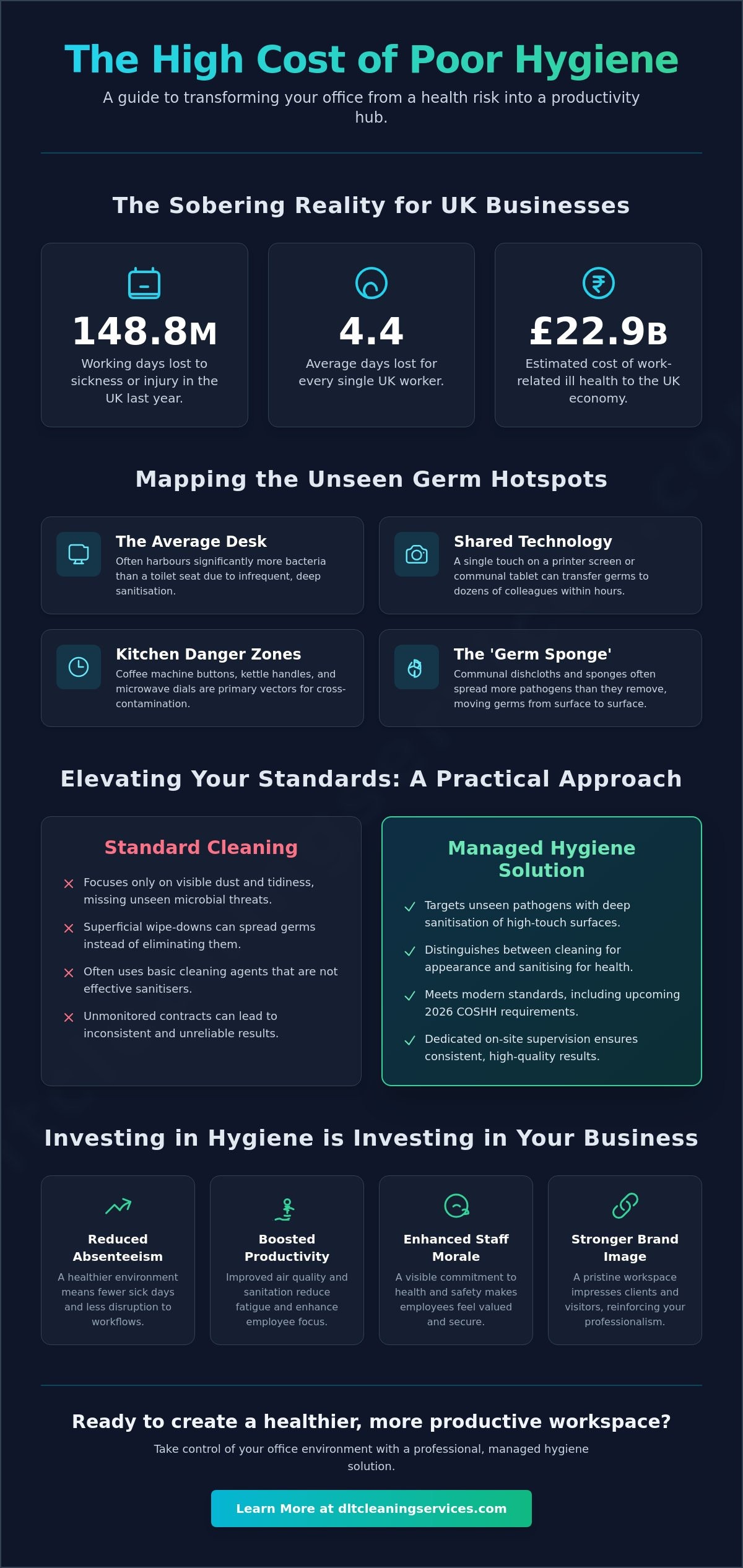
Did you know that 148.8 million working days were lost to sickness or injury in the UK last year? This averages out to 4.4 days lost for every single worker, a statistic that represents a significant hurdle for Surrey office managers striving to maintain momentum. When you look to improve workplace hygiene, you’re doing more than just tidying desks; you’re building a foundation for a healthier, more resilient team.
We know how draining it is to handle constant staff complaints about kitchen cleanliness or to feel let down by unmonitored cleaning contractors who don’t share your standards. It’s frustrating when seasonal illnesses seem to spread through the office unchecked, whilst your to-do list only grows longer. This guide offers a practical roadmap to reclaim control over your environment, ensuring your office impresses every visitor and truly supports your staff. You’ll learn how to implement professional hygiene services that meet the latest 2026 COSHH requirements and discover strategies that help reduce sick leave, creating a workspace where everyone can perform at their best.
Key Takeaways
- Identify the top five germ hotspots in your office and learn how to prevent cross-contamination in communal kitchen areas.
- Learn how to draft a practical hygiene policy that balances employee responsibility with professional cleaning standards.
- Discover actionable daily and weekly strategies to improve workplace hygiene and distinguish between simple surface cleaning and deep sanitisation.
- Understand why managed hygiene solutions with dedicated on-site supervision provide more consistent results than unmonitored cleaning contracts.
- Establish a clear business case for high hygiene standards by understanding the direct link between air quality, sanitation, and team productivity.
The Business Case for Improving Workplace Hygiene in 2026
Workplace hygiene is often misunderstood as merely a cleaning schedule. In reality, it is a sophisticated ecosystem comprising rigorous sanitation, high indoor air quality, and the daily habits of your team. By following the principles of occupational hygiene, businesses can anticipate and control health hazards before they impact the bottom line. When you decide to improve workplace hygiene, you aren’t just ticking a compliance box; you’re investing in the physical and mental stamina of your workforce. A clean office serves as a silent partner in your business success, providing the stability your employees need to focus on their core tasks.
Recent data highlights the scale of the challenge for UK employers. In 2025, the country saw 148.8 million working days lost to sickness or injury, which equates to roughly 4.4 days per worker. These aren’t just abstract numbers on a national spreadsheet. For a Surrey-based firm, this represents a direct hit to project timelines and client service. Poor hygiene also leads to the “presenteeism” trap. This occurs when unwell employees come into the office and unknowingly spread germs across shared surfaces. This behaviour eventually leads to a much larger spike in absenteeism that costs far more than a professional hygiene service ever would.
In the same way that professional hygiene services protect your bottom line from the costs of absenteeism, partnering with experts like CTC Tax & Accounting ensures your business’s financial health through diligent bookkeeping and tax compliance.
The Real Cost of Poor Office Hygiene
The financial burden of absenteeism on Surrey businesses is substantial, contributing to the estimated £22.9 billion cost to the UK economy for work-related ill health. Germs move with alarming speed through shared office equipment, often following a predictable path:
- Shared Tech: A single touch on a printer touchscreen or a communal tablet can transfer bacteria to dozens of colleagues within hours.
- Kitchen Vectors: Coffee machine buttons and kettle handles are prime spots for cross-contamination.
- Hidden Reservoirs: Dirt trapped in carpets and upholstery acts as a reservoir for allergens and pathogens, which can exacerbate respiratory issues and fatigue.
Meeting Modern Employee Expectations
Today’s workforce has a different perspective on the office environment than they did five years ago. Employees in Guildford and across the South East now prioritise visible hygiene standards. They want to see that their wellbeing is a genuine priority rather than an afterthought. Maintaining a pristine workspace doesn’t just keep people healthy; it strengthens your brand image when clients visit your premises. As many firms encourage a “back-to-office” culture for their hybrid teams, providing a managed, hygienic environment is essential. Taking proactive steps to improve workplace hygiene shows your team that you value their health, which is a powerful tool for staff retention and morale.
When hosting hybrid meetings or corporate events to bring teams together, it is equally important to have reliable technical support; you can discover Straight Street Event Services to see how professional event production can complement your office environment, providing inspiration for technical solutions in live and hybrid spaces.
Mapping Germ Hotspots: Where to Focus Your Efforts
To effectively improve workplace hygiene, we must look beyond the visible dust. Many office managers focus on floor appearance, yet the most significant health risks often hide in plain sight on frequently touched surfaces. Understanding where bacteria thrive allows for a targeted approach that protects your team more efficiently than a general wipe-down. This methodical focus ensures that your cleaning budget is spent where it has the greatest impact on employee health.
Research has consistently shown that the average office desk can harbour significantly more bacteria than a toilet seat. This is primarily because washrooms are cleaned regularly with strong disinfectants, whereas desks often become “personal ecosystems” where staff work, eat, and store equipment without routine sanitisation. When multiple people share these spaces, as is common with hot-desking, the risk of illness spreading increases rapidly. Addressing these employee safety concerns requires a shift from superficial cleaning to deep, technical hygiene practices.
Communal Kitchens and Breakrooms
The office kitchen is the heart of the workplace, but it’s also a primary site for cross-contamination. Bacteria from raw food or unwashed hands can quickly move from a fridge handle to a kettle button or microwave dial. One of the biggest culprits in this cycle is the humble dishcloth or sponge. These items often become “germ sponges,” spreading pathogens across every surface they touch. We recommend replacing these frequently or moving to a system of professional deep cleans for food preparation areas. Ensuring these surfaces are truly sanitised, rather than just wiped, is a vital step to improve workplace hygiene.
High-Touch Points and Office Tech
High-traffic areas like lifts and doorways contain numerous touch points that require constant attention. Lift buttons and door handles are touched by almost every person entering the building, making them high-speed vectors for seasonal illnesses. Similarly, shared peripherals like keyboards and mice require specialised care. Because these items contain sensitive electronics, they cannot be treated with standard liquid cleaners. Using high-quality microfibre cloths and approved sanitising wipes ensures these tools remain hygienic without risking equipment failure. If you’re finding it difficult to keep up with these detailed requirements, our team is ready to assist with a tailored hygiene schedule.
Finally, we must consider the air we breathe. A comprehensive hygiene strategy includes monitoring ventilation and air quality. Stagnant air allows airborne pathogens to linger, increasing the likelihood of transmission amongst staff. Combining surface sanitisation with improved air circulation creates a multi-layered defence that keeps your Guildford or Surrey office running smoothly and safely.
How to Organise Effective Workplace Hygiene Policies
A successful hygiene strategy relies on more than just high-quality cleaning products; it requires a clear, shared understanding of expectations. Implementing a structured policy is one of the most effective ways to improve workplace hygiene long-term. This document shouldn’t just sit in an HR folder. It needs to be a living framework that guides daily behaviour. When drafting your policy, focus on clarity and practicality. Define what the company provides, such as professional Hygiene Services, and what is expected of the individual, such as keeping personal tech clean.
Simple visual cues, often called “nudges,” play a significant role in habit formation. Strategically placed signage in washrooms and kitchens serves as a gentle reminder for handwashing and surface wipe-downs. These prompts are most effective when they’re positive and instructional rather than scolding. Occasionally, you may need to address personal hygiene issues. These conversations require a delicate balance of empathy and firm professional standards. By framing these discussions around the collective health of the team, you maintain a supportive atmosphere whilst upholding your office standards.
Creating a Culture of Cleanliness
Management must lead by example to truly embed these values. If senior leaders ignore “clean desk” policies, the rest of the team will likely follow suit. A clean desk policy is vital because it allows our cleaning teams to thoroughly sanitise surfaces every night. Without clear surfaces, deep cleaning becomes impossible. Ubiquitous hand sanitiser stations also send a powerful message: health is a priority here. This proactive approach reduces the “presenteeism” trap mentioned earlier, keeping your Guildford team safe and productive.
Managing Janitorial Supplies and Consumables
Running out of soap or paper towels isn’t just a minor inconvenience. It’s a critical failure in your hygiene chain. We recommend a managed supply service to ensure constant availability of essential items. This removes the burden from your internal team and guarantees that your office always meets UK health and safety standards. Selecting eco-friendly janitorial supplies for the office is also a growing trend in 2026. Using sustainable, high-performance chemicals shows a commitment to both employee wellbeing and environmental responsibility, which is increasingly important for modern Surrey businesses.
Practical Steps to Improve Workplace Hygiene Daily
Consistency is the secret to a healthy office environment. To improve workplace hygiene effectively, you must distinguish between simple surface cleaning and sanitising high-traffic areas. While cleaning removes visible debris and dust, sanitising involves using anti-viral agents to kill the pathogens that lead to employee absenteeism. For office managers in Surrey, establishing a clear rhythm of daily, weekly, and monthly tasks ensures that no corner of the workspace is neglected.
Daily tasks form the first line of defence against the spread of illness. These actions should be non-negotiable and performed with meticulous attention to detail. Wiping down the hotspots identified earlier, such as door handles and lift buttons, using professional-grade anti-viral agents is essential. If you’re struggling to maintain these rigorous standards with unmonitored contractors, you can book a professional hygiene assessment to see how a managed service can transform your workspace. This hands-on approach ensures total compliance with health regulations and provides the peace of mind that your team is fully protected.
The Daily Hygiene Checklist
Daily maintenance keeps the environment fresh and prevents the immediate transfer of germs. Focus on these core areas every evening:
- Waste Management: Emptying bins and sanitising the receptacles themselves prevents unpleasant odours and discourages pests.
- Surface Sanitisation: Wiping down all high-touch surfaces, including shared tech and kitchen appliances, with appropriate disinfectants.
- Washroom Maintenance: Ensuring bathrooms are fully stocked with soap and paper towels, and that floors are mopped with a strong disinfectant. Facilities managers looking to go further can explore dedicated office bathroom hygiene services to ensure washrooms meet full compliance standards and genuinely support employee wellbeing.
Weekly and Monthly Deep Cleaning Tasks
While daily cleaning handles surface-level risks, deeper tasks are required to manage long-term hygiene. Carpets and soft furnishings act as filters, trapping allergens and deep-seated bacteria that can degrade indoor air quality. A weekly schedule should include thorough vacuuming with HEPA-filter equipment and the sanitisation of office upholstery. On a monthly basis, high-level dusting and window cleaning should be prioritised to remove accumulated pollutants that circulate through the ventilation system.
Monitoring these standards is just as important as the cleaning itself. Without a system for oversight, it’s easy for small details to be missed, leading to a gradual decline in hygiene. Professional washroom deep cleans are particularly vital to prevent the build-up of uric scale and bacteria in hard-to-reach areas. By establishing a clear roadmap to improve workplace hygiene, you create a workspace that doesn’t just look clean but is fundamentally healthy for everyone who enters it.
Why Managed Hygiene Solutions are the Logical Choice
Many office managers find that cleaning standards often start high but gradually decline as weeks turn into months. This common issue usually stems from a lack of consistent oversight. Unmanaged cleaning contracts frequently fail to meet rigorous standards because there is no one on-site to verify that every task has been completed to a professional level. To truly improve workplace hygiene, a move away from ad-hoc or unmonitored cleaning is essential. A managed solution ensures that the high standards you expect on day one are maintained every single night.
The “DLT Difference” lies in our commitment to accountability. As a family-run company rooted in Surrey and Hampshire, DLT Cleaning Services Ltd doesn’t view office cleaning as a distant, corporate transaction. Instead, we see it as a personal partnership. We take ownership of your environment so you can focus entirely on your business operations. Partnering with a local expert who understands the specific needs of firms in Guildford or Basingstoke provides a level of dedication that national providers often struggle to match. A bespoke hygiene contract with DLT Cleaning Services Ltd is also more cost-effective than ad-hoc services, as it allows for a planned, methodical approach that prevents expensive deep-cleaning emergencies later on.
The Importance of On-Site Supervision
Direct supervision is the only way to prevent the “corner-cutting” that often occurs in unmonitored cleaning. Our hands-on approach ensures that every hotspot, from the communal printer to the breakroom microwave, is addressed during every shift. This level of detail is a core component of Health and Safety Executive (HSE) compliance, particularly regarding the latest COSHH regulations. Facilities managers gain total peace of mind knowing that a dedicated supervisor from DLT Cleaning Services Ltd is verifying the work, ensuring that the hygiene roadmap we’ve established is followed to the letter.
Tailored Hygiene Services for Surrey Businesses
Every office has a unique rhythm. A law firm in Guildford may have different footfall patterns and hygiene requirements than a tech start-up in Basingstoke. We don’t believe in one-size-fits-all schedules. Instead, we customise your cleaning programme to match your office’s specific usage and occupancy levels. This flexibility is vital in a world of hybrid working, where certain areas may require more intensive sanitisation on busy mid-week days. Being “on hand” locally means we can adapt quickly to your changing needs. If you are ready to elevate your standards and protect your team’s health, you can request a professional hygiene audit for your office today. We will provide a clear, honest assessment of your current environment and show you exactly how to improve workplace hygiene for the long term.
Secure a Healthier Future for Your Surrey Office
Establishing a resilient environment requires more than just occasional cleaning; it demands a strategic focus on high-traffic hotspots and a policy that encourages personal responsibility. By following a structured roadmap of daily sanitisation and professional deep cleans, you can significantly reduce the impact of seasonal illnesses on your team’s productivity. The choice to improve workplace hygiene is an investment in your staff’s wellbeing and your company’s operational stability. Your team deserves a safe, productive space.
At DLT Cleaning Services Ltd, we’ve spent over 25 years perfecting this balance for businesses across Guildford, Surrey, and Hampshire. As a family-run enterprise established in 1999, we pride ourselves on a hands-on approach that includes dedicated on-site supervision for every contract. We’re ready to take ownership of your office environment so you can focus on what matters most.
Get a tailored office hygiene quote from DLT Cleaning Services Ltd today and discover the peace of mind that comes with a truly managed service. We look forward to helping you create a workspace that inspires confidence in both your employees and your clients.
Frequently Asked Questions
What is the best way to improve workplace hygiene during flu season?
To improve workplace hygiene during flu season, you should increase the frequency of sanitisation on high-touch surfaces like door handles, lift buttons, and shared kitchen equipment. Using professional-grade antiviral cleaning agents ensures that pathogens are neutralised before they can spread amongst the team. This proactive approach is more effective than standard cleaning, as it specifically targets the vectors most responsible for seasonal outbreaks.
How often should office bathrooms be deep cleaned?
Office bathrooms require thorough cleaning every day to maintain basic sanitation, but a professional deep clean should be performed at least once a month. This intensive process removes uric scale and bacteria build-up in hard-to-reach areas that standard daily mopping often misses. Regular deep cleans prevent unpleasant odours and long-term hygiene issues, ensuring your facilities always reflect the high standards of your business. For a detailed breakdown of what a compliant washroom programme should include, our guide to office bathroom hygiene services covers everything from sanitary waste disposal to infection control best practices.
What are the most important janitorial supplies for a small office?
The most important supplies include high-quality hand soap, paper towels, and alcohol-based hand sanitiser stations. To truly improve workplace hygiene, you also need antiviral surface wipes for personal electronics and colour-coded microfibre cloths. These specific tools help prevent cross-contamination between different office zones, such as moving bacteria from the washrooms into the communal kitchen area. For a comprehensive overview of what to stock, consult our strategic guide to janitorial supplies for the office to ensure your cleaning cupboard is fully equipped for 2026 compliance standards.
Can professional cleaning help reduce employee sick days?
Professional hygiene services directly contribute to reduced absenteeism by breaking the chain of infection within the workspace. By sanitising shared surfaces and improving air quality, you reduce the likelihood of seasonal illnesses spreading. This helps keep your absenteeism rates low, protecting your team’s productivity and ensuring your office remains a healthy environment for both staff and visiting clients.
What should be included in a workplace hygiene policy?
A workplace hygiene policy should include clear protocols for handwashing, desk cleanliness, and the use of provided sanitiser stations. It’s also important to outline expectations for “clean desk” habits, which allow professional cleaners to sanitise surfaces thoroughly. Including guidance on when staff should work from home due to illness helps maintain a healthy environment and prevents the spread of infection amongst the wider team.
How do I choose the right cleaning company in Surrey?
Look for a partner with deep roots in the local community and a proven track record of serving Guildford and the surrounding areas. A family-run business often provides a higher level of accountability and a more personalised service. Ensure they offer dedicated on-site supervision, as this guarantees that the high standards promised at the start of the contract are maintained every single night.
Is on-site supervision necessary for office cleaning?
Dedicated on-site supervision is vital because it prevents the gradual decline in standards often seen with unmanaged teams. A supervisor acts as a point of accountability, verifying that every hotspot is sanitised and that the cleaning team remains fully compliant with health and safety standards. This hands-on approach provides the consistency needed to protect your staff and gives office managers total peace of mind.
What are the legal requirements for workplace hygiene in the UK?
Employers must comply with the Health and Safety at Work etc. Act 1974, which mandates a safe and healthy working environment. The Control of Substances Hazardous to Health (COSHH) Regulations 2002 also require you to manage risks from biological agents, such as viruses and bacteria. Staying updated with the latest 2026 HSE Workplace Exposure Limits is essential for maintaining a legally compliant and hygienic office.
2 thoughts on “How to Improve Workplace Hygiene: A Comprehensive Guide for Surrey Office Managers”