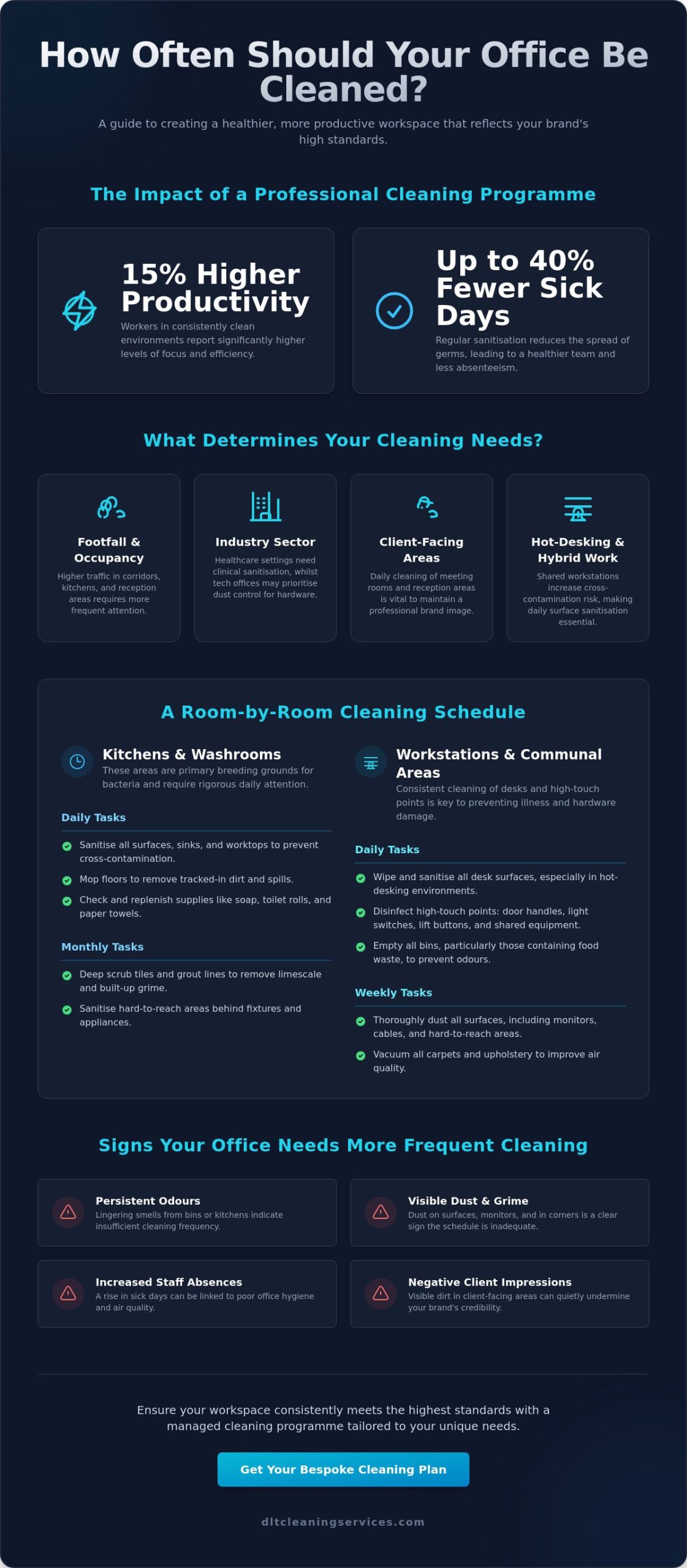
Did you know that office workers in clean environments report 15% higher productivity levels, according to a February 2026 study in the Journal of Environmental Psychology? Most business leaders recognise that a tidy workspace fosters focus, yet it’s common to feel frustrated by inconsistent standards or a sudden rise in staff absences. You’ve likely noticed how visible grime in a meeting room can quietly undermine your brand when a client visits, leaving you wondering exactly how often should offices be cleaned to maintain a truly professional edge.
We understand that your environment should be a foundation for success, providing peace of mind rather than a source of stress. In this article, you’ll discover the ideal cleaning frequency for your specific workspace to ensure a healthy and productive atmosphere for your entire team. We provide a practical framework to help you decide on a schedule that can reduce sick days amongst staff by up to 40% and ensure your office always reflects the high standards of your business.
Key Takeaways
- Identify how footfall and modern working habits, such as hot-desking, create unique hygiene requirements that dictate your maintenance schedule.
- Discover why essential areas like kitchens and bathrooms require daily intervention when determining how often should offices be cleaned for maximum safety.
- Learn how to combat “Sick Building Syndrome” by improving indoor air quality and eliminating germs on high-touch surfaces.
- Spot the subtle signs of an inadequate cleaning regime, from persistent odours to visible dust build-up in hard-to-reach areas.
- Understand the value of a bespoke cleaning specification and hands-on supervision in ensuring consistent standards that reflect your brand’s professionalism.
Determining the Ideal Cleaning Frequency for Your Office
Every workspace is unique. A quiet consultancy firm with five employees doesn’t generate the same “dirt load” as a bustling creative agency in the centre of town. Deciding how often should offices be cleaned depends entirely on your specific operations, staff density, and the nature of your industry. High footfall naturally leads to a faster accumulation of allergens and bacteria. This isn’t merely a matter of appearances; it’s a fundamental part of maintaining workplace health and well-being for your staff.
Consider the specific requirements of your business sector. In a healthcare or laboratory setting, sanitisation is a clinical necessity that usually demands a daily, deep-clean approach. In a tech-focused office, the priority might shift toward dust management for sensitive hardware and the maintenance of communal breakout areas. Your visitor frequency also plays a major role. If you host clients daily, your reception area and meeting rooms require a pristine finish every single morning to reflect your brand’s quality. A workspace that looks neglected can subtly damage a client’s trust before you’ve even started your presentation.
Assessing Footfall and Occupancy Patterns
High-traffic communal areas like corridors, lift lobbies, and kitchens require much more frequent attention than individual cubicles or storage rooms. With the rise of hybrid working, your needs might fluctuate significantly throughout the week. If your team is only on-site from Tuesday to Thursday, your cleaning schedule should be adjusted to focus resources when they’re needed most. We help you calculate the “dirt load” by evaluating your total headcount and the volume of visitors. A space running at 90% capacity requires a far more rigorous daily regime than one operating at 40% capacity whilst staff work from home.
The “Hot-Desking” Hygiene Challenge
Shared workstations are notorious hotspots for bacteria transmission. When multiple people use the same keyboard, mouse, and telephone throughout the week, the risk of cross-contamination increases. This makes daily surface wipes for communal hardware a necessity rather than an optional extra. Implementing a “clear desk” policy is a practical way to support your cleaning team. It allows them to access every inch of the desk surface easily, ensuring a more thorough and efficient service. When desks are free of clutter, our dedicated staff can focus on deep sanitisation rather than just tidying around paperwork. This proactive approach is essential when considering how often should offices be cleaned to keep your team healthy and focused.
Daily vs Weekly Tasks: A Room-by-Room Breakdown
Establishing a routine isn’t just about ticking boxes. It’s about maintaining high cleaning industry standards that protect your investment and your people. When considering how often should offices be cleaned, a tiered approach is most effective. Daily tasks focus on hygiene and immediate presentation, whilst weekly or monthly tasks tackle the deeper build-up that impacts long-term health and hardware longevity.
High-Traffic Zones: Kitchens and Washrooms
These areas are the heart of any office and, unfortunately, the primary breeding grounds for bacteria. An unmanaged kitchen isn’t just unsightly; it’s a health risk. Daily attention to sinks, worktops, and microwave interiors is essential to prevent cross-contamination. We also recommend that bathroom deep cleans are scheduled monthly alongside daily maintenance to tackle limescale and deep-seated grime in grout lines.
- Daily: Sanitising all surfaces, cleaning sinks, and mopping floors.
- Supply Management: Checking and replenishing hand soap, toilet rolls, and paper towels so they never run out.
- Monthly: Deep scrubbing of tiles and sanitising hard-to-reach areas behind fixtures.
Our dedicated hygiene services take the guesswork out of this process, ensuring your facilities remain a credit to your brand rather than a point of concern for staff.
Workstations and Communal Areas
Dust is a silent disruptor. It settles on IT equipment, clogs cooling fans, and can eventually lead to hardware failure. Whilst desks need daily wipes to remove surface germs, a more thorough dusting of monitors and cables should occur at least once a week. Odour control is another critical factor. Emptying bins, particularly those containing food waste, must be a daily priority to maintain a fresh atmosphere.
High-touch points like door handles, light switches, and lift buttons require daily sanitisation. These are often overlooked but are central to reducing employee absence. For elements like window cleaning and upholstery shampooing, a less frequent but consistent schedule works best. We typically advise the following:
- Daily: Bin removal, surface sanitisation of shared desks, and high-touch point cleaning.
- Weekly: Detailed dusting of skirting boards, picture frames, and IT equipment.
- Quarterly: Internal window cleaning and deep cleaning of upholstered office chairs.
Floor maintenance also follows a split schedule. Vacuuming high-traffic carpets should be a daily task to remove grit that wears down fibres, whereas deep carpet extraction is usually an annual or bi-annual requirement depending on your footfall. This systematic approach ensures you never have to guess how often should offices be cleaned to keep your workspace in peak condition.
The Productivity Link: How Cleanliness Impacts Employee Focus
Cleanliness isn’t just about polishing surfaces; it’s about clearing the path for high-level thinking. Research from the Harvard Business Review in December 2024 showed that clean and well-designed spaces can improve cognitive performance and decision-making accuracy by up to 20%. When considering how often should offices be cleaned, it’s vital to view hygiene as a strategic investment in your team’s output. A cluttered or dusty environment increases the brain’s cognitive load, forcing employees to process unnecessary visual noise whilst they attempt to focus on complex tasks.
Beyond the psychological benefits, physical health remains a major driver of performance. Sick Building Syndrome often stems from poor indoor air quality caused by accumulated dust and allergens. By maintaining a rigorous schedule, you ensure that HEPA-filtered vacuums and regular dusting of vents keep the air fresh. This reduces stress and boosts job satisfaction, as 67% of workers in a 2025 study confirmed that the cleanliness of their workspace directly affects their happiness at work. A pristine office also serves as a silent ambassador for your brand identity. When clients visit a spotless meeting room, they immediately associate that level of detail with the quality of your professional services.
Health, Hygiene, and Reduced Absenteeism
For businesses across the region, employee absence represents a significant hidden cost. Proper sanitisation in an office can lead to a 35-40% reduction in employee sick days, according to 2025 research. Targeting seasonal viruses through frequent sanitisation of shared touchpoints ensures that minor illnesses don’t sweep through your entire department. Desk hygiene is particularly critical because the average office desk can harbour hundreds of times more bacteria per square inch than a toilet seat if not regularly disinfected. By prioritising hygiene, you protect your staff’s health and your company’s bottom line. For businesses in the local area, a comprehensive approach to office hygiene services Guildford businesses rely on can provide a structured framework for achieving these results consistently.
Cognitive Load and the “Visual Noise” of Grime
Visible stains or dust build-up on monitors act as constant, subtle distractions that pull focus away from high-value tasks. This phenomenon relates to the broken window theory. If an environment appears neglected, staff behaviour often follows suit, leading to lower standards of work and reduced pride in the office. Conversely, a pristine workspace encourages a culture of excellence. When employees see a dedicated team maintaining their environment, they feel valued and are more likely to take ownership of their own productivity. Deciding how often should offices be cleaned involves balancing these psychological needs with practical maintenance to ensure your office reflects your brand’s commitment to quality.
Common Signs Your Office Needs More Frequent Cleaning
It can be easy to overlook the gradual accumulation of grime in a busy workspace. However, there are clear indicators that your current schedule is failing to keep pace with your operational needs. If you find yourself questioning how often should offices be cleaned, start by observing the behaviour of your team. A major red flag is seeing staff members spending their own time cleaning their desks or keyboards before they start work. This suggests they don’t feel their environment is hygienic enough to support their well-being, and it’s a direct drain on the productivity you’re trying to protect.
Visible dust build-up on monitors or hard-to-reach shelving is another sign that your provider is skipping the detailed work. Whilst the main floors might look acceptable, these neglected areas contribute to poor air quality and can trigger allergies. Lingering odours in kitchens or washrooms, even shortly after a visit, indicate that surface-level tidying is being prioritised over deep sanitisation. If your team is experiencing a frequent cycle of “office colds” or minor illnesses, your current hygiene protocols likely aren’t robust enough to break the chain of infection. Determining exactly how often should offices be cleaned often involves looking for these silent signals before they become major disruptions.
The Subtle Indicators of Inadequate Maintenance
Beyond the obvious, look for the small details that define a professional image. Scuff marks on skirting boards and a build-up of dark grime in carpet corners suggest that vacuuming is being rushed. Fingerprints on glass partitions and entrance doors are immediately noticeable to visiting clients and suggest a lack of attention to detail. We also recommend the “sniff test”. If your office smells stale or musty when you first open the doors in the morning, it’s a sign that bacteria are present and that your current cleaning frequency isn’t sufficient to maintain a fresh, healthy atmosphere.
When to Move from Weekly to Daily Cleaning
Your cleaning requirements aren’t static. Team expansion is a common trigger; if you’ve recently increased your headcount, the “dirt load” on communal areas and washrooms will have risen proportionally. Seasonal adjustments are also necessary. Winter months bring in more mud and grit from the street, alongside a higher risk of seasonal flu, making a more robust daily frequency essential. If you’re receiving direct feedback from staff about hygiene standards, it’s important to act quickly. Transitioning to our professional office cleaning services ensures that every corner of your workspace is managed with the dedication it deserves. We believe hands-on supervision is the only way to ensure that the agreed frequency actually translates into consistent, high-quality results.
Tailoring a Managed Cleaning Schedule for Your Business
Selecting a cleaning frequency is only half the battle. Without a managed approach, even the most frequent schedule can fall short of expectations. A “one size fits all” plan rarely addresses the specific pressures of a growing business. Instead, we focus on creating a bespoke cleaning specification that evolves alongside your operations. Determining how often should offices be cleaned is a collaborative process that balances your daily footfall with your long-term health and safety goals. By integrating our specialised hygiene services with routine maintenance, we ensure that every aspect of your environment supports your team’s focus.
As a local partner deeply rooted in the Surrey and Guildford business landscape, we understand the standards required by firms in the South East. Our approach is built on 25 years of family-run reliability, where we take personal pride in every contract we manage. We don’t just provide a service; we act as a dedicated partner who is on hand to take ownership of your workspace. This allows you to focus on your own operations whilst we maintain a stable and professional environment for your staff and clients.
Developing Your Bespoke Specification
The first step is a thorough audit of your current space to identify high-priority zones. We look at shared kitchenettes, high-traffic reception areas, and washrooms that require daily attention, whilst balancing the frequency of less-used rooms to suit your budget. This methodical planning ensures you meet all necessary hygiene standards without paying for unnecessary tasks. Our goal is to provide a steady, organised schedule that reflects your brand’s commitment to quality and employee well-being. When selecting a provider, using a structured evaluation process such as the ultimate checklist for hiring professional office cleaners Surrey businesses rely on can help you verify compliance and long-term service consistency.
Ensuring Accountability Through Supervision
Accountability is where many cleaning providers fail. Unmonitored contractors often drift away from the original specification over time, leading to the inconsistent standards that many managers find frustrating. We solve this through hands-on, on-site supervision. Our supervisors verify that every task is completed to rigorous health and safety standards, providing a sense of order that mirrors the physical results of our work. This level of dedication ensures that when you decide how often should offices be cleaned, those standards are actually maintained every single day.
If you’re ready to move away from inconsistent service and toward a reliable, managed solution, we’re here to help. You can request a tailored office cleaning quote for your Surrey business to see how a bespoke plan can transform your workspace and protect your team’s productivity.
Elevate Your Workspace Standards
Determining how often should offices be cleaned is a fundamental business decision that impacts everything from employee health to your bottom line. Throughout this guide, we’ve explored how a tailored approach, balancing daily high-touch sanitisation with weekly detailed maintenance, creates an environment where staff can truly thrive. By addressing the subtle signs of neglect before they impact morale, you ensure your office remains a hub of focus and excellence.
Since 1999, our family-run business has provided the stability and expertise needed to manage professional environments across Surrey, Hampshire, and Berkshire. We believe that consistent results come from dedicated on-site supervision; it’s a standard we’ve upheld for over 25 years. If you’re ready to secure peace of mind for your business, we’re on hand to help. Book a professional site survey with DLT Cleaning Services Ltd today to develop a bespoke cleaning schedule that works for you. Let’s create a workspace that reflects the true quality of your operations.
Frequently Asked Questions
Is a weekly office clean enough for a small business?
A weekly clean might suffice for a very small team with low footfall, but it’s rarely enough for communal areas. Kitchens and washrooms typically require daily attention to prevent bacterial growth and maintain a professional standard. We often recommend a hybrid approach where high-priority zones are managed daily whilst general office areas receive a deeper weekly service to balance budget and hygiene.
How much does professional office cleaning typically cost in Surrey?
Costs for professional cleaning vary significantly depending on the square footage of your space and the specific frequency you require. Factors such as the number of washrooms, the type of flooring, and the density of workstations all influence the final price. Rather than relying on generic estimates, it’s best to request a bespoke site survey to ensure your quote reflects your actual operational needs and standards.
Does our office cleaning frequency need to change in the winter?
Yes, winter usually demands a more robust schedule to handle increased mud, salt, and grit tracked in from outside. This is also the peak season for respiratory viruses, meaning high-touch points require more frequent sanitisation to keep the team healthy. Adjusting your plan seasonally is a practical way to manage the higher “dirt load” that occurs during the colder months when deciding how often should offices be cleaned.
What is the difference between regular cleaning and a deep clean?
Regular cleaning focuses on daily maintenance tasks like emptying bins, sanitising desks, and mopping floors to keep the office presentable. A deep clean involves detailed work that isn’t performed every day, such as carpet extraction, scrubbing grout lines, and dusting high vents or skirting boards. Most businesses find that a combination of daily maintenance and quarterly deep cleans provides the best results for furniture and hardware longevity.
How can we improve office hygiene between professional cleaning visits?
Encouraging a “clear desk” policy is the most effective way to help your cleaning team reach every surface during their visit. You can also provide antibacterial wipes at workstations for personal use and ensure hand sanitiser stations are available in high-traffic communal areas. These small habits support the professional service and help maintain a healthy environment for everyone throughout the working day.
Can professional cleaning really reduce employee sick days?
Professional sanitisation can lead to a 35-40% reduction in employee sick days, according to research from January 2025. By targeting high-touch surfaces like door handles and lift buttons, we break the chain of infection for common seasonal illnesses. This proactive approach to hygiene is a foundational element of business success and long-term staff well-being, especially in shared workspaces.
What should be included in a daily office cleaning checklist?
A daily checklist should prioritise the most used areas, including the sanitisation of all kitchen surfaces, washroom fixtures, and communal tables. It’s essential to empty all bins to prevent odours and to disinfect high-touch points such as light switches and kettle handles. Floors in high-traffic zones should be vacuumed or mopped daily to maintain a professional first impression for visiting clients and staff.
How do I know if my current cleaning company is meeting H&S standards?
Check if your provider is up to date with the latest regulations, such as the 2024 updates to workplace labels and Safety Data Sheets (SDS) which must be finalised by November 2026. You should also look for consistent results and regular supervisor reports that document task completion. A reliable partner will always be transparent about their hygiene protocols and ready to take ownership of the environment so you can focus on your business.
3 thoughts on “How Often Should Offices Be Cleaned for Maximum Productivity?”