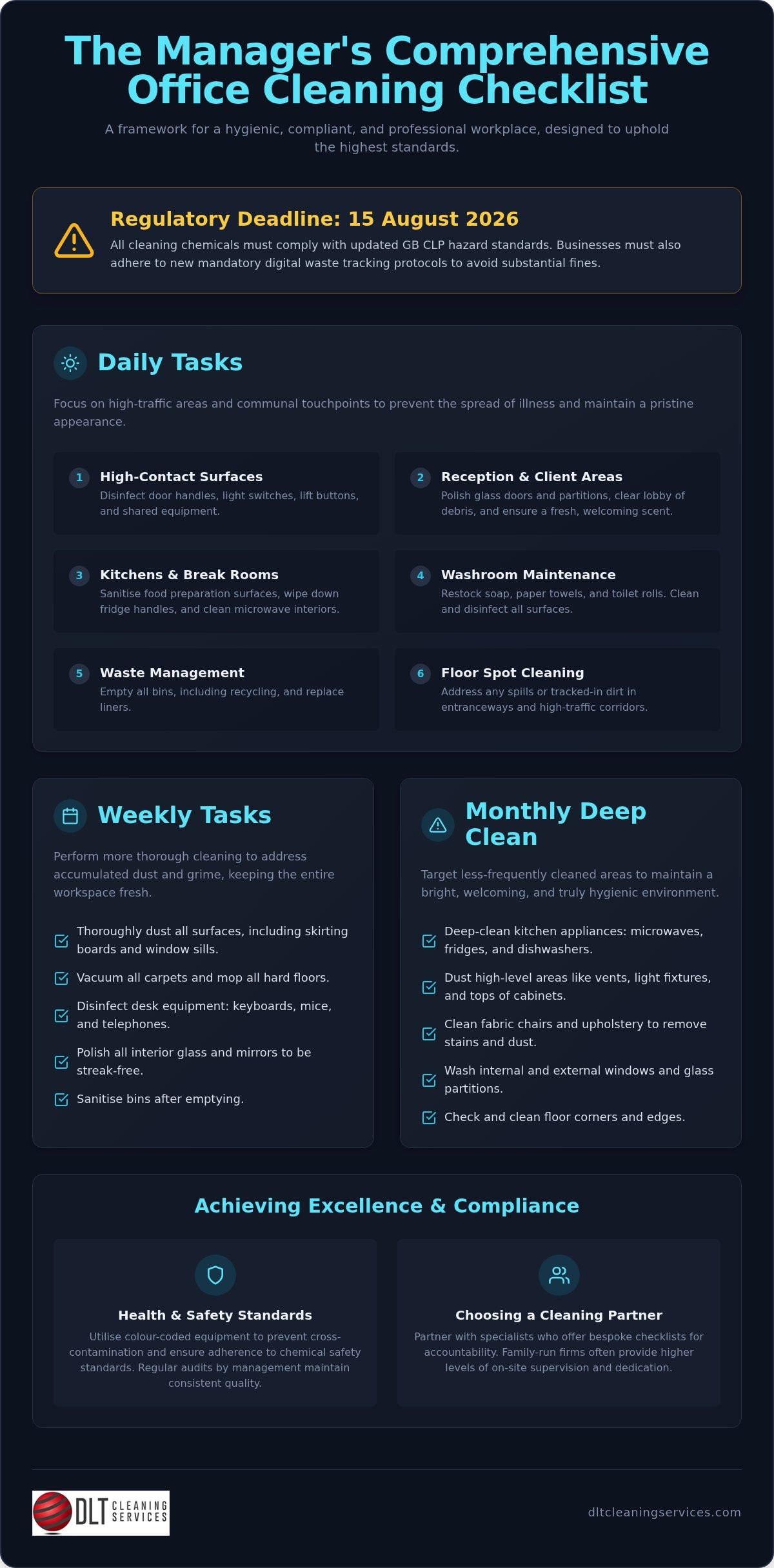
By 15 August 2026, every cleaning chemical in your cupboard must meet the updated GB CLP hazard standards or your business could face substantial fines and litigation. It’s an unsettling prospect for any manager already battling inconsistent cleaning results and the mounting costs of employee sick days. You recognise that a pristine environment is vital for staff morale, yet finding the time to monitor every bin and keyboard is nearly impossible. We’ve designed this comprehensive office cleaning checklist for managers to remove the guesswork and ensure your workplace remains hygienic, compliant, and professional.
This framework moves beyond simple surface cleaning to address the specific health and safety requirements of 2026, including the new mandatory digital waste tracking protocols. You’ll discover how to organise daily, weekly, and monthly routines that hold your service providers to the highest possible standards whilst reducing your own administrative burden. By implementing these structured tasks, you can foster a healthier office culture and enjoy the peace of mind that comes from a truly well-managed workspace.
Key Takeaways
- Learn how a tailored cleaning routine directly influences employee morale and protects your professional reputation in the South East.
- Implement a comprehensive office cleaning checklist for managers that targets high-traffic touchpoints and desk hygiene to reduce staff absenteeism.
- Understand the critical role of colour-coded equipment and health and safety standards in keeping your business compliant with 2026 regulations.
- Identify essential monthly tasks, including deep-cleaning kitchen appliances and glass partitions, to maintain a bright and welcoming workplace.
- Discover why partnering with a family-run specialist ensures higher levels of accountability and on-site supervision for your office.
Why a Bespoke Office Cleaning Checklist is Essential for Surrey Managers
A clean office isn’t just a luxury; it’s a strategic asset for any business aiming for excellence. In the competitive business hubs of Surrey and the South East, productivity is closely tied to the physical environment. A cluttered or dusty workspace creates subtle distractions that erode focus and lower morale. By using a structured office cleaning checklist for managers, you ensure that every square inch of your facility supports employee well-being rather than hindering it. High standards in the workplace signal to your team that their health and comfort are priorities, which naturally fosters a more dedicated and energetic culture.
Your office is a physical manifestation of your brand. When clients visit your Guildford headquarters, they judge your attention to detail by the state of your boardroom and reception area. Beyond aesthetics, the modern workplace requires a shift from a mere “surface clean” to being “hygienically safe”. Adhering to Commercial cleaning industry standards ensures that invisible pathogens are managed alongside visible dust. This level of thoroughness protects your reputation and reduces staff absenteeism by breaking the chain of infection. It’s about creating a space where people feel safe to collaborate and innovate amongst their peers.
A bespoke checklist serves as a vital bridge between your expectations and the service delivered. It transforms vague requests into measurable outcomes. Without this document, monitoring performance becomes subjective, leading to potential friction with service providers. A detailed list allows you to track task completion with precision, ensuring that the investment you make in hygiene services yields tangible results every single day. It provides a clear roadmap for accountability, making it much easier to identify and rectify any lapses before they become persistent problems.
The Manager’s Role in Maintaining Standards
Delegation often fails when there’s no clear framework for success. Without a specific office cleaning checklist for managers, it’s easy for standards to slip over time. This often results in “cleaning blindness”, where you stop noticing the smudge on the door or the dust on the skirting boards. Your clients, however, will notice immediately. Regular audits based on a structured list ensure that both internal staff and professional partners remain aligned with your high standards. It’s about taking ownership of the environment so your team can focus entirely on their own operations whilst you maintain peace of mind.
First Impressions: The Reception and Client Areas
The entrance to your business sets the tone for every interaction that follows. It’s the first point of contact for visitors and must remain pristine throughout the working day. Specific tasks, such as polishing glass partitions to remove fingerprints and ensuring lobbies are free of tracked-in debris, are essential. Even the colour and scent of a space influences visitor behaviour; a fresh, neutral aroma suggests a well-managed and professional operation. Consistent attention to these details ensures your first impression reflects the quality of your work.
The Daily Office Cleaning Checklist: High-Traffic Areas and Touchpoints
Daily routines form the backbone of a healthy workplace. Whilst weekly deep cleans are vital, it’s the daily attention to detail that prevents the spread of illness amongst your team. A structured routine ensures that these high-contact zones receive the attention they deserve, maintaining a professional standard that reflects your business values. An effective office cleaning checklist for managers should prioritise areas where bacteria accumulate fastest. This includes communal touchpoints such as door handles, lift buttons, and light switches. These surfaces are touched hundreds of times a day, making them primary vectors for cross-contamination.
To maintain a high standard, managers should refer to a comprehensive office cleaning checklist to ensure no critical area is overlooked. Kitchens and breakout rooms require particular vigilance to manage odours and food safety. Surfaces where food is prepared must be sanitised with food-safe chemicals, and fridge handles should be wiped down nightly. Equally, washrooms need constant monitoring; ensuring that soap dispensers are full and paper towels are restocked is a basic yet essential requirement for maintaining staff dignity and hygiene.
Workstation and Desk Hygiene
Keyboards, mice, and telephone handsets often harbour more bacteria than a toilet seat. We recommend implementing a “clear desk policy” to allow cleaners to sanitise the entire surface area of each workstation every evening. Using specialised microfibre cloths and appropriate sanitising agents ensures that sensitive electronics aren’t damaged whilst effectively removing grime and skin oils. Emptying individual bins daily and replacing liners is also crucial to prevent pest issues and maintain a fresh atmosphere throughout the office floors.
Communal Spaces and Floors
High-traffic carpeted areas in Surrey offices take a heavy beating, especially during the wetter months when mud and grit are tracked inside. Daily vacuuming is necessary to remove allergens and dust that can affect air quality and trigger respiratory issues. For hard floors, mopping with appropriate anti-slip solutions is a safety requirement to prevent accidents in lobbies and corridors. Dusting should extend beyond just the eye-level surfaces to include chair legs, cabinets, and skirting boards, where dust often settles unnoticed. If you feel your current provider is missing these finer details, it might be time to consider professional hygiene services that prioritise supervised consistency.
Weekly and Monthly Periodic Tasks to Maintain Your Workspace
While daily routines manage immediate hygiene, periodic maintenance preserves the integrity of your office assets and ensures a deep level of cleanliness. A robust office cleaning checklist for managers must look beyond the obvious surfaces to address areas where grime accumulates slowly over time. Deep-cleaning kitchen appliances, such as microwaves and fridge interiors, prevents the buildup of bacteria and unpleasant odours that can affect the entire breakout area. Similarly, descaling kettles ensures they remain efficient and hygienic for staff use, reflecting a high level of care for employee well-being.
Internal glass partitions and mirrors are essential for a modern, open-plan feel, yet they quickly collect smudges and dust. Weekly polishing maintains that bright, professional atmosphere that visiting clients expect. High areas often go ignored; high shelving, picture frames, and air vents accumulate dust that eventually recirculates into the air. Cleaning these vents is a technical necessity for maintaining indoor air quality and reducing respiratory irritants amongst your team. Regular attention to upholstery and soft furnishings is equally vital, as it removes allergens and extends the lifespan of your office furniture.
The Weekly Rotation: Deep-Diving into Detail
Every week, the focus should shift to tasks that don’t require daily attention but are critical for long-term standards. Descaling taps and sanitising sinks in washrooms and kitchens prevents limescale buildup, which can harbour pathogens if left unchecked. Polishing hard floors helps maintain their durability and aesthetic appeal, particularly in high-traffic corridors. Spot-cleaning walls to remove scuff marks ensures the office doesn’t begin to look tired or neglected, maintaining a crisp and professional appearance for everyone who enters the building.
Monthly and Quarterly Strategic Maintenance
Longer-term maintenance involves tasks that require more time or specialised knowledge. Detailed dusting of light fixtures and ceiling fans is a monthly priority, as dust accumulation can dim the lighting and impact the overall mood of the workplace. Deep-cleaning of carpets and upholstery is a quarterly essential. This process removes embedded dirt and allergens that standard vacuuming cannot reach, significantly improving the environment. Finally, use your office cleaning checklist for managers to review janitorial supply levels. Ensuring a consistent availability of essentials prevents service interruptions and maintains the rhythm of your cleaning schedule.
Ensuring Health and Safety Compliance: The Manager’s Hygiene Checklist
Compliance isn’t just about ticking boxes; it’s about legal protection and employee welfare. In the competitive corporate hubs of the South East, managers face strict expectations regarding workplace safety. A robust office cleaning checklist for managers must include a dedicated section for health and safety compliant cleaning. This ensures your facility meets the latest GB CLP hazard standards, which became mandatory on 15 August 2026. Non-compliance isn’t just a hygiene risk. It’s a litigation risk that can damage your brand’s stability and reputation.
One of the most effective ways to prevent cross-contamination is through a strict colour-coded equipment system. Red is typically for washrooms, blue for general dusting, and green for kitchens. This visual system removes human error and ensures that a cloth used in a cubicle never touches a boardroom table. Behind the scenes, your cleaning cupboard must adhere to COSHH (Control of Substances Hazardous to Health) regulations. This means every substance has a corresponding safety data sheet and is stored securely. Training staff in safe chemical handling is a foundational requirement, ensuring they don’t just clean, but do so without risking their own health or yours.
Professional Hygiene Services and Supplies
Managing janitorial supplies is a common headache for busy managers. Your office cleaning checklist for managers should account for the regular restocking of anti-bacterial soaps and the maintenance of feminine hygiene units. Under UK law, businesses must provide a safe and compliant way to dispose of sanitary waste. Choosing the right products matters too. We’re seeing a shift towards eco-friendly supplies that provide high-level disinfection without harsh toxins. A robust bathroom deep-clean schedule is the only way to prevent the buildup of bacteria that standard daily wipes might miss.
On-Site Supervision and H&S Audits
A checklist is only a piece of paper without active oversight. This is why supervised office cleaning is the only way to truly guarantee H&S compliance. Monthly hygiene audits allow you to identify potential risks, like a blocked vent or a leaking soap dispenser, before they escalate into larger issues. Documenting these checks in a digital or physical cleaning log is essential. These logs serve as your evidence of due diligence during official inspections. If you’re finding it difficult to keep up with these regulatory demands, consider a partner that provides professional hygiene services to handle the heavy lifting for you.
How to Choose and Manage Your Surrey Cleaning Partner
Selecting a cleaning partner in the South East requires more than just comparing quotes. It involves finding a team that understands the specific demands of your sector and location. Local expertise in Surrey, Hampshire, and Berkshire is invaluable because it ensures your provider is familiar with regional standards and can respond promptly to your needs. A partner based in Guildford, for example, is “on hand” to address issues as they arise. When you integrate your office cleaning checklist for managers into a formal Service Level Agreement (SLA), you create a foundation of transparency and high expectations from day one.
The most significant advantage of a dedicated provider is on-site supervision. This level of oversight removes the daily stress of monitoring bins or checking soap dispensers yourself. A supervised team takes ownership of the environment, allowing you to focus on your core operations whilst knowing that the health and safety of your staff is in expert hands. This proactive approach ensures that standards don’t slip over time, providing the stability and consistency your business deserves.
The Reliability of Local, Family-Run Expertise
There’s a unique level of accountability that comes with a family run office cleaning Surrey company. Unlike large national chains where you might be just another contract number, a family-run business relies on its reputation for personal investment and reliability. This translates to higher standards of care and a more amicable, supportive relationship with your management team. These tailored office cleaning services are designed to adapt to your specific business size, whether you’re a small local firm or a larger corporate office.
Next Steps: Implementing Your 2026 Checklist
To get started, we recommend organising a professional walkthrough of your premises. This allows your partner to customise the office cleaning checklist for managers to your specific layout and high-traffic zones. During this process, you should establish a direct communication channel for feedback and special requests. It’s also wise to book an initial deep-clean to establish a high baseline of hygiene for your new routine. Setting these foundations early ensures that your transition to a new provider is seamless and that your workspace remains a centre of excellence throughout 2026 and beyond.
Elevating Your Workplace Standards for 2026
Maintaining a pristine environment is a continuous commitment that requires both structure and professional oversight. By implementing a robust office cleaning checklist for managers, you’ve taken the first step towards ensuring your facility is not just aesthetically pleasing, but also hygienically safe and fully compliant with 2026 regulations. We’ve explored how daily vigilance in high-traffic areas, combined with strategic monthly maintenance, creates an environment where your team can truly thrive.
Since 1999, our family-run company has been dedicated to providing this peace of mind to businesses across Surrey, Hampshire, and Berkshire. We believe that true excellence is only achieved through dedicated on-site supervision, ensuring that every task on your checklist is completed to the highest possible standard. When you choose a partner with local expertise and a personal investment in your success, you regain the time to focus on your own operations.
Request a tailored office cleaning quote for your Surrey business today and let us help you transform your workplace into a centre of productivity and health. We look forward to supporting your business goals with the reliable, high-quality service you deserve.
Frequently Asked Questions
How often should a professional office cleaning checklist be updated?
You should update your checklist at least quarterly or whenever your office layout and occupancy levels change significantly. It’s vital to ensure your office cleaning checklist for managers accounts for the latest 2026 health and safety standards, such as the GB CLP hazard updates. Regular reviews allow you to adapt to seasonal needs, such as increased floor maintenance during winter or more frequent sanitisation during flu season, keeping your workspace consistently safe.
Can we use the same checklist for small offices and large national chains?
Whilst the core hygiene principles remain the same, a one-size-fits-all approach rarely works for different business sizes. A large national chain requires complex scheduling for multiple zones, whereas a small Guildford office might focus more on high-traffic communal areas. We recommend a bespoke office cleaning checklist for managers that reflects your specific square footage, staff numbers, and the frequency of client visits to ensure every task is relevant and efficient.
What is the most commonly missed task in a standard office cleaning routine?
High-level dusting and vent cleaning are the most frequently overlooked tasks in standard routines. Many providers focus solely on visible surfaces at eye level, leaving dust to accumulate on light fixtures, ceiling fans, and air conditioning vents. This neglect can lead to poor indoor air quality and trigger allergies amongst your team. A thorough routine must include these less accessible areas to maintain a truly healthy and professional working environment for all employees.
How does on-site supervision improve the effectiveness of a cleaning checklist?
On-site supervision provides a layer of accountability that a standalone document cannot offer. A dedicated supervisor ensures that every task on your checklist is actually completed to the required standard before the team leaves the premises. This proactive oversight identifies missed spots in real time, reducing the burden on you to monitor the work yourself. It’s the most effective way to guarantee consistent results and long-term hygiene compliance for your workplace.
What janitorial supplies should a manager always have in stock?
Managers should ensure they always have a surplus of essential hygiene products, including anti-bacterial soaps, paper towels, and COSHH-compliant cleaning agents. It’s equally important to stock colour-coded microfibre cloths and appropriate liners for various waste streams. Maintaining these levels prevents service interruptions and ensures your cleaning team has the right tools to follow the established protocols effectively. Regular audits of your cupboard help avoid last-minute shortages that could compromise office hygiene.
Is a daily clean necessary for offices with remote-working staff?
A daily clean remains essential even with a hybrid workforce to manage the hygiene of shared touchpoints and communal areas. Dust and allergens accumulate regardless of occupancy, and shared desks require thorough sanitisation between different users to prevent the spread of germs. Consistent daily attention ensures that when staff do come into the office, they enter a pristine, professional environment that supports their productivity and reflects your commitment to their well-being.
How do I know if my cleaning company is following health and safety regulations?
You can verify compliance by requesting to see their updated COSHH safety data sheets and training logs for staff. A reputable provider will document every clean and provide regular audit reports that highlight their adherence to the latest 2026 safety standards. If your partner is hesitant to share these documents or can’t explain their colour-coding system, it’s a significant red flag that they may not be following essential health and safety regulations correctly.
What should I do if my current cleaning standards are falling behind the checklist?
Your first step should be to conduct a formal walkthrough with your provider to identify exactly where the service is failing. Use your checklist as an objective tool to highlight missed tasks and set a clear timeline for improvement. If standards don’t recover after a direct conversation, it may be time to seek a more reliable partner. Look for a family-run specialist that offers supervised services to ensure your high standards are permanently restored.