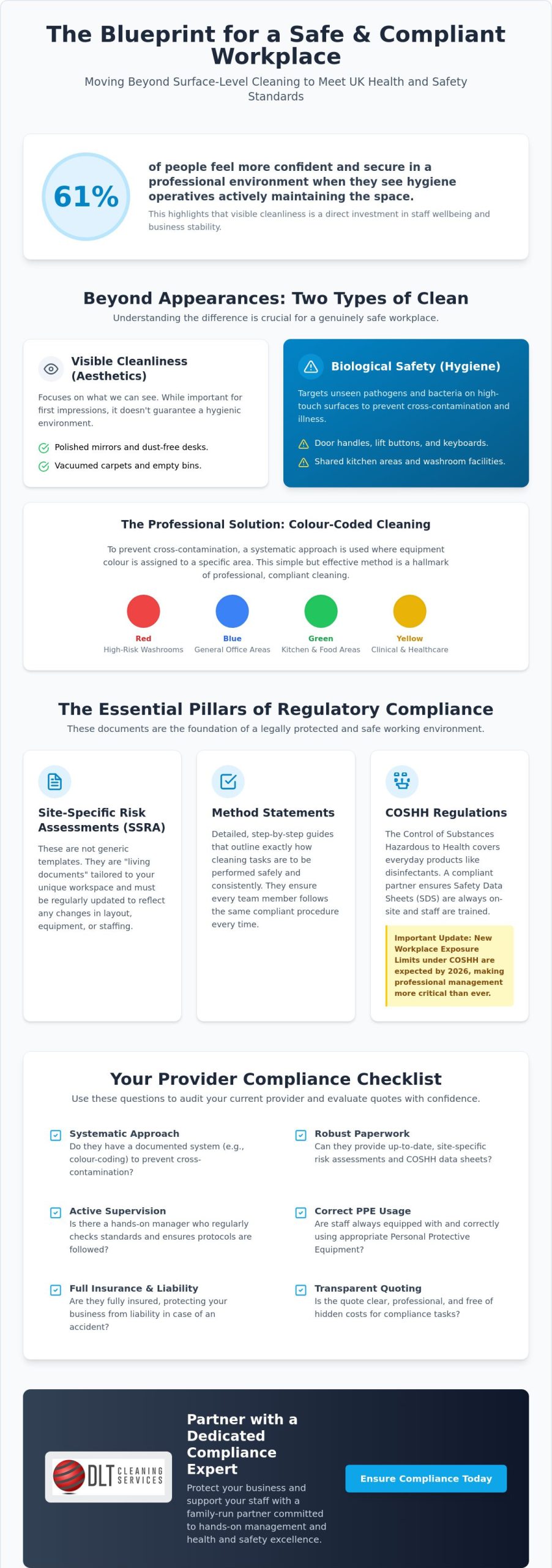
Did you know that 61% of people feel more confident in a professional environment when they see hygiene operatives actively maintaining the space? This statistic highlights that cleanliness is no longer a background task; it is a visible commitment to the wellbeing of everyone who walks through your doors. For many managers, the real challenge lies in ensuring that every routine task contributes to health and safety compliant cleaning that meets rigorous UK standards.
We understand the pressure of keeping up with complex regulations, especially with the 2026 updates to Workplace Exposure Limits under COSHH. It is natural to feel a sense of unease regarding risk assessment paperwork or the potential liability if an unsupervised team misses a critical safety step. You deserve a workplace that supports your staff rather than creating additional administrative hurdles.
This guide will show you how to align your office maintenance with current legal requirements to protect your business and reduce employee sick days. We will explore how to manage hazardous substances effectively and why a dedicated, hands-on partner is the key to maintaining a reliable and safe professional environment.
Key Takeaways
- Learn how to move beyond surface-level aesthetics to implement a systematic approach that addresses cross-contamination and legal requirements.
- Discover the essential components of health and safety compliant cleaning, including how to manage Site-Specific Risk Assessments and COSHH regulations effectively.
- Understand why active on-site supervision is vital for ensuring your cleaning team follows safety protocols and uses PPE correctly every day.
- Gain a practical checklist to help you audit your current provider’s standards and evaluate professional quotes with confidence.
- See how a dedicated, family-run partner can provide the hands-on management and local expertise required to keep your business fully compliant.
Understanding Health and Safety Compliant Cleaning in the Modern Office
In a professional setting, the term “clean” is often used subjectively. For some, it means a desk free of dust; for others, it means a bin that has been emptied. However, health and safety compliant cleaning is a systematic, documented approach to hygiene that strictly follows UK legislation. It is an operational discipline that ensures your workplace isn’t just tidy, but fundamentally safe for every occupant. This standard is rooted in the Health and Safety at Work Act 1974, which mandates that employers provide a working environment that is, so far as is reasonably practicable, safe and without risks to health.
The landscape of occupational safety and health has evolved significantly. By 2026, employee expectations regarding workplace hygiene have reached a new peak. Staff are no longer satisfied with a cursory wipe-down of surfaces; they want the peace of mind that comes from knowing their office is managed with clinical precision. Meeting these expectations is vital for business stability. When your team feels protected, they are more productive and less likely to take unplanned sick leave, directly supporting your bottom line.
Visible Cleanliness vs. Biological Safety
It’s a common misconception that a “visibly clean” office is a healthy one. Aesthetics focus on what we can see, such as polished mirrors or vacuumed carpets. Biological safety, however, targets what we cannot see: pathogens and bacteria that thrive on high-touch points. Door handles, lift buttons, and shared keyboards are hotspots for cross-contamination. To manage this, we utilise colour-coded cleaning systems. By using specific colours for cloths and mops in different zones, such as red for washrooms and blue for general office areas, we eliminate the risk of spreading germs from one part of the building to another. This methodical approach ensures that whilst a room looks pristine, it is also hygienically sound.
The Legal Responsibility of the Office Manager
As an office manager, you hold a significant degree of accountability for the welfare of your staff. This responsibility extends to the actions of your contractors. Hiring uninsured or non-compliant “cash-in-hand” cleaners might seem like a cost-saving measure, but it exposes your business to immense legal risk. If an accident occurs or if hygiene standards fall below legal requirements, the Health and Safety Executive (HSE) can conduct inspections that lead to heavy fines or legal action. Choosing a partner that prioritises health and safety compliant cleaning ensures that every risk assessment is in place and every chemical is handled correctly, protecting you from liability and ensuring your business remains fully compliant with UK law.
The Essential Pillars of Regulatory Compliance: COSHH and Risk Assessments
Compliance is built on a foundation of robust documentation that reflects the reality of your specific workspace. For any manager, maintaining health and safety compliant cleaning involves more than just a general policy; it requires Site-Specific Risk Assessments (SSRA). Every office layout presents unique challenges, from the placement of floor sockets to the ventilation in the kitchen. Filing these documents away at the start of a contract is a common mistake. To remain effective, these must be “living” documents, updated regularly to account for changes in office layout, staff numbers, or new cleaning equipment.
Alongside these assessments, we utilise Method Statements to outline exactly how tasks are performed. These documents provide clarity and consistency, ensuring that every member of the cleaning team understands the safe systems of work required for your premises. When combined, these form a comprehensive safety package that protects your employees and your business from the risks of inconsistent standards. A one-size-fits-all approach rarely accounts for the specific hazards of your unique environment, which is why investing in tailored office cleaning services ensures your documentation and procedures genuinely reflect the needs of your workspace.
Navigating COSHH in the Workplace
The Control of Substances Hazardous to Health (COSHH) regulations are central to safe operations. In a standard office kit, hazardous substances aren’t just industrial acids; they include everyday floor cleaners, disinfectants, and even some air fresheners. Under the updated 2026 Workplace Exposure Limits, it’s vital to ensure your team is not overexposed to certain chemicals. You must have Safety Data Sheets (SDS) available on-site for every product used. These sheets provide critical information on first aid and spill control. Proper storage is equally important. All agents must be kept in original, labelled containers in a secure area to prevent accidental exposure or mixing, which can create dangerous fumes. Understanding these cleaning industry hazards is the first step toward a safer environment.
Drafting Effective Risk Assessments
A high-quality risk assessment identifies specific dangers such as wet floors, trailing vacuum cables, or the manual handling of heavy waste bins. We use a risk matrix to prioritise these hazards, calculating the likelihood of an incident against the severity of potential harm. This allows us to implement control measures, such as using “wet floor” signage or scheduling heavy tasks when the office is at its quietest. A Method Statement is a step-by-step guide to performing a task without injury. These combined documents provide a clear roadmap for our staff, ensuring that high standards are maintained without compromising safety. If you are concerned that your current documentation is out of date, it may be time to consult with a professional provider to ensure your office remains fully protected.
Beyond the Paperwork: Why On-Site Supervision Ensures Real-World Safety
While risk assessments and COSHH sheets provide the legal framework for your operations, they are only effective if they are followed on the ground. Compliance isn’t a static document; it’s a daily behaviour that must be cultivated. This is where active on-site management becomes the most critical component of health and safety compliant cleaning. Without a supervisor to monitor the team, protocols can easily slip as staff focus on finishing tasks quickly rather than safely, potentially leaving your business exposed to liability.
Supervisors act as the eyes and ears of the office manager, ensuring that Personal Protective Equipment (PPE), such as nitrile gloves or eye protection, is used correctly and replaced when damaged. They also verify that the team employs safe cleaning methods, such as using the correct dilution ratios for chemicals to avoid respiratory irritation or damage to office surfaces. This level of oversight is a core part of supervised office cleaning. It provides a layer of accountability that national agencies often struggle to match, as it places a senior professional directly at the point of service delivery.
The Role of the Dedicated Supervisor
A dedicated supervisor conducts daily audits to ensure every task meets the agreed standard. This oversight is vital for combating “complacency risk,” where long-term staff might begin to cut corners on safety steps as they become overly familiar with the routine. By maintaining a constant, hands-on presence, supervisors help your business maintain a clean office environment that is both hygienic and legally sound. They are also trained to spot non-cleaning hazards, such as faulty electrical sockets, frayed carpets, or plumbing leaks, reporting them to you immediately before they escalate into accidents or costly repairs.
Training and Competency Standards
Real health and safety compliant cleaning requires a commitment to ongoing education. Initial inductions are important, but staff need regular refreshers on new equipment and updated chemical safety data. These training records serve as a vital legal defence for your business, proving that you have taken all reasonable steps to ensure worker competency in the event of an inspection. For more complex tasks, such as commercial deep cleaning in Hampshire, we provide specialised training that covers high-level disinfection and the use of advanced machinery, ensuring every job is completed without incident or disruption to your staff.
How to Evaluate Your Cleaning Provider’s Compliance Standards
Selecting a cleaning partner is a significant operational decision that directly impacts your liability profile. You must look beyond the initial visual appeal of a proposal to ensure a provider can deliver health and safety compliant cleaning every day. A professional partner should be transparent about their processes and willing to provide evidence of their standards during the tender process. This transparency builds the trust necessary for a long-term, stable relationship where you can focus on your core business functions.
Insurance is a non-negotiable element of this evaluation. You should verify that a prospective company holds adequate Public and Employers’ Liability Insurance. These policies protect your business if a cleaner is injured on your premises or if their actions cause damage to your property. When you speak to their existing clients, focus your questions on their safety behaviour rather than just the “shininess” of the office. Ask if they have ever seen a cleaner working without proper wet-floor signage or if the team has ever failed to report a potential hazard like a frayed cable.
The Compliance Audit Checklist
- Written Health and Safety Policy: Does the provider have a formal document? This is a legal requirement for any business with five or more employees and demonstrates a structured approach to risk.
- PAT Testing Records: Are the records for vacuum cleaners and floor polishers up to date? All electrical equipment must be tested annually to prevent electrical fires or shocks in your office.
- Accident Reporting: A provider committed to health and safety compliant cleaning will have a clear system for documenting “near misses” and incidents. This ensures you are kept informed of any risks on your site.
Analysing the Cleaning Quote
An unusually low quote is often a red flag. It typically suggests that the provider is cutting costs on essential areas like staff training, high-quality PPE, or comprehensive insurance. In contrast, a family-run enterprise often provides better value because the owners have a personal stake in maintaining their reputation and compliance standards. They are more likely to be hands-on and accountable for the results. Always ask who will be supervising the team when you are not there. If the answer is vague, the standards will likely be inconsistent, leaving your business vulnerable to compliance gaps. If you want to ensure your workspace meets the highest regulatory standards, contact us for a comprehensive compliance review.
DLT Cleaning Services: Decades of Dedicated Health and Safety Excellence
DLT Cleaning Services Ltd is a family-run business that has been providing expert hygiene solutions across Surrey, Hampshire, and Berkshire since 1999. Whilst larger national chains often struggle with distant management structures, we operate as a “Reliable Local Expert.” This means our leadership team is personally involved in the quality of your service. We believe that health and safety compliant cleaning is only possible through this hands-on approach. We take full ownership of your environment, allowing you to focus on your daily operations with complete peace of mind.
Our commitment to dedicated on-site supervision remains the core of our strategy. We don’t just send a team and hope for the best. We ensure that every operative is supported by a supervisor who understands the nuances of your specific contract. This level of accountability has been our hallmark for over two decades, building trust with businesses that value consistency and high standards above all else. It is this dedication that ensures your workplace remains safe, healthy, and fully compliant with all UK regulations.
Our Local Commitment to Surrey and Beyond
Based in Guildford, our local team understands the specific needs of businesses throughout the Home Counties. Our 25-year history provides a foundation of stability that our clients rely on year after year. We provide office cleaning in Surrey that scales with your business, whether you manage a boutique studio or a multi-storey corporate centre. Being local means we are always on hand to respond to your needs, providing a level of agility that distant competitors simply cannot offer.
A Personalised Approach to Hygiene
We treat each office as a unique environment with its own set of safety requirements and operational challenges. Our team is amicable, professional, and trained to work within your specific culture. We don’t just clean; we manage the hygiene of your space to ensure it remains health and safety compliant cleaning at all times. This personalised approach ensures that hazards are identified and mitigated before they become problems. If you are looking for a partner that prioritises your staff’s health as much as you do, we are ready to help. Contact DLT Cleaning Services for a compliant cleaning consultation today to discuss your requirements.
Securing Your Workspace for the Future
Maintaining a safe office environment requires more than just surface-level aesthetics; it demands rigorous adherence to COSHH standards and active on-site supervision to prevent complacency. By shifting your focus from simple tidiness to documented biological safety, you protect both your team’s wellbeing and your company’s legal standing. Implementing a strategy for health and safety compliant cleaning is a vital investment in your business’s long-term stability and employee productivity.
Since 1999, DLT Cleaning Services has acted as a dedicated partner for businesses across Surrey, Hampshire, and Berkshire. We provide the hands-on management and specialised expertise that larger national chains often lack, ensuring every contract benefits from dedicated on-site supervision. We take ownership of your environment so you can focus entirely on your own operations with confidence. Our amicable team is ready to help you navigate the complexities of modern workplace standards whilst maintaining the highest levels of hygiene.
Ensure your workplace is safe and compliant—request a professional office cleaning quote from DLT today. We look forward to helping you create a healthier, more productive workspace for your team.
Frequently Asked Questions
What is health and safety compliant cleaning?
Health and safety compliant cleaning is a structured hygiene process that ensures all tasks meet legal UK standards, such as those set by the Health and Safety Executive (HSE). It involves documented procedures, the use of approved chemicals, and adherence to safe working practices. This approach goes beyond surface aesthetics to ensure the environment is biologically safe for all employees and visitors.
Is a cleaning company responsible for their own health and safety?
Cleaning companies are legally responsible for their staff’s safety, but you share a “duty of care” as the site occupier. You must ensure that the contractors you hire are competent and that your premises don’t pose hidden risks to them. It’s a collaborative effort where both parties must communicate to maintain a safe working environment and avoid potential legal complications.
What documents should my commercial cleaners provide?
Your cleaning provider should supply Site-Specific Risk Assessments, Method Statements (often called RAMS), and COSHH assessments for all chemicals. They must also provide proof of Public and Employers’ Liability Insurance. These documents prove that the team is performing health and safety compliant cleaning and that they have considered the specific hazards of your unique office layout.
How often should a health and safety risk assessment be updated?
You should update risk assessments at least once a year or whenever a significant change occurs in your office. This includes moving furniture, installing new equipment, or changing the cleaning chemicals used. Regular reviews ensure that the safety measures in place remain relevant and effective against current workplace hazards, protecting your business from unforeseen liabilities.
Does my office need a COSHH register for cleaning supplies?
Yes, any workplace using or storing hazardous cleaning chemicals must maintain a COSHH register. This register should include a list of all substances and their corresponding Safety Data Sheets (SDS). It ensures that your staff and the cleaning team know how to handle chemicals safely and what to do if an accidental spill or exposure occurs.
Can I be held liable for a cleaners accident in my office?
You can be held liable if an accident is caused by a hazard under your control, such as a faulty lift or a trip hazard you failed to signpost. Whilst the cleaning company is responsible for their own work practices, your “duty of care” as a manager means you must provide a safe site for them to work in.
What is the difference between a risk assessment and a method statement?
A risk assessment identifies potential hazards and evaluates the level of risk they pose to workers. A method statement is a separate document that provides a step-by-step guide on how to perform a specific task safely. Together, they ensure that every job is planned with safety in mind and executed according to a proven, low-risk sequence.
Why is on-site supervision important for health and safety?
On-site supervision is vital because it ensures that safety protocols are followed in practice, not just on paper. Supervisors monitor staff behaviour, check that PPE is being worn correctly, and identify new hazards like leaks or faulty sockets. This active management is a core part of health and safety compliant cleaning, as it prevents the complacency that often leads to accidents.
73 thoughts on “Health and Safety Compliant Cleaning: A Manager’s Guide to Workplace Standards”