Why does your office often still look lacklustre on a Monday morning, even though you’re paying a premium for a professional service? It’s a common frustration for many facility managers in Surrey and Hampshire who find themselves stuck with inconsistent results and a complete lack of communication. With the global cleaning market projected to reach over $481 billion by 2026, the industry is more crowded than ever, yet many providers still rely on vague terms. If you’re constantly chasing supervisors or pointing out missed bins, the problem usually lies within a weak office cleaning service level agreement. Without precise metrics and clear accountability, you’re left with a contract that protects the vendor rather than your workplace hygiene.
We understand that you need a reliable partnership that doesn’t require constant micro-management. This guide provides the clarity you’ve been looking for, helping you master the complexities of cleaning contracts to ensure a healthy, spotless environment for your staff. You’ll learn how to establish a clear framework for measuring success and maintaining strict compliance with UK health and safety regulations. We’ll show you how a robust agreement, paired with dedicated on-site supervision, can finally give you the peace of mind to focus on your own operations while a trusted partner takes full ownership of your environment.
Key Takeaways
- Learn why moving from a general contract to a performance-based agreement is essential for maintaining consistent hygiene standards in your workplace.
- Discover how to define a room-by-room scope of works that removes ambiguity and ensures every corner of your office receives the attention it deserves.
- Master the use of KPIs and regular site audits within your office cleaning service level agreement to guarantee compliance with UK health and safety regulations.
- Identify common pitfalls, such as vague frequencies and hidden costs, that often prevent businesses in Surrey and Hampshire from receiving true value for money.
- Understand the critical role of dedicated on-site supervision in bridging the gap between a written contract and a truly spotless office environment.
What is an Office Cleaning Service Level Agreement (SLA)?
An Service-level agreement (SLA) isn’t just a static piece of paper tucked away in a filing cabinet. It’s a dynamic, living document that defines the heartbeat of your facility’s hygiene. Whilst a standard cleaning contract might simply state that a provider will “clean the office”, a professional office cleaning service level agreement provides the granular detail required to hold that provider accountable. It sets the baseline for excellence, ensuring that both the client and the service provider share a single, unified vision of what “clean” actually looks like.
This document acts as the foundation of a healthy workplace. When employees walk into a space that smells fresh and looks immaculate, productivity naturally rises. Conversely, a lack of clarity in service standards leads to friction. By establishing a clear “problem-solution” framework, the SLA removes the need for awkward confrontations. If a standard isn’t met, the document provides the roadmap for how the issue will be resolved, ensuring a professional and amicable partnership.
The Difference Between Input-Based and Output-Based SLAs
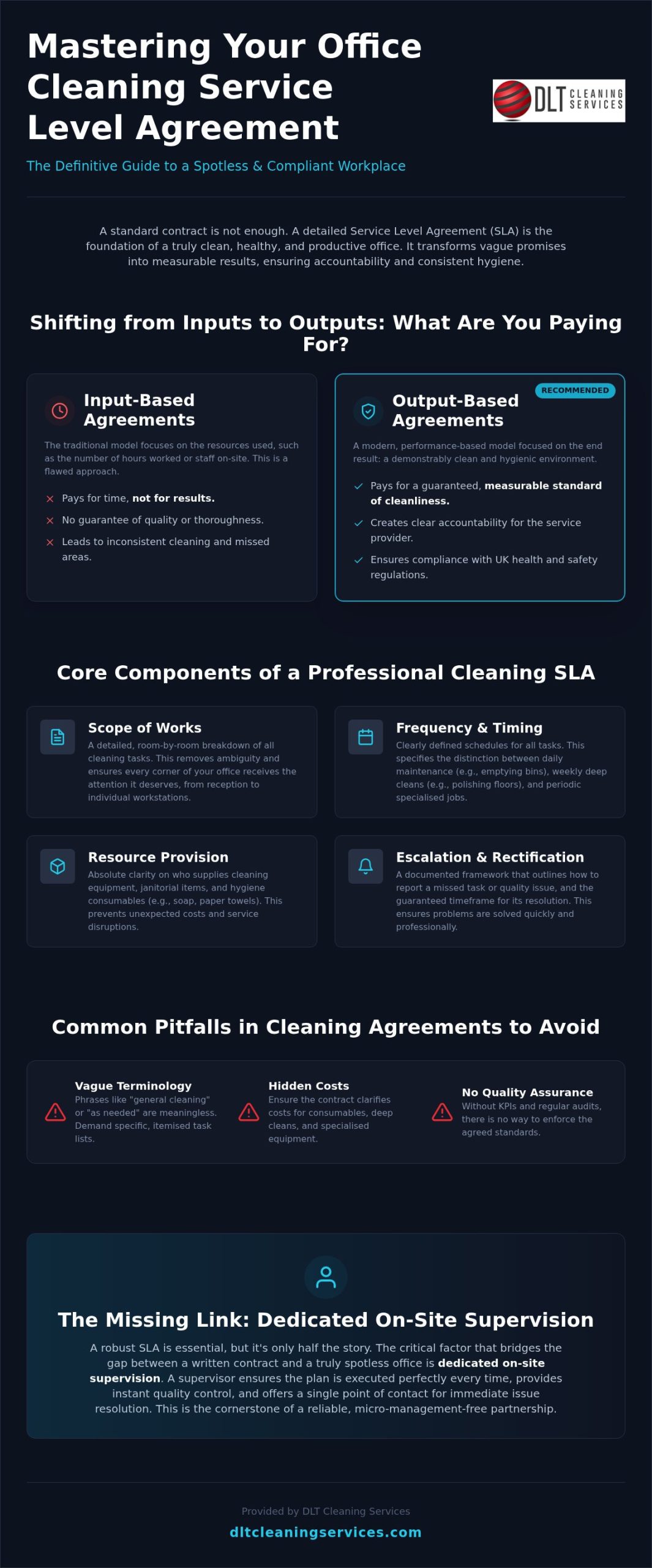
Traditional agreements often focus on “inputs”. This means you’re paying for a specific number of staff members to be on-site for a set number of hours. The problem? It doesn’t guarantee a result. If a cleaner spends four hours on-site but ignores the high-touch surfaces in the boardroom, the input requirement is met, but the hygiene standard is not.
Output-based agreements shift the focus to the visible result. These documents specify exactly what the environment should look like after a shift. For professional offices, we recommend a hybrid approach. This model ensures you have the dedicated presence of staff whilst maintaining a strict focus on cleanliness levels. It’s about combining the reliability of a family-run team with the precision of modern performance metrics.
Why Your Guildford Business Cannot Afford to Skip the SLA
Vague expectations are the enemy of a productive workplace. In a competitive business hub like Guildford, your office’s appearance is a direct reflection of your brand’s reputation. A poorly managed environment doesn’t just look bad; it can lead to increased staff sickness and lower morale. It tells your clients and your team that details don’t matter.
There are also significant legal and safety implications to consider. Meeting UK workplace health and safety standards isn’t optional. Without a robust office cleaning service level agreement, it’s difficult to prove that your facility is compliant with hygiene regulations. A structured agreement acts as a vital tool for corporate stability and hygiene excellence, protecting your business from the risks of inconsistent standards.
Key Components Every Professional Office Cleaning SLA Must Include
To move beyond basic expectations, your office cleaning service level agreement needs to be built on specificity. It’s the difference between a tidy desk and a truly hygienic environment. A robust agreement acts as a safeguard, ensuring that every square foot of your Surrey or Hampshire office is maintained to a professional standard. When these components are clearly defined, it removes the guesswork and builds a foundation of trust between you and your service provider.
Every comprehensive SLA should address several core pillars of service delivery. These include:
- Scope of Works: A granular, room-by-room breakdown of exactly what needs to be cleaned, from the reception area to individual workstations.
- Frequency and Timing: Clear distinctions between daily maintenance, weekly deep cleans, and monthly specialised tasks.
- Resource Provision: Absolute clarity on whether the client or the provider supplies janitorial items, specialised floor buffers, or hygiene consumables.
- Escalation Procedures: A documented “problem-solution” framework that outlines how to report a missed task and the timeframe for its rectification.
Detailed Scope of Works: Beyond the Basics
Communal areas and meeting rooms often require different cleaning intensities compared to quiet back-office zones. Whilst a standard contract might overlook the intricacies of specific floor types, a well-defined scope ensures that delicate surfaces receive the specialised care they require. Many businesses find that tailored office cleaning services are the most effective way to address these nuances. By customising the scope, you can specify frequencies for window cleaning or carpet shampooing that align with your office’s actual usage patterns rather than a generic template.
Hygiene and Janitorial Supply Management
Modern employee health depends on more than just “visible” cleanliness. Your SLA must govern the management of hygiene supplies to ensure your washrooms never run low on essential products. This includes setting benchmarks for bathroom deep cleans that go beyond the surface to prevent the spread of seasonal illnesses. We recommend ensuring the use of professional-grade, eco-friendly cleaning chemicals. These products maintain high hygiene standards whilst supporting your company’s environmental goals. If you’re looking for a partner to take ownership of these details, choosing a reliable local expert ensures that your supply chain and hygiene standards remain consistent and managed without your constant intervention.
Measuring Performance: KPIs and Quality Assurance Audits
An office cleaning service level agreement is only as effective as the mechanisms used to monitor it. Without clear metrics, “cleanliness” remains a subjective opinion rather than a professional standard. To ensure your workspace remains a productive environment, you need a framework that translates vague expectations into measurable data. This process moves the relationship with your cleaning provider from one of guesswork to one of absolute transparency and accountability.
Objective scoring systems are the most effective way to remove bias from the equation. By utilising a simple 1-5 star rating or a percentage-based checklist, both the facility manager and the cleaning supervisor can agree on the state of the office. If a zone falls below a four-star standard, it triggers a clear “problem-solution” response. Central to this is the concept of rectification times. Your SLA should specify exactly how quickly a service failure must be addressed; for instance, a missed bin might require action within two hours, whilst a floor buffing issue might be resolved within twenty-four hours.
Regular site audits are the primary tool for maintaining health and safety compliant cleaning. These inspections ensure that hygiene protocols are being followed to the letter, protecting your staff and keeping your business compliant with UK regulations. When audits are conducted with a “can-do” attitude, they become a collaborative effort to maintain excellence rather than a punitive exercise.
Top 5 KPIs for Office Cleaning Success
Identifying the right Key Performance Indicators (KPIs) allows you to track consistency across your Hampshire or Surrey office. We recommend focusing on these five core metrics:
- Visual Inspection Scores: Consistent tracking of cleanliness across reception, workstations, and washrooms.
- Staff Attendance and Punctuality: Ensuring your dedicated team arrives on time to complete their scheduled tasks.
- Client Feedback Loops: Documented monthly meetings between the cleaning manager and the client to discuss performance.
- Reactive Request Response Time: How quickly the team handles unexpected spills or urgent hygiene needs.
- Supply Management Accuracy: Ensuring washroom consumables are always replenished before they run out.
Organising Effective Quality Audits
The most successful partnerships rely on joint audits. When a facility manager and a cleaning supervisor walk the floor together, they can identify potential issues before they become complaints. This hands-on approach reflects the personal investment of a family-run service, where accountability is paramount. Using digital audit tools further enhances this process by allowing you to track trends over time. If a particular meeting room consistently scores lower than others, the data will highlight the need for a change in strategy. These findings should directly inform your monthly service review, ensuring that your office cleaning service level agreement remains a tool for continuous improvement and hygiene excellence.
Common Pitfalls in Cleaning Agreements and How to Avoid Them
Signing a contract without a meticulous office cleaning service level agreement often leads to a slow decline in standards. It’s a frustrating cycle where initial excellence fades into mediocrity because the document lacks teeth. Many facility managers find themselves trapped by vague terminology that makes accountability impossible. Phrases like “cleaning as needed” or “regularly maintained” are subjective traps. Instead, your agreement must specify exact frequencies. If a floor needs buffing every Tuesday, the document should state exactly that.
Hidden costs are another common hurdle. A quote might look attractive on the surface, but if it doesn’t explicitly include all labour, insurance, and specialised equipment, you’ll likely face unexpected invoices later. Transparency is the bedrock of a stable partnership. Similarly, a lack of flexibility can stifle your operations. As your business grows or your office layout changes, your SLA must adapt. A rigid agreement signed three years ago probably won’t meet the hygiene demands of your current workforce. Offices change. Your cleaning plan should too.
The “set and forget” trap is perhaps the most dangerous. A contract without active management is destined to fail. Hygiene excellence requires a dedicated partner who stays hands-on rather than a vendor who only appears when there’s a problem. Consistency is earned through daily attention to detail, not just a signed piece of paper.
Eliminating Ambiguity in Your Contract
Drafting a precise “Specification of Service” leaves no room for doubt. We recommend using industry standards, such as those set by the British Institute of Cleaning Science (BICSc), to define exactly what “clean” means for your premises. This level of detail ensures that your provider meets the high expectations for office cleaning in Surrey. By removing ambiguity, you create a reliable framework where both parties understand their responsibilities from day one. It turns a vague promise into a professional commitment.
The Danger of Unsupervised Cleaning Teams
Remote management is a significant pitfall that leads to “standard creep”. When supervisors are rarely on-site, cleaning teams can become demotivated and small details begin to slip. Before signing any office cleaning service level agreement, always check the supervisor-to-cleaner ratio. You need to know that your provider is actually present to verify the work and support their staff. At DLT, we believe that on-site supervision is non-negotiable for maintaining consistency. If you want to move away from unsupervised teams and experience a more accountable service, contact our dedicated local team today to discuss a managed solution that works for you.
The DLT Approach: On-Site Supervision and Accountability
Since 1999, DLT Cleaning Services Ltd has operated as a family-run specialist with a clear mission: to provide the professional standards of a national chain with the personal investment of a local expert. We don’t believe in the “hands-off” approach that often leads to declining standards. Our 25 years of experience have taught us that a robust office cleaning service level agreement is only effective when it’s paired with active, physical management. We take personal pride in every contract we manage across Surrey, Hampshire, and Berkshire, ensuring that our clients receive the stability and dedication they deserve.
The “DLT Difference” is rooted in our commitment to dedicated on-site supervision for every single contract. Whether your business is located in Guildford, Basingstoke, or Woking, we don’t leave your workspace hygiene to chance. We understand the nuances of these local business hubs and tailor our approach to meet the specific requirements of each facility. By taking ownership of the environment, we allow you to focus entirely on your own operations. Our long-standing reputation is built on being “on hand” and ready to solve problems before they even reach your desk.
Why Supervision is the Key to SLA Compliance
Many providers fail because there’s a disconnect between the management team and the staff on the ground. At DLT, our supervisors act as the vital bridge between your facility manager and our cleaning team. They conduct rigorous on-site checks to ensure that every hygiene standard outlined in the agreement is met daily. Choosing family run office cleaning in Surrey means you’re partnering with a team that takes personal pride in every audit. We don’t just tick boxes; we ensure the results reflect our reputation for excellence and our “can-do” attitude.
Getting Started with a Reliable Partner
Transitioning from a failing contract can feel daunting, but it doesn’t have to be. We assist our clients in drafting a bespoke office cleaning service level agreement that matches their specific office layout and employee needs. Our team handles the entire transition process, moving you from a state of frustration to a managed service that requires minimal micro-management. We look at your current pain points and provide a reliable framework that ensures long-term hygiene success and compliance with UK health and safety regulations. We invite you to experience a truly hands-on approach to office hygiene where accountability is a standard, not an extra.
Securing Long-Term Hygiene Excellence for Your Workspace
Mastering your workplace standards begins with a shift from vague expectations to measurable results. By implementing a precise office cleaning service level agreement, you create a transparent framework that protects your brand’s reputation and ensures your staff work in a healthy, productive environment. Remember that the strongest contract is only as effective as the management behind it. Precision in your KPIs, combined with the removal of ambiguous terminology, provides the clarity needed for a truly successful partnership.
At DLT Cleaning Services Ltd, we’ve spent over 25 years refining this balance. As a family-run business established in 1999, we provide the stability and personal investment required to maintain these high standards daily. Our dedicated on-site supervision for all contracts ensures that standard creep never becomes an issue for firms across Surrey, Hampshire, and Berkshire. We take ownership of your environment so you don’t have to. If you’re ready to move away from inconsistent results and experience a more accountable approach, we’re on hand to help. Request a Bespoke Office Cleaning Quote for Your Surrey Business and let’s build a reliable foundation for your office hygiene today.
Frequently Asked Questions
What is the most important part of a cleaning SLA?
The most important part of an office cleaning service level agreement is the clear definition of measurable standards and the framework for accountability. Without precise metrics, cleanliness remains a matter of opinion. You need to include specific Key Performance Indicators (KPIs) and rectification timeframes. This ensures that both parties have a shared understanding of what constitutes a successful shift, leaving no room for the vague terminology that often leads to inconsistent results.
How often should an office cleaning SLA be reviewed?
We recommend reviewing your agreement at least once a year, or more frequently if your office layout or staff numbers change significantly. Modern workplaces are dynamic; an agreement signed three years ago might not reflect current hygiene requirements. Regular reviews allow you to adjust cleaning frequencies and scope to match actual usage patterns. This proactive approach ensures your hygiene services remain aligned with your business goals and current health and safety regulations.
Can an SLA include penalties for poor cleaning performance?
Yes, a robust office cleaning service level agreement can include service credits or financial penalties for failing to meet agreed standards. However, we find that a collaborative rectification approach is often more effective for long-term success. Instead of focusing solely on penalties, the SLA should outline clear steps for how a provider must fix a failure within a specific timeframe. This fosters a partnership based on solving problems rather than just penalising them.
What is the difference between a cleaning specification and an SLA?
A cleaning specification is a simple list of tasks, such as vacuuming carpets or emptying bins. In contrast, an SLA defines the performance level expected for those tasks and the consequences if they aren’t met. Whilst the specification tells the cleaner what to do, the SLA tells the manager how to measure the result. It bridges the gap between a simple list of chores and a professional, performance-based service that guarantees consistency.
How do I measure the success of my office cleaning contract?
Success is measured through objective data gathered during regular site audits and visual inspection scores. You should track specific KPIs, such as staff punctuality, reactive response times, and washroom hygiene levels. Using a digital scoring system removes subjectivity, allowing you to see trends in performance over time. A successful contract is one where the office consistently meets these pre-defined benchmarks without requiring constant micro-management from your own facility team.
Should my cleaning company provide their own equipment and supplies?
Generally, it’s best if the cleaning provider supplies their own professional-grade equipment and eco-friendly chemicals. This ensures that the tools used are fit for purpose and that all Safety Data Sheets are managed by the experts. It also simplifies your supply chain. Your agreement should clearly state who is responsible for replenishing janitorial consumables like hand towels and soap to ensure your washrooms never run low on essential hygiene products.
What happens if a cleaning company fails to meet the SLA standards?
If standards aren’t met, the documented escalation procedure in your SLA should be triggered immediately. This typically involves reporting the failure to a supervisor who must ensure the issue is rectified within a set timeframe, such as two to four hours for urgent hygiene tasks. If failures become persistent, the agreement should outline a formal review process. This structured approach ensures that problems are handled with a can-do attitude before they impact staff morale.
How do I choose between a local family-run company and a national cleaning firm?
Choosing a local, family-run company often provides a higher level of personal investment and accountability. Unlike national firms that may rely on remote management, a local expert is more likely to provide dedicated on-site supervision. This hands-on approach ensures that the person responsible for your contract is actually present to verify the work. For businesses in Surrey or Hampshire, this proximity means faster response times and a partnership built on genuine local pride. Even if your operations are based elsewhere, identifying established specialists is vital; for example, you can learn more about Pink Lady Cleaning Services to see how these professional standards are upheld by experts in the Irish market.