Why does that pristine “new contract” feeling always seem to fade after the first few weeks? It’s a common frustration for office managers across Surrey and Hampshire. You start with high expectations, yet soon you are noticing neglected corners, dusty high-touch points, and a general slide in standards. You shouldn’t have to spend your valuable time micromanaging cleaners or worrying if your workspace actually meets the latest Health and Safety regulations. It is exhausting to be the one constantly pointing out missed spots when you have a business to run.
We believe a clean office is a foundational element of your business success and employee health. Opting for supervised office cleaning is the most effective way to bridge the gap between a basic service and a truly consistent, high-standard environment. By having a dedicated, hands-on supervisor on-site, you ensure that every task is verified and every safety protocol is followed without you ever having to intervene. This article explains how on-site management eliminates service inconsistencies and provides you with a single, reliable point of contact for all your hygiene needs. We will explore how this methodical approach guarantees full compliance with UK regulations whilst maintaining a safe, professional space for your team every single day.
Key Takeaways
- Learn how to prevent the common “First-Month Drift” by implementing a managed structure that maintains high standards long after the initial contract begins.
- Understand the practical differences between working and non-working supervisors to determine the most effective management fit for your specific workplace.
- Discover why supervised office cleaning is the foundation of robust Health and Safety compliance, ensuring your workspace remains safe and fully regulated.
- Identify the essential questions to ask during a tender to distinguish between distant mobile managers and dedicated on-site accountability.
- Explore how a hands-on, family-run approach provides a single point of contact for all hygiene issues, removing the burden of micromanagement.
The Hidden Risks of Unsupervised Office Cleaning
Many businesses in Surrey and Hampshire view cleaning as a simple commodity; a task that happens after hours with little thought given to how it is managed. However, true quality control requires more than just a set of keys and a checklist. At its core, supervised office cleaning is a managed service where a dedicated lead or supervisor is physically present to oversee every shift. This individual ensures that the work meets specific quality benchmarks and that no corner is cut. Without this layer of accountability, even the most well-intentioned cleaning teams can fall into habits that compromise the hygiene of your workspace.
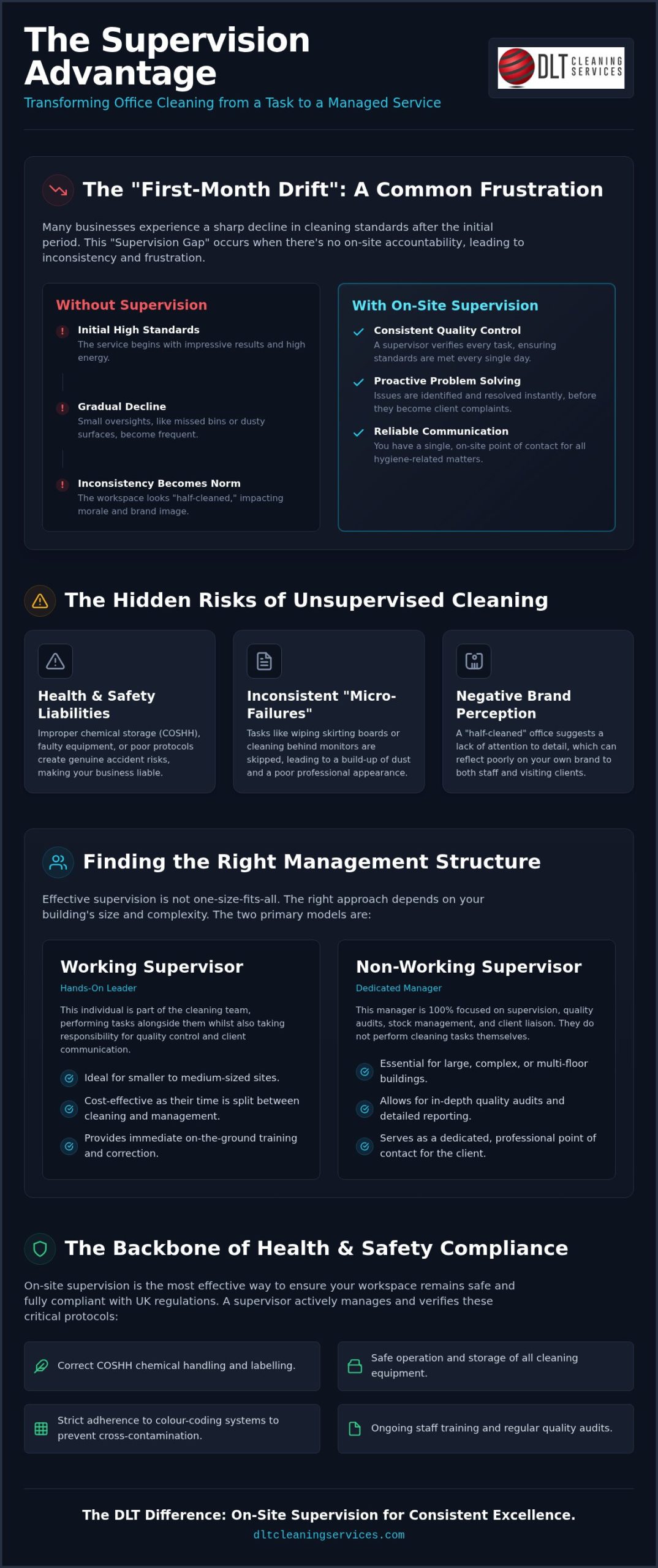
One of the most frustrating patterns for office managers is the “First-Month Drift.” This occurs when a new cleaning contract begins with high energy and impeccable results, only for standards to slowly slide as the weeks pass. Without active, on-site management, small oversights become the new norm. A missed bin here or a dusty monitor there might seem minor at first, but these lapses quickly accumulate. In the busy commercial hubs of Guildford and Woking, a neglected office environment can directly impact employee morale and lead to increased sick days, as high-touch points aren’t properly disinfected to commercial cleaning industry standards.
The communication gap is often the root cause of these failures. When a manager is off-site, they rely on second-hand reports or occasional spot checks. This creates a lag between a problem arising and it being resolved. A supervised approach closes this gap immediately, as the on-site lead acts as a proactive bridge between the client’s needs and the cleaning staff’s actions.
Inconsistency: The Enemy of a Professional Workspace
Hygiene issues are rarely the result of a single catastrophic event. Instead, they are the product of “micro-failures.” When tasks like wiping down skirting boards or cleaning behind printers are skipped, dust and allergens build up over time. This creates a “half-cleaned” appearance that staff and visiting clients notice instantly, even if they can’t quite put their finger on the cause. It suggests a lack of attention to detail that can reflect poorly on your own brand. The Supervision Gap is the measurable decline in hygiene standards and professional reputation that occurs when cleaning staff operate without direct, on-site accountability.
Health and Safety Liabilities in the South East
Beyond aesthetics, unsupervised cleaning poses genuine risks to your business. Improper chemical storage or the use of faulty equipment can lead to accidents that fall squarely on the shoulders of the Facilities Manager. On-site supervisors ensure that all team members follow strict health and safety compliant cleaning protocols, from correct COSHH labelling to ensuring that mops are properly colour-coded to prevent cross-contamination. This level of supervised office cleaning protects your staff and ensures you remain fully compliant with UK safety regulations without needing to micromanage the process yourself.
Understanding the Two Types of Cleaning Supervision
Choosing the right management structure for your workplace depends entirely on the size of your team and the complexity of your building. Effective supervised office cleaning isn’t a rigid template; it’s a flexible framework that adapts to your needs. In our experience serving the South East since 1999, we’ve found that supervision generally falls into two distinct categories: working and non-working leads. Both roles are vital for maintaining consistency, yet they serve very different operational purposes.
The core responsibilities of any supervisor extend far beyond simply “watching” the staff. They are responsible for proactive stock ordering so you never run out of essential hygiene supplies. They conduct regular quality audits to catch the “drift” mentioned earlier, and they provide ongoing staff training. This training is particularly important for client liaison; a supervisor must be an amicable, professional point of contact who understands your specific business priorities. Even though we operate within UK regulations, looking at global benchmarks like OSHA safety standards for cleaning highlights the complexity of modern hygiene and the need for expert oversight.
The Working Supervisor: Efficiency for Smaller Teams
For many independent Surrey businesses in towns like Guildford, a working supervisor is the most efficient choice. This model is designed for teams of two to five operatives. In this scenario, the supervisor balances their own cleaning duties with the oversight of the wider team. It’s a “lead by example” approach where the supervisor is directly on the office floor, ensuring that every desk is wiped and every bin is emptied to the required standard.
This hands-on presence means that issues are corrected in real-time. If a new team member is unsure about a specific surface treatment, the supervisor is right there to demonstrate the correct technique. It provides a high level of accountability without the overhead of a dedicated manager for a smaller footprint.
Non-Working Supervision: Strategic Management for Large Sites
Large-scale corporate headquarters in Berkshire or multi-floor complexes require a more strategic level of oversight. Here, non-working supervision becomes essential. These dedicated managers do not take on cleaning tasks themselves; instead, they focus entirely on the logistical and safety management of the contract. Their day is spent managing complex rotation schedules, overseeing deep-cleaning programmes, and ensuring that all activities align with stringent safety protocols.
This role is pivotal for maintaining tailored office cleaning services across vast environments where different zones may have varying hygiene requirements. Whether it’s managing a 20-person team or coordinating specialist floor care, the non-working supervisor provides the stable, dedicated leadership needed for large-scale operations. If you are unsure which model fits your current needs, our team at DLT Cleaning Services is on hand to help you evaluate your workspace requirements.
Why Supervision is the Backbone of Health and Safety
In the commercial cleaning sector, safety isn’t a passive state; it is an active management task. On-site supervisors function as the primary Health and Safety (H&S) officers during each cleaning shift. They don’t just monitor the quality of the finish; they ensure the environment remains safe for your employees and our operatives alike. This hands-on oversight is what transforms a basic service into robust supervised office cleaning.
One of the most critical safety duties managed by a supervisor is the regular inspection of equipment. They ensure that all electrical items, such as vacuums and floor buffers, have undergone PAT testing and are free from frayed cables or mechanical faults. Beyond equipment, they enforce the strict use of colour-coded cleaning systems. By ensuring red cloths are used only in washrooms and green cloths are reserved for kitchen areas, they effectively eliminate the risk of cross-contamination. This methodical approach is backed by a comprehensive audit trail. Should an insurance query or safety inspection occur, the supervisor’s logs provide the necessary proof that all safety protocols were followed diligently.
COSHH Compliance and Chemical Management
The Control of Substances Hazardous to Health (COSHH) regulations require meticulous management of all cleaning agents. Supervisors ensure that every chemical is stored, diluted, and used exactly according to its specific Safety Data Sheet. This prevents dangerous errors, such as untrained staff inadvertently mixing incompatible chemicals which can create hazardous fumes. A supervisor’s primary duty is the safety of both cleaners and office staff. By managing these risks on-site, they remove the burden of chemical safety from your shoulders whilst ensuring a hygienic results.
Managing Risk Assessments and Method Statements (RAMS)
Every professional contract relies on Risk Assessments and Method Statements (RAMS). These documents are not just paperwork; they are the blueprints for safe working. The supervisor’s role is to ensure that every member of the team follows the agreed Method Statement for every task, whether it’s manual handling or cleaning in high-traffic corridors. When your office layout changes or you introduce new furniture, the supervisor proactively updates these assessments to reflect the new environment. This proactive management is a hallmark of the high office cleaning Surrey managers expect. It ensures that supervised office cleaning remains a dynamic service that adapts to the evolving needs of your workspace without compromising on safety.
Evaluating Your Cleaning Provider’s Management Structure
When you put a cleaning contract out to tender, it’s easy to focus solely on the hourly rate or the initial pitch. However, the success of the service depends entirely on the management structure supporting the operatives. To ensure supervised office cleaning is actually delivered, you must ask a critical question: “Who is physically on-site whilst the cleaning is being performed?” Many larger, national firms promise “management,” but they often mean a Mobile Area Manager who might only visit once a month. This is a far cry from a Dedicated On-Site Supervisor who is present every single shift to verify standards in real-time.
There are specific red flags to watch for in a cleaning contract. If a quote doesn’t explicitly list supervisory hours or a management fee, it’s highly likely that supervision isn’t actually happening. Transparency is key. You should be able to see exactly how much time is allocated to quality control. Without this dedicated budget, the responsibility for checking the work often falls back onto your own team, which defeats the purpose of hiring a professional firm. If you are researching how different providers structure their management and quality assurance, you can learn more about Valley Clean and their comprehensive range of residential and commercial cleaning solutions.
A proactive supervisor’s goal is to identify and fix issues before you or your staff ever notice them. When evaluating a provider, ask to see a sample audit report and enquire about the frequency of inspections. Whilst monthly checks are common in the industry, they are often too infrequent to catch a slide in standards. Daily or weekly inspections are the benchmark for high-traffic offices. Digital reporting is now the preferred standard over paper-based logs; it provides real-time transparency, date-stamped photos, and a clear history of your office hygiene that can be shared instantly with your facilities team.
Communication and Accountability
Effective management relies on a clear line of sight and an amicable point of contact. Every contract should include a “Communication Log” or provide you with direct access to the supervisor. If an issue arises, you shouldn’t have to navigate a faceless helpdesk or wait days for a response. In a family run office cleaning Surrey firm, escalations move quickly from the on-site lead to the senior management team. This personal investment leads to lower staff turnover and a more stable, consistent team on your premises. To see how we structure our on-site management for maximum accountability, you can learn more about the dedicated approach at DLT Cleaning Services and how we maintain our 25-year legacy of quality.
The DLT Difference: On-Site Supervision in Guildford and Beyond
DLT Cleaning Services Ltd was founded in 1999 with a clear mission: to provide the level of accountability that only a family-run business can offer. Whilst many national providers have expanded into faceless corporations, we’ve remained a dedicated independent firm rooted in the Surrey, Hampshire, and Berkshire corridor. Our 25-year history is built on the belief that cleanliness is a foundational element of business success. This is why every single contract we manage includes dedicated on-site supervision. By choosing supervised office cleaning from a local expert, you aren’t just buying a service; you’re investing in a healthier, more productive centre for your employees.
Our hands-on approach ensures that our vetted teams maintain the highest standards day after day. We don’t believe in the “First-Month Drift” because our supervisors are always there to catch it. This local presence in areas like Guildford and Woking means we can respond to issues within hours, not days, ensuring your workspace remains professional at all times.
Our Approach to Managed Office Cleaning
Our supervisor training programme is the cornerstone of our service. Every lead operative undergoes rigorous training with a specific focus on the latest H&S compliance and chemical management protocols. This expertise allows us to seamlessly integrate hygiene services and janitorial supplies into your managed contract. For example, when managing a multi-site business in Guildford, our supervisors coordinate across locations to ensure that every floor, from the reception to the staff kitchen, meets the exact same high-standard clean. This level of coordination removes the logistical burden from your facilities manager, as we take full ownership of the hygiene cycle.
A Partner, Not a Vendor
We view ourselves as your partner in maintaining a professional environment. As an independent firm, we take personal pride in the results we deliver, projecting a sense of quiet confidence that comes from decades of experience. You won’t find aggressive sales tactics here; instead, you’ll find a stable, committed team with low staff turnover and a “can-do” attitude. Our commitment to supervised office cleaning ensures that your workspace remains a safe, professional environment without you needing to intervene or micromanage.
We’re on hand to take ownership of your environment so you can focus on your own operations. If you’re ready to experience the DLT difference, we invite you to contact us for a site survey and a tailored quote designed specifically for your office’s unique requirements.
Securing Long-Term Consistency for Your Workplace
A professional workspace deserves a management structure that reflects your own high standards. By prioritising supervised office cleaning, you move away from the frustration of neglected corners and inconsistent results. As we’ve explored, the presence of an on-site lead is the only reliable way to prevent service drift, maintain strict Health and Safety compliance, and ensure that your office remains a healthy, inviting environment for your team. It replaces the need for your own constant oversight with a single, accountable point of contact who understands the nuances of your building.
DLT Cleaning Services Ltd has been a family-run specialist in South East office hygiene since 1999. We understand that stability and reliability are the foundations of a successful partnership. This is why we provide dedicated on-site supervision for every contract we manage, from Guildford to Berkshire. We take ownership of your environment so you can focus on your core operations with total peace of mind. To experience a higher standard of workspace management, get a professional, supervised office cleaning quote for your Surrey business today. We look forward to helping you maintain a workspace you can truly be proud of.
Frequently Asked Questions
What is the difference between a cleaning supervisor and a cleaning manager?
A cleaning supervisor is physically present on-site during the shift to oversee quality in real-time, whereas a cleaning manager typically operates from a central office and visits periodically. The supervisor ensures immediate task completion and H&S compliance. In contrast, the manager focuses on broader contract logistics and account management. For most businesses, the supervisor is the amicable, daily point of contact who ensures your workspace remains a safe, professional environment.
Does supervised office cleaning cost more than standard cleaning?
Investing in supervised office cleaning generally involves a specific management fee, but it often saves money by preventing service failure and the need for expensive remedial deep cleans. Without oversight, standards often slide, leading to hidden costs like increased employee sick days or damaged surfaces from improper chemical use. A managed service ensures you receive the full value of your contract every single day, protecting your business reputation and your facilities budget.
How many cleaners does one supervisor typically manage in an office setting?
In a standard office setting, a working supervisor typically manages a team of two to five operatives. This ratio allows the lead to balance their own cleaning duties with thorough oversight of the wider team. For larger corporate headquarters with more than ten cleaners, a non-working supervisor is usually appointed. This dedicated manager focuses entirely on complex rotation schedules and safety audits to maintain consistent standards across multiple floors or sites.
Can I have a supervised clean for a small office with only two cleaners?
Yes, small offices with only two cleaners absolutely benefit from a “working supervisor” model. In this scenario, one of the two cleaners is designated as the on-site lead, taking responsibility for stock ordering, H&S checks, and the final walk-through. This ensures that even a small team remains accountable. It prevents the common issue of neglected corners or missed high-touch points that often occurs when small teams operate without a clear point of leadership.
What happens if the supervisor is absent; who manages the cleaning team?
If a supervisor is absent, their responsibilities are immediately covered by a trained deputy or a mobile area manager. As a family-run firm established in 1999, we ensure that every contract has a robust contingency plan. This prevents any drop in standards or breach of safety protocols during staff holidays or illness. Your office hygiene remains a priority, with a temporary lead on hand to take ownership of the shift and verify all tasks.
How often should a cleaning supervisor conduct a formal audit of the premises?
A formal audit should be conducted by the supervisor at least once a week for high-traffic commercial spaces. Whilst daily visual checks are part of the routine, a structured audit involves date-stamped digital reporting and a detailed review of all H&S logs. For smaller offices with lower footfall, a comprehensive monthly audit may be sufficient. These reports provide you with a transparent history of your workspace hygiene and identify proactive maintenance needs early.
Do supervisors also perform cleaning tasks or do they just observe?
Whether a supervisor performs cleaning tasks depends on the specific management model chosen for your workplace. A working supervisor is hands-on and completes cleaning duties whilst leading by example on the office floor. Conversely, a non-working supervisor focuses entirely on strategic management, safety audits, and staff training. Both roles are essential for supervised office cleaning, ensuring that every operative follows the correct colour-coded systems and COSHH regulations without you needing to intervene.
Is supervision necessary for offices that only require cleaning twice a week?
Supervision is highly beneficial for offices cleaned twice a week, as it prevents the quality drift that often happens between visits. Even with infrequent cleaning, tasks like chemical storage and equipment safety checks remain critical. A supervisor ensures that the limited time on-site is used with maximum efficiency and that no high-touch areas are overlooked. This methodical approach guarantees that your professional standards are maintained consistently, regardless of the cleaning frequency.