What if the biggest threat to your office compliance isn’t a visible trip hazard, but the microscopic risks lurking on shared desks and kitchenettes? It’s a question many UK office managers are asking as we look towards 2026, especially when faced with the pressure of maintaining a truly safe environment. We understand that health and safety legislation often feels like a maze of overwhelming jargon; it’s natural to worry about failing an inspection or missing a hidden hygiene risk. That’s why we’ve created a practical office health and safety risk assessment checklist designed specifically for the modern workplace.
This guide promises to help you master your compliance requirements with ease. Drawing on over 25 years of local expertise, we’ll show you how to gain the legal peace of mind you need to focus on your core business operations. We’ll walk you through the essential steps to identify hazards, implement effective hygiene controls, and foster a healthier environment that actively reduces employee sick days. From high-touch surfaces to workstation ergonomics, you’re about to discover how a dedicated focus on cleanliness forms the backbone of a robust safety strategy.
Key Takeaways
- Understand your legal duties under UK regulations to keep your team safe and avoid the stress of potential inspections.
- Utilise our practical office health and safety risk assessment checklist to systematically identify trip hazards and workstation issues before they become problems.
- Uncover the biological risks often missed in standard assessments, such as mould and virus transmission, and learn how professional cleaning manages these threats.
- Master the documentation process for businesses with five or more employees whilst ensuring your team’s voices are heard during the review.
- Discover how 25 years of local expertise and dedicated on-site supervision can transform your office into a centre of excellence for health and safety.
What is an Office Health and Safety Risk Assessment?
An office health and safety risk assessment is a systematic process of identifying hazards that could cause harm amongst employees, visitors, or contractors within your workspace. It’s a legal requirement under the Management of Health and Safety at Work Regulations 1999, which mandates that every UK employer protects their staff from harm. This assessment functions as a proactive tool for business continuity, ensuring your operations aren’t derailed by preventable incidents. Whilst many firms start with a generic template, a truly effective office health and safety risk assessment checklist must be site-specific. A generic document might mention “trailing cables”, but a site-specific assessment identifies the exact wire in your Guildford boardroom that poses a recurring trip hazard.
The Five Steps of Risk Management
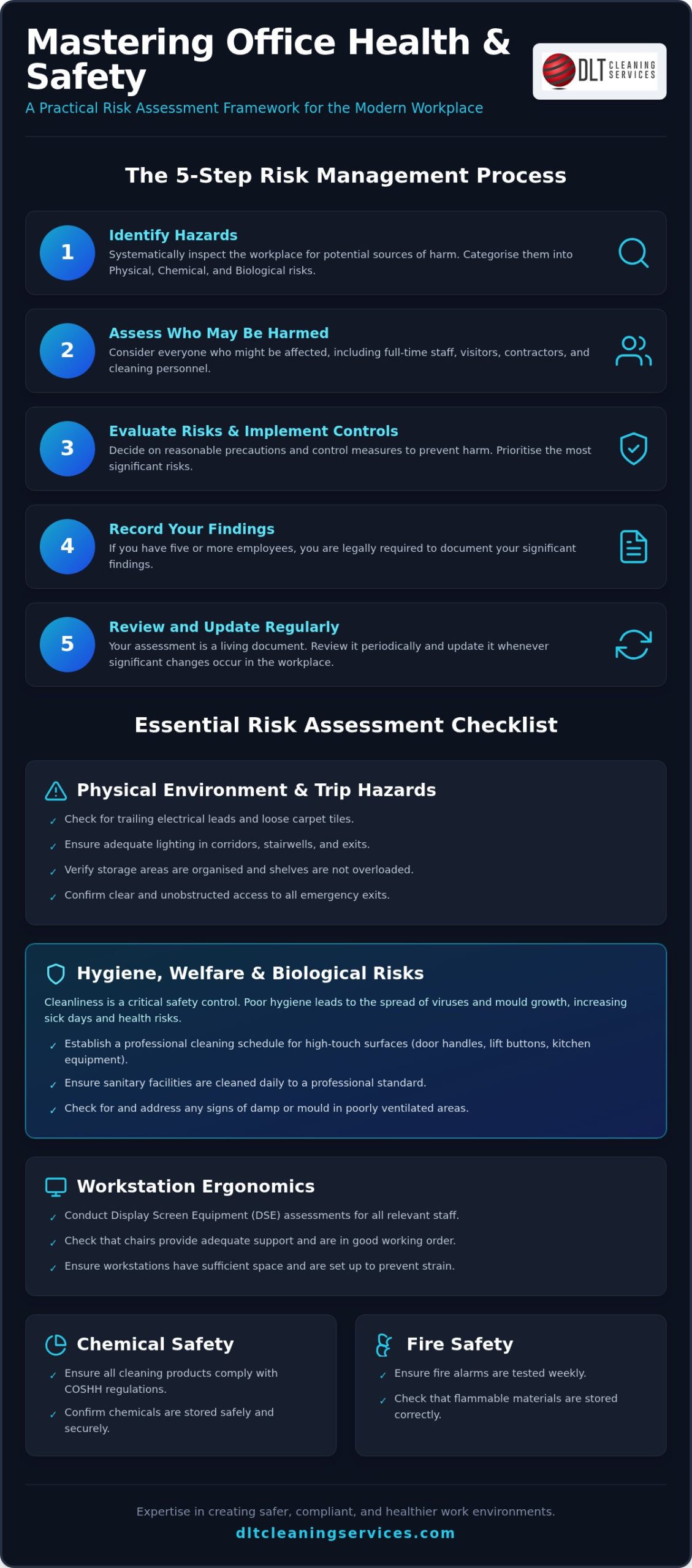
Managing risk isn’t about eliminating every possibility of an accident; it’s about ensuring you’ve taken reasonable steps to prevent them. This framework aligns with the broader principles of Occupational safety and health (OSH), which aims to foster a safe and healthy environment for everyone. The process begins with identifying hazards, which generally fall into physical, chemical, or biological categories. You must then decide who might be harmed and how. This includes your full-time staff, but also visitors, delivery drivers, and the cleaners who maintain the premises after hours. Finally, you evaluate these risks to decide on suitable precautions and control measures, documenting your findings to build a safer workplace culture.
Why Cleanliness is a Safety Priority
Hygiene is often the silent partner in workplace safety. Poor hygiene leads directly to biological hazards, such as the rapid spread of seasonal viruses or the growth of mould in damp, poorly ventilated areas. Implementing health and safety compliant cleaning is a critical component of risk mitigation that many managers overlook. A dedicated cleaning regime identifies “high-touch” areas, such as door handles, lift buttons, and shared kitchenette equipment, as critical safety checkpoints. By treating cleanliness as a safety priority, you reduce the likelihood of illness-related downtime. Our office health and safety risk assessment checklist incorporates these hygiene standards to ensure your environment is not just tidy, but truly safe. DLT Cleaning brings 25 years of local expertise to this task, providing the dedicated on-site supervision needed to manage these risks effectively.
The Essential Office Health and Safety Risk Assessment Checklist
A robust office health and safety risk assessment checklist must account for both the obvious physical dangers and the subtle hygiene risks that impact long term employee health. Whilst fire safety and ergonomics are standard inclusions, a modern workspace requires a more comprehensive approach to remain compliant in 2026. Fire safety protocols should prioritise clear exit routes, weekly alarm testing, and the secure storage of any flammable materials. Equally, workstation ergonomics must focus on Display Screen Equipment (DSE) assessments and chair safety to prevent repetitive strain injuries. Don’t overlook chemical safety; ensure all cleaning products stored on site meet COSHH requirements to protect both your staff and your cleaning team.
Physical Environment and Trip Hazards
Slips, trips, and falls remain the leading cause of workplace injuries in the UK. Your assessment should start with a thorough walk-through to check for loose carpet tiles or trailing electrical leads that could easily cause an accident. Lighting is another critical factor. Ensure all stairwells, corridors, and emergency exits are brightly lit to prevent missteps. We also recommend reviewing the organisation of your storage areas. Overloaded shelves or poorly stacked boxes can lead to falling objects, creating a hazard for anyone walking nearby. By addressing these physical factors, you create a stable foundation for a safer office.
Hygiene, Welfare, and Sanitary Facilities
Many traditional checklists fail to address the health risks associated with poor hygiene. Bacteria and viruses spread rapidly in shared environments, making professional sanitisation a safety necessity rather than a luxury. Your bathrooms should be cleaned to a professional standard daily, with a clear deep clean schedule in place for high traffic periods. It’s vital to confirm a consistent supply of hygiene services and janitorial products to encourage regular handwashing. Kitchen areas also require careful assessment for cross contamination risks and the safety of shared appliances like kettles and microwaves. If you find managing these hygiene checkpoints overwhelming, our team at DLT Cleaning is on hand to help you maintain a compliant, healthy workspace.
Implementing this office health and safety risk assessment checklist helps you move beyond basic compliance. It demonstrates a genuine commitment to your team’s well-being. By focusing on these specific areas, you reduce the likelihood of accidents and illness, ensuring your business remains productive and your environment stays welcoming for everyone.
Identifying Common Hazards in the Modern Workspace
Identifying hazards requires a keen eye for the less obvious. Electrical safety is a prime example; whilst PAT testing for computers is a standard part of any office health and safety risk assessment checklist, many offices overlook the danger of overloaded sockets or “daisy-chained” extension leads. These create significant fire risks that are easily avoided with better cable management. Biological hazards also pose a persistent threat in modern workspaces. Stagnant water in infrequently used taps can harbour bacteria, and shared equipment like printers or touchscreen panels often become hotspots for virus transmission if they aren’t part of a rigorous sanitisation schedule. Your assessment should also account for environmental stressors. Excessive noise or poor temperature control can lead to increased stress and reduced mental well-being over time. Manual handling remains a factor too, particularly when staff move heavy deliveries or reconfigure office furniture without the correct training or equipment.
The Hidden Danger of Poor Air Quality and Dust
Dust accumulation in ventilation systems isn’t just an aesthetic issue. It directly impacts respiratory health, potentially triggering asthma or allergies amongst your workforce. Regular, high-filtration vacuuming is essential to keep allergen levels low and prevent dust from recirculating through the building. When evaluating the frequency of office cleaning in Surrey, consider how air quality affects your team’s daily productivity. A clean vent system and dust-free surfaces ensure the air your staff breathes remains fresh. This proactive approach to hygiene reduces the likelihood of respiratory complaints and keeps your environment feeling professional and well-managed.
Managing Hazardous Substances (COSHH)
Control of Substances Hazardous to Health (COSHH) is a vital part of your safety strategy. Every cleaning chemical stored on-site must be correctly labelled and accompanied by a current Safety Data Sheet (SDS). These sheets provide essential information on how to handle substances safely and what to do in the event of an accidental spill or exposure. Managing this documentation is a significant administrative task that requires constant updates. This is why professional cleaning contractors must take full ownership of their own COSHH compliance. By partnering with an expert, you ensure that all substances are handled, stored, and documented according to the latest safety standards. This removes the burden of risk from your own management team and provides the peace of mind that your cleaning regime is as safe as it is effective.
How to Implement and Review Your Assessment
Implementing your findings is where the real work begins. It’s not enough to simply fill out an office health and safety risk assessment checklist; you must breathe life into the document through active engagement. Start by consulting with your employees. They interact with the workspace daily and often spot overlooked hazards, like a flickering light in a corner or a stiff fire door, long before management does. This collaborative approach ensures no detail is missed and builds a culture of shared responsibility.
For any business with five or more staff, recording your findings is a legal necessity. This documentation serves as your proof of compliance and a roadmap for future safety improvements. Once the assessment is complete, communicate the results to all staff members in an accessible format. Whether it’s a digital handbook or a physical noticeboard update, everyone needs to understand the risks and the measures in place to control them. Set a firm review schedule to keep the document relevant. Whilst annual updates are the minimum standard, trigger-based reviews are equally important. If you introduce new equipment, reconfigure the office layout, or experience a “near-miss” incident, you must update your assessment immediately to reflect these changes.
Turning Findings into Action Plans
Once hazards are identified, you must prioritise high-risk items that require immediate rectification. Assign clear responsibility and realistic deadlines for every safety improvement to ensure accountability. Integrating these safety checks into the daily office routine makes compliance feel like a natural part of the workday rather than a heavy administrative burden. Small, consistent actions, such as checking that fire exits remain clear every morning, prevent minor issues from escalating into significant risks.
The Role of On-Site Supervision
Professional oversight is a powerful tool in maintaining these standards over the long term. Our approach to supervised office cleaning ensures that safety and hygiene standards are met during every single shift. Having a dedicated lead on-site allows us to spot new hazards daily, such as a spill in a stairwell or a blocked fire exit, and address them before they cause harm. We maintain a live log of all cleaning and maintenance activities, providing you with a transparent and reliable record of your site’s hygiene status. This hands-on management style provides the peace of mind that your environment is being looked after by experts who take personal pride in their work.
If you want to ensure your workplace remains consistently safe and compliant, contact DLT Cleaning today to discuss how our managed hygiene services can support your health and safety goals.
Partnering with DLT Cleaning for H&S Excellence
Choosing a partner for your workplace hygiene is a decision that impacts the fundamental safety of your operations. DLT Cleaning Services Ltd has provided professional office cleaning and hygiene services across Surrey, Hampshire, and Berkshire since 1999. We understand that a clean office is a safe office, and our family-run values mean we take personal pride in every contract we manage. Unlike generic providers, we offer a hands-on approach that prioritises your team’s well-being. By integrating our services with your office health and safety risk assessment checklist, you ensure that the hygiene risks you’ve identified are managed by experts with over 25 years of specialised knowledge.
Our dedicated on-site supervision is what truly sets us apart in the regional commercial landscape. We don’t believe in “set and forget” contracts. Instead, we provide a supervisor for every project to ensure that H&S compliance remains consistent day after day. This level of oversight allows us to spot new hazards as they arise, from a spill that needs immediate attention to a blocked fire exit. This proactive stance means your workspace remains stable and secure, giving you the peace of mind to focus on your own operations whilst we take ownership of the environment. Our tailored hygiene solutions address the specific risks found in your assessment, ensuring a healthier space that actively reduces employee sick days.
Local Expertise in Surrey, Hampshire, and Berkshire
A local partner brings a level of accountability that national chains often struggle to match. We’ve been a committed part of the Guildford business community for over two decades, and our “can-do” attitude has helped us build long term relationships with firms of all sizes. Whether you’re an independent business in Hampshire or a national chain with a large centre in Berkshire, we’re on hand to provide the amicable, professional support you need. We understand the nuances of the regional commercial landscape and are dedicated to maintaining the high standards your business deserves.
Next Steps for Your Office Safety
Taking control of your workplace safety doesn’t have to be an overwhelming task. We recommend starting with these three actionable steps to secure your environment:
- Download our office health and safety risk assessment checklist and conduct your first walk-through of the premises to identify immediate hazards.
- Review your current cleaning contract against your H&S requirements to ensure your hygiene regime isn’t leaving you vulnerable to biological risks.
- Contact DLT Cleaning Services for a professional hygiene consultation to see how our dedicated on-site supervision can enhance your compliance.
Our team is ready to help you transform your office into a centre of excellence for health and safety. With DLT Cleaning, you aren’t just hiring a vendor; you’re partnering with a reliable local expert who takes ownership of your environment so your staff can thrive in a safer, healthier workspace.
Securing Your Workplace for 2026 and Beyond
Effective risk management isn’t just a box-ticking exercise; it’s a commitment to the people who make your business thrive. By moving beyond generic templates and using a site-specific office health and safety risk assessment checklist, you protect your staff from both physical hazards and the often-overlooked biological risks that impact long term productivity. A truly safe environment requires constant vigilance and a methodical approach to hygiene that many standard assessments miss.
Maintaining these high standards requires a dedicated partner who understands the nuances of local commercial environments. Since 1999, DLT Cleaning Services has provided that stability for businesses across Surrey, Hampshire, and Berkshire. Our family-run approach ensures that every contract benefits from dedicated on-site supervision, guaranteeing that hygiene and safety remain a constant priority. It’s time to take the next step in your compliance journey. Please request a professional office hygiene consultation from DLT Cleaning Services to discover how we can help you build a healthier, more resilient workspace.
You’ve already done the hard work by identifying your specific risks. Now, let’s put the right systems in place to manage them effectively. A safer, cleaner office is well within reach.
Frequently Asked Questions
Is a written risk assessment a legal requirement for my small office?
Every employer has a legal duty to assess workplace risks, but you only need to record your findings in writing if you employ five or more people. Even if you have fewer staff, we recommend documenting your process to provide clear evidence of your commitment to safety. Using a structured office health and safety risk assessment checklist helps you stay organised and ensures you don’t overlook critical hygiene or physical hazards that could impact your team.
How often should an office risk assessment be reviewed in the UK?
There is no fixed legal timeframe, but the Health and Safety Executive (HSE) suggests reviewing your assessment annually as a minimum standard. You must also update it immediately if there is a significant change in your workspace, such as a new office layout, the introduction of different equipment, or a “near-miss” incident. Regular reviews ensure your safety measures remain effective and reflect the current reality of your modern UK office environment.
Who is responsible for carrying out the health and safety risk assessment?
The ultimate legal responsibility lies with the employer or business owner, though you can appoint a “competent person” to help manage the process. This individual needs the right skills, knowledge, and experience to identify hazards accurately. Whilst you can delegate the task, you cannot delegate the legal accountability. Engaging with professional partners for specific areas, such as hygiene services, provides expert support in managing complex risks like biological hazards and chemical safety.
What are the most common hazards found in a typical UK office environment?
The most frequent hazards in UK offices include slips and trips from trailing cables, poor workstation ergonomics leading to repetitive strain, and fire risks from overloaded electrical sockets. Biological hazards, such as the spread of viruses on high-touch surfaces, are also increasingly significant. Your office health and safety risk assessment checklist should prioritise these areas to ensure a comprehensive overview of your environment. Addressing these common issues helps maintain high productivity and reduces employee sick days.
Can I use a generic risk assessment template for my Guildford office?
You can use a generic template as a foundational guide, but it must be tailored to your specific premises in Guildford or Surrey. A template won’t know about a particular loose carpet tile in your reception or a specific ventilation issue in your basement. To be legally compliant and truly effective, your assessment must reflect the unique physical layout and daily operations of your business. Site-specific details are what make a risk assessment a functional safety tool.
How does professional cleaning impact my health and safety compliance?
Professional cleaning directly mitigates biological risks and ensures that your hygiene standards meet legal requirements. It provides a structured regime for sanitising high-touch areas and managing waste safely, which are key components of your overall risk strategy. At DLT Cleaning, our dedicated on-site supervision ensures that these safety protocols are followed consistently every day. This hands-on management style provides the documentation and peace of mind needed to pass health and safety inspections with confidence.
What is the difference between a hazard and a risk in an office setting?
A hazard is anything that has the potential to cause harm, such as a trailing power cable or a wet floor. A risk is the likelihood, great or small, that someone will actually be harmed by that hazard, combined with the severity of the potential injury. In an office setting, your goal is to identify all hazards and then implement controls to reduce the associated risks to the lowest level reasonably practicable for your staff.
Do I need a separate risk assessment for my office cleaning contractors?
You don’t necessarily need a separate document, but you must account for the risks that contractors face and the risks they might introduce to your staff. Under UK law, employers and contractors must cooperate and coordinate their safety efforts. This includes sharing information about hazardous substances used in cleaning or specific building risks like asbestos. We manage our own COSHH compliance and safety logs to ensure our presence in your office remains a safe and seamless partnership.