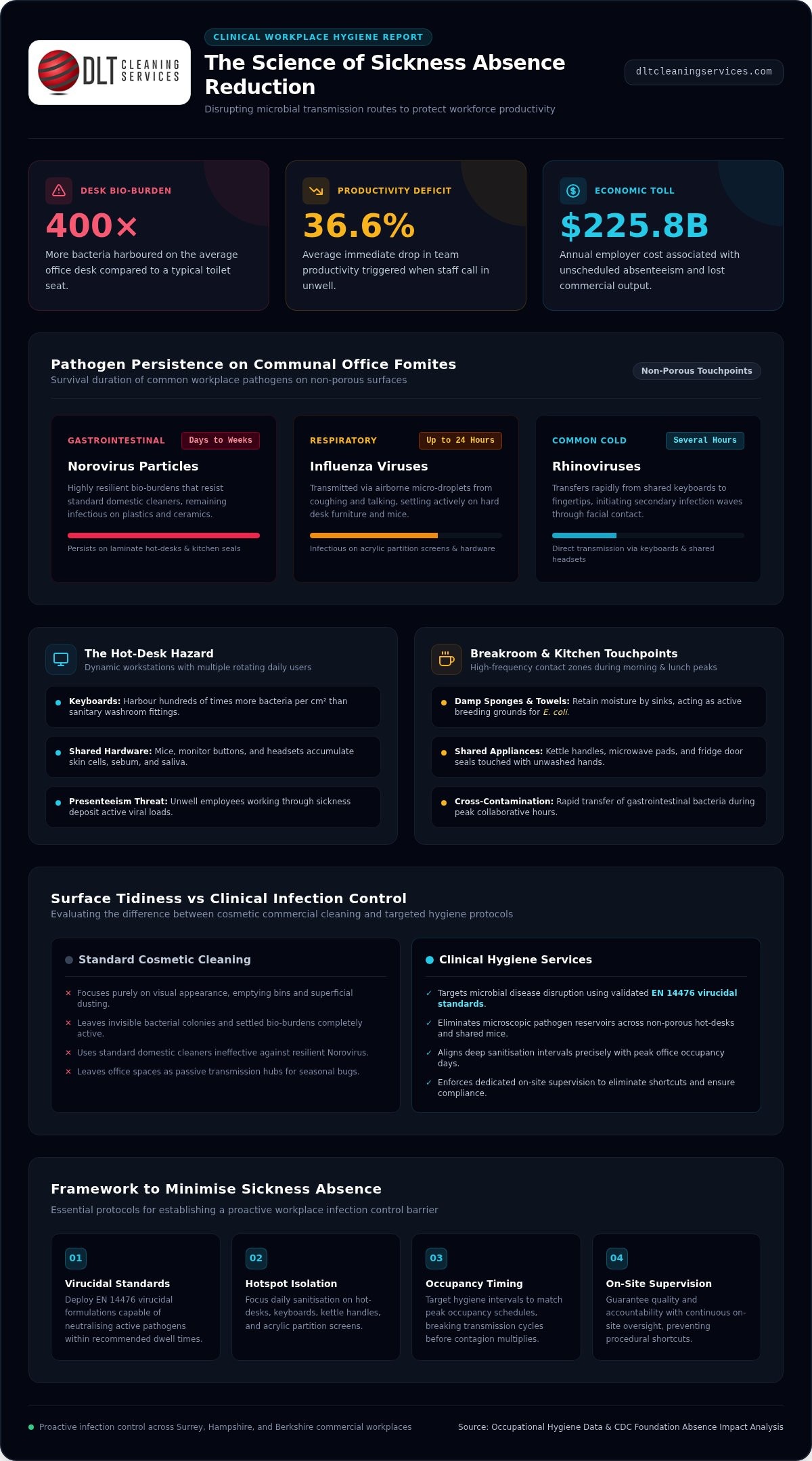
The average office desk harbours roughly 400 times more bacteria than a toilet seat, meaning visual tidiness often masks invisible transmission routes. When staff call in unwell, unplanned absences trigger an average 36.6% drop in productivity whilst project deadlines slip and temporary cover costs mount. If you have noticed seasonal bugs cycling through your teams, you already know that superficial dusting doesn’t protect your workforce. Reducing staff sick days with office hygiene services is about tackling those hidden microbial risks before they disrupt your daily workplace operations.
You shouldn’t have to absorb rising Statutory Sick Pay overheads and operational delays when proactive, clinical-grade cleaning can halt viral spread at the source. In this guide, you’ll discover how professional office hygiene services curtail cross-contamination, protect workforce health, and measurably cut unplanned absenteeism. We’ll explore the essential protocols needed to break infection chains in communal spaces, alongside a clear framework for selecting dependable commercial hygiene partners who take genuine ownership of your environment.
Key Takeaways
- Distinguish between surface tidiness and true clinical sanitation to eliminate invisible bacterial colonies that drive UK workplace illness.
- Identify high-risk transmission hotspots across collaborative communal areas, particularly where flexible hot-desking accelerates pathogen sharing.
- Understand the vital role of EN 14476 virucidal chemical standards and how reducing staff sick days with office hygiene services protects operational output.
- Align targeted hygiene intervals with peak office occupancy days whilst promoting accountable workplace cleanliness habits amongst your teams.
- Discover why dedicated on-site supervision provides the consistent oversight needed to eliminate cleaning shortcuts and guarantee compliance.
The Hidden Connection Between Workplace Hygiene and Staff Sick Days
Most commercial cleaning contracts focus purely on visual order. Bins get emptied, desks get dusted, and floors are vacuumed. However, there is a fundamental difference between cosmetic tidiness and genuine microbiological disease disruption. When businesses view cleaning through the lens of preventative infection control rather than appearance, the working environment shifts from a passive transmission hub to an active protective barrier. Establishing effective strategies for reducing staff sick days with office hygiene services requires targeting the microscopic reservoirs where respiratory and gastrointestinal pathogens thrive.
The True Cost of Sickness Absence for South East Businesses
Unplanned employee absences create an immediate operational and financial drag on commercial enterprises across Surrey, Hampshire, and Berkshire. Beyond paying Statutory Sick Pay, companies face sudden productivity losses and steep recruitment costs for temporary cover. Unplanned absences pull project leads away from core deliverables to manage crisis rotas, which swiftly damages client delivery and stretches existing staff to burnout. Presenteeism poses an equally insidious threat. When unwell employees attempt to work through illness in shared spaces, they deposit active viral loads across shared infrastructure, inadvertently triggering secondary waves of staff sickness.
Common Pathogens and Their Lifespans on Office Surfaces
Pathogen survival rates on communal work surfaces reveal why standard dusting regimens fail. Modern open-plan offices feature non-porous fomites such as acrylic partition screens, plastic mice, laminate hot-desks, and stainless steel door furniture, materials that allow viruses to persist for alarming durations:
- Influenza viruses: Persist on hard surfaces and remain infectious for up to 24 hours.
- Norovirus particles: Resist standard domestic cleaners, remaining biologically active on plastics and ceramics for days or even weeks.
- Rhinoviruses: Retain infectious capability on communal hardware for several hours, easily transferring from keyboards to fingertips.
Throughout the working day, talking, coughing, and sneezing discharge micro-droplets that steadily settle over adjacent workstations and communal touchpoints. Applying proven Occupational hygiene principles ensures that cleaning regimes actively neutralise these settled bio-burdens before they can colonise healthy employees. Investing in reducing staff sick days with office hygiene services directly dismantles these physical transmission routes, safeguarding team capacity and supporting reliable commercial output week after week.
Critical Office Hotspots: Where Germs Lurk and Spread
Microbes travel rapidly across modern commercial workplaces through predictable contact chains. Unplanned absenteeism disrupts operations and inflates payroll overheads, echoing global findings where unscheduled absence costs employers $225.8 billion annually in lost output. Breaking these chains requires understanding exactly where microbial colonies concentrate. By isolating high-risk zones, facility managers can target cross-contamination pathways before seasonal bugs spread throughout entire teams.
The Hot-Desk Hazard: Keyboards, Mice, and Shared Workstations
Flexible desking arrangements multiply contamination risks exponentially. While a single employee’s desk accumulates biological matter over weeks, hot-desks host multiple rotating users daily. Computer mice, keyboards, and monitor adjustment points quickly gather skin cells, saliva droplets, and sebum. Standard office keyboards harbour hundreds of times more bacteria per square centimetre than sanitary washroom fittings. When team members share headsets and desk phones without interim sanitisation, pathogens transfer straight to facial contact points.
Breakrooms, Tea Points, and Communal Kitchen Appliances
Communal office kitchens present severe food-hygiene and cross-contamination hazards. Staff routinely touch kettle handles, microwave keypads, and refrigerator seals with unwashed hands throughout the morning rush. Consider the specific points where contamination festers:
- Damp sponges and tea towels: Left by the sink, these retain moisture and act as breeding grounds for gastrointestinal bacteria like E. coli.
- Appliance touchpoints: Shared coffee machine touchscreens and water cooler levers accumulate residues that transfer across departments.
- Food-prep surfaces: Unsanitised draining boards and prep counters expose lunch items to microbial cross-contamination.
Implementing professional tailored office cleaning services helps neutralise these kitchen risks, preventing foodborne pathogens from circulating alongside respiratory viruses.
Washroom Vectors and Sanitary Touchpoints
Washrooms demand strict microbiological separation from the rest of the workplace. Flushing commercial toilets without closing lids disperses aerosolised bio-particulates across stall walls, toilet paper dispensers, and door latches. Mixer tap handles and manual soap pumps collect immediate bacterial deposits as staff turn them on before washing. Commercial washrooms require hospital-grade disinfection chemistry to halt these vectors. If your workplace struggles with recurring seasonal bug cycles, consulting with DLT Cleaning Services can provide an objective assessment of your site’s physical touchpoints.
Prioritising targeted microbiological intervention across these high-traffic focal areas is the core foundation of reducing staff sick days with office hygiene services across your organisation.
Evaluating Commercial Cleaning vs Comprehensive Hygiene Services
Procurement teams often conflate routine janitorial duties with dedicated infection control. A standard commercial clean generally prioritises aesthetic appearance, ensuring floors are hoovered, bins are emptied, and horizontal surfaces look clear. In contrast, comprehensive hygiene programmes focus on biological decontamination. To achieve measurable results in reducing staff sick days with office hygiene services, facilities managers must look past surface sheen and audit the chemical formulations, contact times, and segregation systems utilised by their cleaning partners.
Basic Office Tidying vs Pathogen-Targeted Sanitisation
The core distinction between basic tidying and clinical sanitisation lies in dwell times and certified chemical efficacy. Wiping a desk with an all-purpose detergent merely spreads active bio-films across a wider surface area. Legitimate pathogen eradication requires virucidal chemistry certified to EN 14476 standards, which proves efficacy against enveloped respiratory viruses and non-enveloped gastrointestinal bugs. Cleaners must leave these solutions wet on target surfaces for the manufacturer’s specified contact window, typically between 60 seconds and five minutes, before wiping. Adhering to these strict chemical protocols ensures health and safety compliant cleaning that breaks active infection chains across your organisation.
Physical equipment segregation is equally vital. Professional hygiene contracts mandate strict British Institute of Cleaning Science (BICSc) colour-coded cloth systems:
- Red cloths and mops: Restricted solely to high-risk washroom sanitary fittings and toilet bowls.
- Yellow materials: Assigned to washroom sinks, tiles, and cubicle touchpoints.
- Green cloths: Used exclusively in food preparation areas, breakrooms, and tea points.
- Blue equipment: Reserved for general office areas including desks, keyboards, and meeting rooms.
Without rigid enforcement of these distinct colour codes, cloths used near sanitary fittings inevitably contaminate collaborative workspaces.
Specialised Janitorial Consumables and Dispensers
Hand-to-surface transmission accounts for a vast proportion of office contagion. Citing clinical validation, a peer-reviewed trial assessing a comprehensive workplace hand hygiene program demonstrated significant reductions in healthcare claims for preventable illnesses alongside lower absenteeism. Upgrading basic washroom hardware transforms communal spaces into passive infection barriers. Wall-mounted, no-touch infrared soap dispensers eliminate manual contact points where microbes congregate. Similarly, providing single-use absorbent paper towels prevents the airborne dispersal of residual bacteria caused by high-velocity warm air hand dryers. Modern hygiene management integrates these touchless dispensers with regularly serviced, foot-pedal sanitary bins to maintain continuous infection defence across high-risk communal areas.
Implementing a Workplace Hygiene Strategy to Minimise Absenteeism
A reactive approach to office sanitation guarantees that sickness sweeps through your teams before anyone intervenes. Lasting protection demands an integrated strategy that pairs expert commercial cleaning with sensible day-to-day internal protocols. By synchronising professional visits with real-world footfall patterns, organisations turn hygiene into an operational asset. Successfully reducing staff sick days with office hygiene services depends on treating sanitation as an active operational process rather than an invisible after-hours afterthought.
Aligning Cleaning Frequency with Hybrid Working Patterns
Hybrid arrangements have changed how offices collect grime. Workplaces no longer experience uniform footfall from Monday to Friday. Instead, peak attendance typically hits between Tuesday and Thursday, generating concentrated microbial loads on specific days. Facilities teams should focus their intensive sanitisation sweeps immediately after these peak occupancy windows. Resetting shared meeting rooms, collaborative pods, and agile desking between heavy-use days halts pathogen transmission before the next cohort arrives. For tailored strategies on structuring these rotations, explore our guide to office cleaning in Surrey.
Promoting Internal Hygiene Culture Alongside Professional Support
Professional contractors supply the clinical foundation, but daily staff habits sustain it. Building a supportive internal hygiene culture bridges the gap between evening sanitisation rounds:
- Accessible sanitising points: Position automatic hand rub stations at lift lobbies, kitchen entrances, and main exterior doorways.
- Clear-desk standards: Require employees to clear physical paperwork from workstations each evening so cleaning operatives can properly disinfect desk surfaces.
- Remote working flexibility: Actively encourage staff displaying early respiratory or gastrointestinal symptoms to stay home rather than bringing illnesses into communal areas.
Continuous Quality Control and Supervision Audits
You cannot manage what you do not measure. Evaluating your hygiene strategy requires comparing facility cleaning logs against internal HR sickness records. This comparison highlights vulnerable departments or problem zones during peak viral months. Periodic inspections ensure high-contact points, like meeting room screens and tea-station taps, receive adequate chemical dwell times rather than hurried wipe-downs. If your current cleaning contract lacks methodical oversight, partner with DLT Cleaning Services to establish an accountable, professionally supervised hygiene routine that keeps your workplace healthy and productive.
Consistent auditing guarantees contract standards never slip, delivering the measurable returns that come with reducing staff sick days with office hygiene services.
Why Dedicated On-Site Supervision Delivers Reliable Hygiene Protection
A comprehensive infection control plan is only as reliable as the operatives executing it each evening. Commercial cleaning contracts frequently break down when off-site management relies solely on remote digital time-stamps or unchecked checklists. Without physical oversight, operatives under tight deadlines can succumb to fatigue, skipping vital chemical dwell times or overlooking non-obvious touchpoints. Achieving sustainable results in reducing staff sick days with office hygiene services requires active managerial presence on the ground, ensuring health protocols never slip into cosmetic corner-cutting.
The Difference Dedicated Supervision Makes to Daily Standards
Hands-on supervisory leadership directly safeguards workplace health. A dedicated supervisor inspects actual cleaning outcomes rather than assuming tasks were completed correctly. This close oversight protects critical hygiene standards across multiple areas:
- Chemical dilution and contact: Verifying that concentrated disinfectant solutions match precise manufacturer dilution ratios and remain wet on contact surfaces for required dwell periods.
- Rigid cross-contamination control: Ensuring operatives strictly follow BICSc colour-coding rules without mixing washroom cloths into general workspace zones.
- COSHH adherence: Maintaining comprehensive Control of Substances Hazardous to Health documentation and keeping chemical storage completely orderly.
- Accountable communication: Giving facilities leads an accessible, dedicated contact point who resolves operational requests immediately.
The Family-Run Approach: Personal Investment in Your Team’s Health
Contracting models significantly influence cleaning consistency. Large, impersonal franchises often suffer from transient staffing, constant subcontracting, and remote account handlers detached from day-to-day site conditions. In contrast, an established independent partner brings direct personal pride to every contract. Taking time to understand the value of family run office cleaning in Surrey illustrates how stable, vetted teams build deep familiarity with your specific floor layout, security parameters, and high-risk operational areas.
Securing a Tailored Hygiene Contract for Your Premises
Effective infection control begins with a comprehensive, on-site premises survey rather than a generic desk-based quotation. A thorough audit evaluates your building’s footfall routes, peak departmental occupancy, and communal washroom demands. Combining washroom consumables, feminine hygiene units, and routine surface sanitisation into a single accountable schedule removes service gaps. Founded in 1999, DLT Cleaning Services brings over 25 years of continuous commercial experience to offices across Surrey, Hampshire, and Berkshire, deploying dedicated on-site supervision to maintain uncompromising clinical hygiene standards.
Prioritising hands-on supervisory management transforms your daily maintenance programme, ensuring consistent protection and reducing staff sick days with office hygiene services all year round.
Take Proactive Control of Your Workplace Health Today
Treating workplace hygiene as active infection control rather than cosmetic tidying transforms employee wellbeing and protects your commercial output. By eliminating viral reservoirs on shared hot-desks, upholding virucidal dwell times, and aligning sanitisation with hybrid attendance, your organisation actively halts preventable contagion. Investing in reducing staff sick days with office hygiene services delivers genuine peace of mind, keeping project schedules intact whilst lifting everyday team morale.
Sustaining these standards requires an experienced partner who takes authentic ownership of your premises. Established in 1999, DLT Cleaning Services brings over 25 years of commercial cleaning expertise to regional organisations across Surrey, Hampshire, and Berkshire. As an independent, family-run business, we provide dedicated on-site supervision on every contract to guarantee meticulous hygiene and stringent safety compliance. Protect your workforce and reduce absenteeism with DLT Cleaning Services, and ensure your workplace remains a healthy, dependable environment throughout every season.
Frequently Asked Questions
How quickly can professional hygiene services reduce staff sick days in our office?
Measurable improvements often appear within three to six weeks of deploying certified infection control routines. By immediately eliminating surface bio-burdens across communal equipment and tea points, active transmission chains break before secondary infections cycle through departments. Guildford businesses typically report fewer cascading sickness absences during peak winter bug periods once hospital-grade virucidal disinfection replaces superficial evening dusting, quickly stabilising daily team capacity.
Can regular office cleaners provide the same protection as dedicated hygiene services?
Standard cleaners usually focus on visual order, such as hoovering floors and emptying waste paper bins, without targeting microbial pathogens. Comprehensive hygiene services employ certified virucidal chemistry, observe mandatory surface dwell times, and enforce colour-coded cloth systems to prevent cross-contamination. Achieving tangible success in reducing staff sick days with office hygiene services requires this deeper, technical level of biological decontamination that general janitorial cleaning simply doesn’t deliver.
How often should high-traffic office touchpoints be disinfected each week?
High-contact surfaces like door handles, hot-desks, and kitchen appliances require disinfection at least daily, with high-occupancy offices benefiting from midday sanitisation rounds. In Guildford commercial premises operating flexible desk policies, sanitising touchpoints at the end of every working day prevents viral deposits from persisting overnight. Increasing disinfection frequency during seasonal flu outbreaks ensures shared infrastructure remains continuously safe for incoming staff cohorts.
What specific areas in an office harbour the highest concentration of bacteria?
Shared computer peripherals, desk phones, and lift buttons routinely harbour significantly higher microbial levels than washroom surfaces. In communal kitchens, damp sponges, microwave controls, and kettle handles carry dense bacterial loads from frequent unwashed contact. Restroom mixer taps and cubicle latches also act as high-risk transmission vectors, requiring targeted chemical disinfection rather than quick wipe-downs to protect employees effectively.
Is on-site supervision really necessary for routine commercial office cleaning?
Yes, dedicated on-site supervision guarantees that contract standards and safety protocols never slip. Without hands-on leadership, cleaners working against the clock can easily miss chemical contact dwell times or overlook high-contact touchpoints. Having a supervisor physically present on every shift ensures strict COSHH compliance, enforces colour-coded cloth segregation, and gives Guildford office managers a reliable, single point of direct accountability.
How does hybrid working affect our commercial office cleaning and hygiene requirements?
Hybrid attendance concentrates footfall onto mid-week anchor days, causing sharp spikes in bacterial contamination on shared equipment. Rotating staff through unallocated desks accelerates cross-contamination across different project teams. Successfully reducing staff sick days with office hygiene services in hybrid offices requires matching intensive cleaning schedules to peak occupancy days, ensuring hot-desks and meeting rooms are fully sanitised before new cohorts arrive.
Which hygiene consumables are essential for maintaining a healthy workplace washroom?
A hygienic washroom requires touch-free infrared antibacterial foam soap dispensers, heavy-duty paper hand towel systems, and foot-pedal sanitary bins. Warm air dryers often circulate airborne bacteria, making single-use paper towels the superior clinical option for physical germ removal. Providing alcohol-based hand rub dispensers near washroom exits and communal doorways reinforces hand hygiene throughout the rest of your office environment.