What if the strongest case for professional cleaners isn’t that the office feels untidy, but that cleaning is taking staff away from their other work? If you’re wondering how to convince my boss we need professional cleaners, start with observable examples: tasks being missed, supplies running low or employees regularly spending time cleaning shared areas.
It’s reasonable for a manager to ask whether an outside service is worth the expense. A clear proposal should avoid blaming colleagues or relying on vague impressions. Record what needs attention, how often it happens and how staff currently manage it. Then compare the time and responsibility involved in staff-led cleaning with the defined scope and supervision of a professional service.
This guide shows you how to build an evidence-led case, explain the practical trade-offs and suggest a manageable next step. You’ll learn how to describe the current standard objectively and outline a tailored office cleaning plan your manager can assess, whether your workplace is in Guildford or elsewhere in Surrey.
Key Takeaways
- Learn how to convince my boss we need professional cleaners by presenting specific workplace observations, not personal criticism.
- Compare staff-led cleaning and a professional service by looking at scope, consistency, staff time and accountability.
- Make the cost discussion more useful by distinguishing regular cleaning needs from occasional deep cleans.
- Prepare a focused meeting: organise your evidence, define the scope, present options and ask for a clear next step.
- See how a tailored office cleaning plan and dedicated on-site supervision can support a Guildford workplace.
How to Convince Your Boss We Need Professional Cleaners: Start With the Workplace Problem
It’s reasonable to be concerned when cleaning seems inconsistent or staff are taking on tasks alongside their usual work. The aim isn’t to blame colleagues or dismiss the arrangements already in place. A useful proposal starts with what you can see and describe clearly. If you’re considering how to convince my boss we need professional cleaners, gather examples that show where the workplace needs attention and how the current approach works in practice.
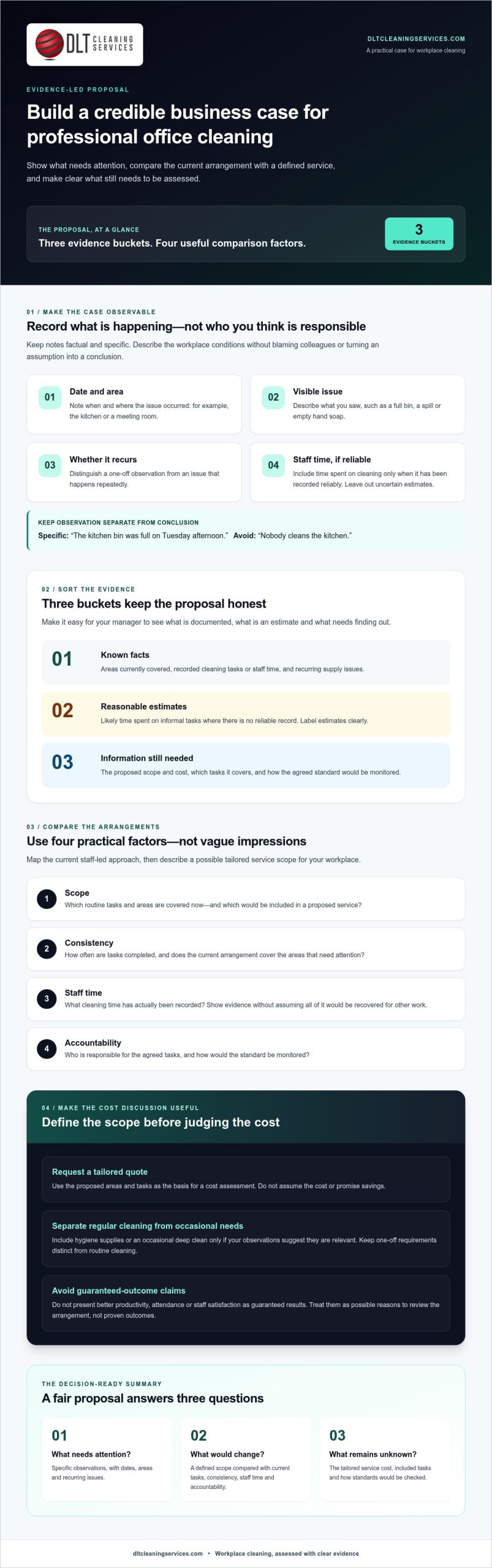
Keep observations separate from conclusions. “The kitchen bin was full on Tuesday afternoon” is specific; “nobody cleans the kitchen” is an assumption. Record the date, location and issue, and note whether it happens repeatedly. This gives your manager a fair picture of the problem and a basis for deciding whether the current arrangements need to change.
Turn everyday cleaning concerns into observable evidence
For a short period, note recurring conditions in shared areas, kitchens, washrooms and meeting rooms. Include practical details, such as a spill left on a floor, empty hand soap or a meeting room that needs attention before a visitor arrives. Avoid singling out staff. The evidence should describe the workplace, not speculate about who was responsible.
- Record the date, area and visible issue.
- Note whether the issue happened once or repeatedly.
- Ask colleagues for concise feedback about practical concerns.
- Estimate time spent on cleaning only when staff can do so reliably.
Feedback might reveal that people are unsure whose role it is to restock supplies, or that someone regularly wipes down a shared surface before using it. Treat comments as individual experiences, not proof that every employee shares the same view. If time estimates are uncertain, leave them out rather than presenting a guess as a measured cost.
Describe the business impact without overstating it
Explain what an observation affects in practical terms. For example, a meeting room that needs a quick tidy before a client visit may interrupt someone’s preparation. Uncertainty over who empties a kitchen bin may leave the task undone. These examples show why the issue matters without claiming that professional cleaning will automatically improve productivity or reduce absence.
Staff feedback or attendance information can add context if it’s available, relevant and interpreted carefully. A few comments may point to concerns worth discussing, but they don’t establish a workplace-wide pattern. Likewise, an absence record cannot by itself show that cleanliness caused illness. Distinguish documented facts from reasonable estimates and questions that still need answering.
Cleanliness is one part of a wider workplace environment. A general introduction to Occupational Safety and Health explains the broader focus on preventing illness and injury at work; your notes should stay specific to conditions you’ve observed. The result is a measured case for reviewing cleaning needs, not a promise of a particular business outcome.
Build a Credible Business Case for Professional Office Cleaning
Once you’ve identified what needs attention, compare the current arrangement with a clearly defined alternative. Focus on practical differences: which tasks are covered, how consistently they’re completed, how much staff time is involved and who is accountable for the agreed standard. This gives your manager something concrete to assess, rather than a general request for a cleaner office.
Compare staff-led cleaning with a professional service
Map out who currently handles routine tasks, such as wiping shared surfaces, emptying bins or replenishing washroom supplies. Check whether these duties are assigned, how often they’re done and whether the current scope covers the areas your workplace needs. Then describe a possible service scope for comparison. A tailored office cleaning plan can set out relevant areas and tasks without assuming every business needs the same arrangement.
Be careful with staff time. Separate time employees have recorded from estimates, and don’t treat informal cleaning as cost-free simply because it isn’t a separate budget line. Equally, don’t claim that all this time could be recovered for other work. Present the evidence and let your manager judge its significance.
Make costs and benefits transparent
Set out the proposed scope and request a tailored quote as an input to the decision, rather than assuming the cost or promising savings. Include hygiene supplies or an occasional deep clean only if your observations suggest they’re relevant. Keep regular cleaning needs distinct from one-off requirements so the proposal remains proportionate.
A practical comparison can distinguish what you know from what you still need to find out:
| Category | Example |
|---|---|
| Known facts | Which areas are currently covered; recorded cleaning tasks or staff time; recurring supply issues. |
| Reasonable estimates | Likely time spent on informal tasks where no reliable record exists. Label estimates clearly. |
| Information still needed | The cost of a proposed scope, what tasks it covers and how standards would be monitored. |
Don’t present possible improvements to productivity, attendance or staff satisfaction as guaranteed results. They may be reasons to review the arrangement, but workplace evidence and a defined proposal are stronger than unsupported promises.
Cleaning also sits within the wider context of workplace health and safety. Check current Health and Safety Executive (HSE) guidance before citing specific UK duties or requirements. The health and safety compliant cleaning guide offers further workplace context. Keep legal or compliance points in your proposal specific to your workplace and supported by current UK guidance.
If you’re working out how to convince my boss we need professional cleaners, make the next step easy to assess: share your comparison and propose obtaining a tailored scope and quote. Explore tailored office cleaning as a basis for that discussion.
Address the Main Objection: Is Professional Cleaning Worth the Cost?
Cost is a fair concern. A manager needs to know what a cleaning arrangement would cover and how it compares with the current approach, not simply be told that a professional service is worthwhile. The balance depends on the space, the tasks required and how those tasks are handled now.
Keep the comparison practical. Set out the proposed cleaning scope alongside existing arrangements, including who manages supplies, assigns tasks and follows up when something is missed. Account for staff time only where it can be estimated credibly, and avoid counting the same time or supply expense twice. The aim is to make the trade-offs visible, not to claim outsourcing will always save money.
Respond when your boss says existing staff can manage
Acknowledge the work colleagues already do before discussing gaps. Staff may be keeping some areas presentable, while routine tasks remain inconsistent or responsibilities are unclear. Suggest agreeing who handles each task and what standard is expected. This gives the current arrangement a fair comparison with a professional service and helps identify whether the issue is workload, unclear ownership or the scope of cleaning.
Cleaning duties can compete with an employee’s main responsibilities, but don’t present every minute as lost productive time. Use reliable records where possible; otherwise, describe the disruption without assigning it a made-up monetary value. Your manager can then decide whether the trade-off is acceptable or whether another arrangement merits consideration.
Respond when budget is the main concern
If the budget is tight, focus first on the areas with the clearest operational or hygiene need. A proposed scope might prioritise regular cleaning in frequently used spaces, with occasional deep-clean work considered separately if the workplace requires it. Include hygiene services or supplies only where they address a specific need, rather than adding them automatically.
Ask management to compare a tailored service scope and quote with current staff time, supplies and the effort involved in organising tasks. Mark each figure as recorded, estimated or still to be established. Don’t promise a return on investment, reduced absence or improved performance; those outcomes depend on factors a cleaning proposal alone can’t control.
To keep the decision proportionate, suggest a staged discussion rather than presenting a commitment as the only option. Management could first agree the priority areas, review a proposed scope and decide what evidence would help assess whether it fits. If a service is put in place, a defined review point can help the business consider whether the agreed tasks and standards suit its needs. This is a way to assess fit, not a promise of a particular result.
For anyone weighing how to convince my boss we need professional cleaners, a calm response to cost objections is stronger than insisting that a service will pay for itself. Present what the current approach involves, explain where it falls short and let the decision rest on a fair comparison of scope, time and accountability.
Presenting Your Proposal to Your Boss: Meeting Plan
A short, well-prepared conversation is more likely to stay focused on the workplace need than an informal complaint raised in passing. Ask your manager for a brief discussion at a suitable time, and share a one-page summary in advance if that would help them prepare. Your goal is to agree a practical next step, not force an immediate decision.
Prepare a one-page office cleaning proposal
Keep the document easy to scan. Summarise the observations and affected areas, then set out a possible scope and why those tasks matter. Separate recorded facts from estimates, include relevant staff feedback without naming individuals, and finish with the decision or information needed. A proposed review point can help management consider how an arrangement would be assessed if it proceeds.
- Workplace issue: What has been observed, where, and how often?
- Current arrangement: Who handles the tasks, and what responsibilities or gaps are evident?
- Suggested scope: Which areas and tasks should be considered first, and why?
- Decision needed: Should management explore a tailored service scope, gather a quote or review current responsibilities?
- Review approach: What standards or feedback would help assess whether the agreed arrangement is working?
Keep the proposal proportionate. If washrooms and shared kitchens are the main concern, explain why those areas come first rather than adding every possible task. This makes it easier to discuss priorities, responsibilities, likely disruption and how the workplace could review the decision.
Make the meeting constructive and decision-ready
Present your points in a clear order: prepare the evidence, define the scope, compare practical options, then ask for a decision or next step. Listen to concerns about budget, access, disruption and accountability. If your manager asks about details you don’t have, note them as information to gather rather than guessing.
- Prepare: Bring your concise observations and one-page summary.
- Define: Explain the priority areas and tasks, keeping assumptions labelled.
- Present: Discuss the current arrangement alongside options, including a tailored office cleaning service for management to assess.
- Request: Ask whether to obtain further information, clarify existing responsibilities or consider a proposed scope.
You could open with: “I’d like to discuss a few recurring cleaning issues and whether our current arrangements cover the workplace’s needs. I’ve summarised what I’ve observed and would value your view on a practical next step.”
This calm framing keeps the conversation about standards and workable responsibilities, not who is to blame. A tailored service is one option to assess; DLT’s office cleaning service can provide a starting point for considering a workplace-specific scope.
What a Professional Office Cleaning Solution Could Look Like in Guildford
A proposal doesn’t have to mean adopting a standard package or including every possible task. A practical office cleaning solution starts with the workplace itself: its layout, how different areas are used and the requirements management has agreed. This gives your boss a clearer option to assess against the issues you’ve documented, rather than a broad request for “more cleaning”.
Match the proposed service to the workplace
Routine office cleaning can form the core of an ongoing plan, with tasks and priorities tailored to the business. If the evidence points to washroom upkeep or a need for specific supplies, bathroom deep cleans and janitorial supplies can also be included. Keep the proposed scope tied to identified needs, and use the complete office cleaning guide for Surrey to explore broader service considerations.
For example, a workplace might prioritise regularly used shared areas and washrooms, while another may need a different balance based on its facilities and agreed requirements. A tailored plan makes clear which areas and tasks are in scope. That clarity supports a more useful conversation about standards, responsibilities and how the arrangement will be managed.
Make the next step straightforward for management
Bring your evidence and priorities to the discussion, then invite your manager to consider a suitable scope. DLT Cleaning Services Ltd is a family-run company established in 1999, serving businesses in Guildford and across Surrey, Hampshire and Berkshire. Dedicated on-site supervision for cleaning contracts provides oversight of agreed standards.
Management can consider the proposed tasks, relevant hygiene needs and how standards should be reviewed before deciding whether the scope is appropriate. Keep the next step measured: first define what the workplace needs, then assess a proposal against those requirements.
If you’re working out how to convince my boss we need professional cleaners, a tailored option gives the discussion something concrete to assess. Share the workplace’s priorities and preferred scope with DLT, and request a tailored proposal for your business. A clear match between observed needs and agreed tasks is a practical place to begin.
Take the Next Step Towards a Cleaner Workplace
A convincing proposal doesn’t need to settle every detail in one meeting. It can help your manager decide what information is needed next, who should be involved and how the workplace will judge whether an agreed cleaning arrangement meets its needs. Keep the discussion open and practical; priorities can be refined as the scope takes shape.
If you’re still considering how to convince my boss we need professional cleaners, focus on making the decision straightforward rather than pressing for an immediate yes. A clear brief gives management room to assess the approach and agree a sensible way forward.
DLT Cleaning Services Ltd brings a family-run approach to office cleaning, with dedicated on-site supervision for cleaning contracts. Discussing a tailored proposal gives management a practical way to consider a cleaning plan shaped around the business’s needs.
With a clear proposal and the right conversation, you can help turn a recurring concern into a constructive workplace decision.
Frequently Asked Questions
How do I convince my boss to hire professional cleaners?
Make the case about workplace needs, not colleagues’ shortcomings. If you’re considering how to convince my boss we need professional cleaners, explain how the current arrangement affects shared spaces, staff responsibilities or visitor preparation. Suggest a practical next step, such as agreeing priority areas for a proposed scope. Your manager may need to weigh budget, timing and operational requirements before deciding.
What evidence should I show my boss to justify office cleaning?
Use a short record of recurring issues, relevant staff feedback and any reliable information about time spent on cleaning. Add context that helps your manager judge the significance, such as whether a shared room needed attention before a scheduled client meeting. Avoid turning individual comments into a claim about the whole workforce. If you have internal feedback or facilities records, use them only for what they actually show.
Can professional office cleaning save a business money?
It may change how the business allocates resources, but savings aren’t automatic. Compare a proposed service scope with the existing arrangement, including supplies, equipment or time spent organising cleaning tasks. Include staff time only where it can be estimated credibly, and don’t assume it would all be redirected to paid work. A quote and an honest comparison can help management assess the financial trade-offs for its workplace.
How should I respond if my boss says office cleaning costs too much?
Acknowledge the budget concern and ask which areas or tasks management considers the highest priority. You could suggest comparing a focused scope for those needs with a broader option, while keeping occasional deep-clean work separate from routine requirements. Make clear which figures are confirmed and which are estimates. This gives your boss room to consider a proportionate approach without pressure to accept a particular service or a promise of savings.
Should employees be responsible for cleaning the office?
Employees can reasonably be expected to leave shared spaces tidy after use, but routine cleaning responsibilities should be clear and manageable. Consider whether staff are being asked to take on tasks that require specific products, equipment or handling procedures, and whether expectations differ between teams. Agreeing what staff should do, and what falls outside those everyday habits, can help management identify whether the current arrangement suits the workplace.
What should a proposal for professional office cleaning include?
Include the workplace’s priority areas, the tasks to be considered and any requirements that could affect the scope, such as shared facilities or access arrangements. Note who will review standards and how staff can raise issues. Identify decisions still needed, including which tasks are essential and whether hygiene supplies are relevant. This helps turn a general request into a brief that management can assess and use to seek a tailored proposal.
How can I raise office cleaning concerns without sounding critical?
Use neutral language and describe the effect on work rather than attributing fault. For example: “Could we review how the shared kitchen is maintained? The current arrangement seems unclear, and I’d like to discuss whether the tasks are covered.” Invite your manager’s perspective and recognise any steps colleagues already take. A calm, specific conversation supports a constructive discussion about responsibilities and suitable next steps.
Can a professional cleaning company tailor its service to a Guildford office?
Yes. DLT Cleaning Services Ltd tailors office cleaning to a Guildford workplace’s layout, priorities and agreed requirements. The scope can cover routine office cleaning, with bathroom deep cleans or janitorial supplies included where they meet an identified need. Share details such as the areas in use and the main cleaning priorities so the proposal reflects your business, rather than assuming every office needs the same arrangement.