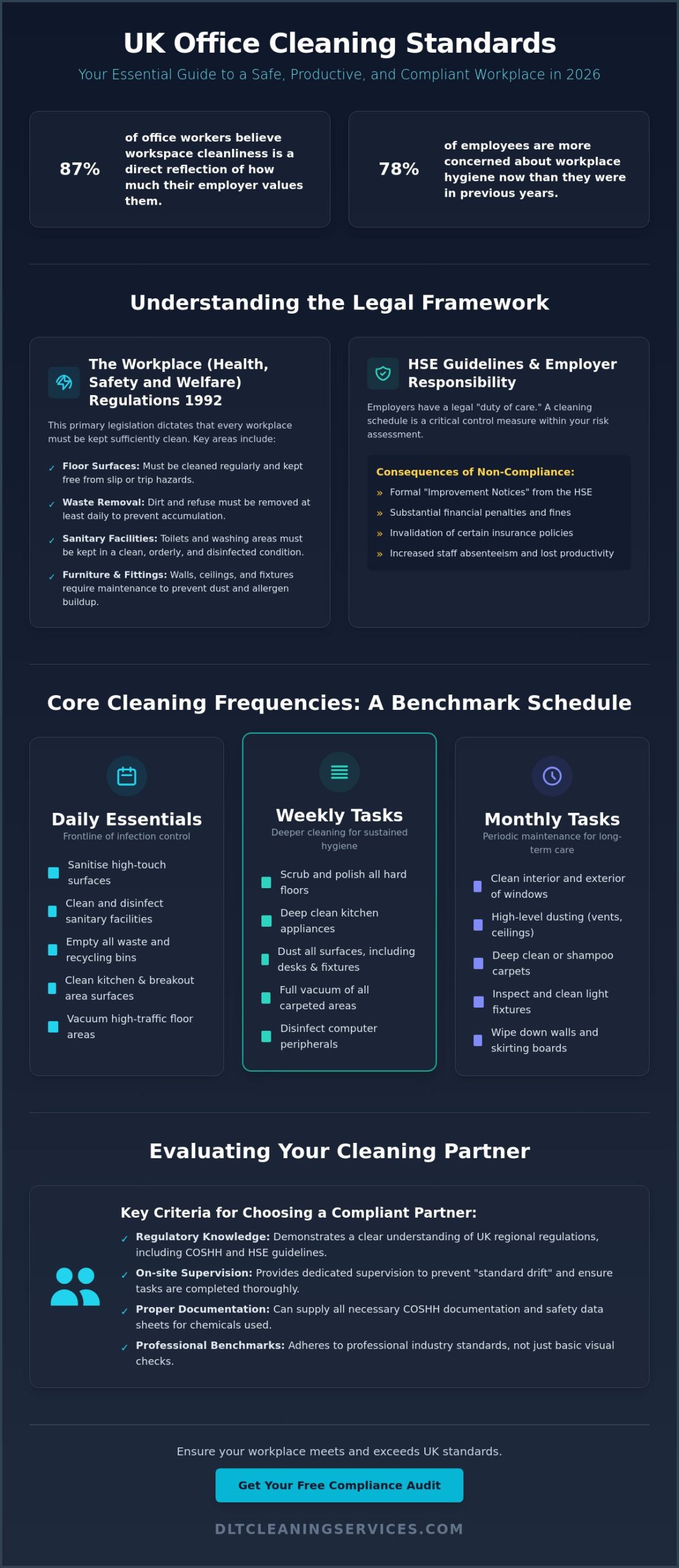
Did you know that 87% of office workers believe the cleanliness of their workspace is a direct reflection of how much their employer values them? You’re likely already aware that a tidy desk boosts morale, yet staying on top of the specific office cleaning standards UK regulators expect in 2026 can feel like a moving target. It’s a common challenge to manage the gap between inconsistent contractor performance and the genuine health anxieties of your staff; particularly whilst you’re trying to separate basic best practice from the strict legalities of the Health and Safety at Work etc. Act 1974.
This guide provides the professional clarity you need to ensure your workplace is safe, productive, and fully compliant. We’ll outline the essential legal requirements, including the latest COSHH updates and EN infection control certifications. You will also discover a practical framework for auditing your own cleaning provision. This approach helps you drive up quality, reassure your team, and ultimately reduce absenteeism through a more methodical and dedicated approach to hygiene.
Key Takeaways
- Understand the legal framework behind UK workplace hygiene, including the specific role of the Health and Safety Executive (HSE) guidelines.
- Learn how to set clear benchmarks for daily and weekly routines to maintain the office cleaning standards UK businesses need for long-term compliance.
- Identify the essential COSHH documentation your contractor must provide to ensure chemical safety and regulatory adherence.
- Recognise the importance of on-site supervision in preventing standard drift and verifying that hygiene tasks are performed thoroughly.
- Gain a framework for evaluating cleaning partners based on their knowledge of regional UK regulations and professional benchmarks.
Understanding the Legal Framework: UK Office Cleaning Standards
Maintaining a compliant workplace starts with the recognition that hygiene is a legal obligation, not an optional extra. For many years, businesses relied on a “visual” check to determine if an office was clean. If the carpets looked vacuumed and the bins were empty, the standard was met. In 2026, this subjective approach is no longer sufficient. High-profile health challenges and a shift in employee expectations have turned hygiene into a core pillar of corporate liability. According to industry research, 78% of employees are now more concerned about workplace hygiene than they were previously, making rigorous commercial cleaning standards a vital part of staff retention and safety.
Professional office cleaning standards UK managers must follow go far beyond domestic expectations. Whilst a home clean focuses on comfort, a professional standard focuses on the mitigation of risk and the suppression of pathogens. This requires a methodical approach that aligns with specific Health and Safety Executive (HSE) expectations and statutory instruments.
The Workplace (Health, Safety and Welfare) Regulations 1992
This legislation is the primary driver for cleanliness in the British office. It dictates that every workplace must be kept sufficiently clean to ensure the health and safety of every person at work. The regulations are specific about several key areas:
- Floor surfaces: Floors must be cleaned regularly and kept free from obstructions or substances that could cause slips, trips, or falls.
- Waste removal: Dirt and refuse must not be allowed to accumulate; it should be removed by a suitable method at least daily.
- Sanitary facilities: Washing facilities and toilets must be kept in a clean and orderly condition. This includes ensuring that surfaces are disinfected to prevent the spread of bacteria amongst staff.
- Furniture and fittings: All internal walls, ceilings, and permanent fixtures must be maintained to a level that prevents the buildup of dust or allergens.
HSE Guidelines and Employer Responsibility
The HSE provides the framework through which these regulations are enforced. As an employer, you have a “duty of care” to provide a healthy environment. This duty is legally tested through risk assessments. A cleaning schedule is not just a list of tasks; it is a control measure designed to prevent hazards such as respiratory issues from dust or the spread of viral infections.
Failing to meet these office cleaning standards UK requirements carries significant weight. Non-compliance can lead to formal “Improvement Notices” from the HSE, substantial fines, and even the invalidation of certain insurance policies. When an office environment is neglected, the resulting rise in absenteeism creates a measurable drain on productivity. By treating cleaning as a regulated necessity rather than a background cost, you protect both your people and your professional reputation.
Maintaining a professional office environment also includes the upkeep of fixtures and fittings; if you are looking to refresh your workplace kitchen or windows with a high-quality finish, check out Casalinga Design.
Core Cleaning Frequencies: Daily, Weekly, and Monthly Benchmarks
Establishing a consistent schedule is the only way to prevent “standard drift” in a busy workplace. Whilst every facility has unique requirements, adhering to established office cleaning standards UK professionals recommend ensures that hygiene remains a constant, rather than a reaction to a complaint. In 2026, hybrid working patterns mean that occupancy fluctuates; however, the legal duty under the Workplace (Health, Safety and Welfare) Regulations 1992 remains fixed. You must ensure that high-traffic zones and shared facilities are maintained to a level that prevents the spread of illness amongst your team.
Frequency should always be dictated by staff behaviour and footfall. If your office is at full capacity on Tuesdays and Wednesdays, your cleaning intensity should reflect that. A “one size fits all” approach often leads to wasted resources on quiet days and insufficient hygiene on busy ones. A dedicated approach involves auditing these patterns to keep the environment safe without unnecessary costs.
Daily Essentials for Hygiene Maintenance
Daily cleaning forms the frontline of infection control. It’s not just about emptying bins. It’s about breaking the chain of transmission. High-touch surfaces like door handles, lift buttons, and shared printers require sanitisation at the end of every shift. In kitchen and breakout areas, food-borne illnesses are a genuine risk if surfaces aren’t degreased and disinfected correctly. We also advocate for a strict colour-coded cleaning system. Using specific colours for cloths and mops, such as red for washrooms and green for kitchens, is an industry benchmark that prevents cross-contamination. It’s a simple yet effective way to ensure that bacteria never travels between zones.
Periodic Deep Cleaning Requirements
Weekly and monthly tasks target the hidden bacteria that daily wipes often miss. Shared IT equipment, such as keyboards and mice, are notorious hotspots for germs. A weekly sanitisation of these peripherals is essential, especially in hot-desking environments where multiple people use the same station. Maintaining these office cleaning standards UK businesses expect requires a methodical approach to periodic tasks. This includes quarterly carpet and upholstery care to remove deep-seated allergens and improve indoor air quality. Hard floors also require periodic buffing and sealing to maintain their professional finish and prevent grime from becoming ingrained. If you’re finding it difficult to manage these overlapping cycles, it might be time to review your current cleaning schedule with a partner who understands these professional benchmarks.
COSHH and Chemical Safety in the Modern Office
Compliance with office cleaning standards UK businesses must uphold extends directly into the safe management of substances. The Control of Substances Hazardous to Health Regulations 2002 (COSHH) provides the legal framework for this. It’s no longer acceptable to simply stock a cupboard with generic cleaning supplies. Every product used in your facility must be assessed for risk to ensure it doesn’t harm your employees or the cleaning staff. This is a foundational element of workplace safety that requires a methodical and dedicated approach.
Your cleaning partner has a legal duty to provide Safety Data Sheets (SDS) for every substance stored on your premises. These sheets aren’t just administrative paperwork; they’re vital safety guides. They detail the exact chemical composition of a product and provide clear instructions on what to do in the event of a spill or accidental exposure. Proper labelling is equally critical. Professional-grade detergents should never be decanted into unlabelled or incorrectly marked bottles. This is a common but dangerous error that can lead to serious accidents in the workplace. Understanding how to strategically manage your janitorial supplies for the office — from correct storage to product selection — is an essential part of maintaining full COSHH compliance.
Managing Chemical Risks in Shared Spaces
Safety is often a matter of timing and environment. We always recommend that intensive cleaning occurs whilst staff aren’t in the immediate vicinity to minimise their exposure to airborne particles or fumes. Even when using modern, milder products, adequate ventilation remains a necessity. One of the most significant risks in janitorial work is the accidental mixing of chemicals. For example, combining bleach with certain acidic descalers can create toxic chlorine gas. Following COSHH for cleaning guidelines ensures your team stays safe from these avoidable hazards through proper training and supervision.
Sustainable Cleaning: Standards for 2026
In 2026, the definition of high standards has evolved to include environmental responsibility. There’s a clear shift towards non-toxic, plant-based agents that offer the same virucidal effectiveness as traditional chemicals without the harsh respiratory impact. These products often conform to the latest EN standards, proving they’re tough on pathogens but gentle on the people using the space.
Modern office cleaning standards UK benchmarks also focus on reducing single-use plastics. Many dedicated contractors now utilise refillable systems or concentrated dose pods to significantly lower their plastic waste. This transition isn’t just good for the planet; it supports your company’s broader ESG (Environmental, Social, and Governance) goals. Choosing a partner who prioritises these sustainable methods demonstrates a quiet confidence in your corporate values whilst maintaining a pristine working environment.
Implementing Standards through Dedicated Supervision
Establishing a comprehensive hygiene schedule is a vital first step, but even the most robust plans can fail without active oversight. We often see businesses struggle with what we call ‘standard drift.’ This occurs when small, seemingly minor tasks are overlooked day after day. Over time, these omissions accumulate until the overall hygiene of the workspace noticeably declines. To maintain the high office cleaning standards UK managers expect, a layer of dedicated supervision is essential. It bridges the gap between a written contract and the physical reality of a consistently sanitised environment.
Supervision isn’t just about pointing out missed spots. It’s about providing a reliable point of contact who takes ownership of the environment. When a supervisor is present on-site, they ensure that every member of the team understands their specific responsibilities and follows the correct protocols. This hands-on approach builds trust and ensures that the quality of work remains steady, regardless of how busy the office becomes. If you feel your current provision is lacking this level of oversight, you can enquire about our supervised cleaning services to see how dedicated management makes a difference.
The Supervised Cleaning Model
A dedicated on-site supervisor acts as the guardian of your workplace health. Their role involves more than just verifying task completion; they are responsible for real-time problem solving. If a specific area sees unexpected heavy use, the supervisor can redirect resources immediately to address the issue before it impacts staff well-being. They also ensure that all staff are motivated and trained in the latest office cleaning standards UK regulations. This proactive management style prevents small issues from escalating into significant health and safety concerns, allowing your team to focus entirely on their own operations whilst we handle the environment.
Auditing and Reporting Progress
Transparency is a core requirement for modern Health and Safety compliance. Maintaining a clear, accessible cleaning log is essential for any formal H&S inspection. These audits provide documented proof that your facility is meeting its legal obligations under the Workplace (Health, Safety and Welfare) Regulations 1992. For many firms in Surrey and the surrounding counties, we recommend a mix of digital and manual auditing. Digital systems allow for instant reporting and photo verification, whilst monthly face-to-face review meetings ensure the service remains aligned with your changing office needs. This methodical approach to reporting provides the peace of mind that comes from knowing your workplace is being managed with professional precision; for similar rigour in your financial auditing and tax planning, you can visit Davis & Co LLP.
Choosing a Partner to Meet UK Cleaning Standards
Selecting a provider who understands the nuances of office cleaning standards UK regulations is a critical decision for any facility manager. It’s not simply about finding a team to empty bins. It’s about finding a partner who shares your commitment to workplace health. A contractor with deep roots in Surrey, Hampshire, and Berkshire offers a level of accountability that larger, national franchises often struggle to match. When a business is locally managed, response times are faster. The personal investment in the community’s success is much higher. Whilst many national firms prioritise volume, we focus on the specific, individual needs of each client.
A family-run enterprise brings a unique ‘hands-on’ quality to the service. There’s a sense of quiet confidence that comes from stable leadership and a dedicated team that’s worked together for years. This stability is particularly important for staff vetting and insurance. You need to know that every person entering your building has been thoroughly checked. You also need to be certain the company carries comprehensive public and employer’s liability insurance. These are the foundational elements of a professional relationship that prioritises your peace of mind. We believe that a cleaning partner should be an extension of your own team, taking ownership of the environment so you don’t have to. For a broader perspective on how to improve workplace hygiene across every area of your office, our comprehensive guide for Surrey office managers offers practical strategies to reduce sickness absence and raise standards.
Questions to Ask Your Potential Cleaning Company
Before signing a contract, it’s helpful to probe the operational depth of the provider. Don’t be afraid to ask direct questions about their management structure and compliance history. Our supervisors ensure that high standards are maintained amongst all staff members through consistent training and oversight.
- Do you provide on-site supervision for every contract?
- How do you ensure compliance with the latest HSE guidelines?
- Can you provide references from other firms in Guildford or Woking?
The DLT Commitment to Excellence
Since our founding in 1999, DLT Cleaning Services Ltd has been a steady presence in the South East business community. For over 25 years, we’ve refined our approach to hygiene services, moving far beyond basic surface cleaning to provide a truly managed environment. We take personal pride in our work. We treat every office as if it were our own. This dedication ensures that the standards we set on day one are the same standards we maintain years into the relationship. Our long-standing clients in Surrey and Hampshire value this consistency. We remain dedicated to supporting the local economy by providing reliable employment and exceptional service. If you are ready to elevate your workplace hygiene, you can Request a professional office cleaning quote for your Surrey workplace today.
Elevating Your Workplace Hygiene for 2026 and Beyond
Maintaining a compliant and healthy environment requires a proactive strategy that balances legal duty with employee well-being. You’ve discovered how the modern legal framework and specific cleaning frequencies form the necessary foundation for a safe office. By prioritising rigorous office cleaning standards UK managers can protect their staff and their professional reputation from the risks of ‘standard drift’. Moving towards a regulated, supervised hygiene model ensures that your workspace remains a productive hub rather than a source of concern.
DLT Cleaning Services Ltd has supported the South East business community as a family-run enterprise since 1999. Our dedicated on-site supervision and full H&S and COSHH compliance mean you can focus entirely on your core operations whilst we take ownership of your environment. We’re ready to help you bridge the gap between basic maintenance and professional hygiene excellence. Secure a high-standard cleaning contract for your office today and enjoy the stability that comes with expert, local care.
Frequently Asked Questions
What are the legal requirements for office cleaning in the UK?
The primary legal requirements are set out in the Health and Safety at Work etc. Act 1974 and the Workplace (Health, Safety and Welfare) Regulations 1992. These laws mandate that employers must keep their premises, furniture, and fittings sufficiently clean to ensure the health and safety of staff. This includes maintaining floor surfaces to prevent slips and ensuring that waste is removed daily to avoid hygiene hazards.
How often should an office be deep cleaned by law?
UK law doesn’t specify a fixed calendar frequency for deep cleaning; instead, it requires that cleanliness is maintained based on a thorough risk assessment. Whilst daily cleaning handles surface dirt, most professional office cleaning standards UK benchmarks suggest a full deep clean every six to twelve months. This frequency should increase for high-traffic environments or shared facilities where the risk of pathogen spread is higher.
What is COSHH and why does it matter for office cleaning?
COSHH stands for the Control of Substances Hazardous to Health Regulations 2002. It matters because almost all professional cleaning agents contain chemicals that could be harmful if misused. Employers must assess the risks of these substances, provide safe storage, and ensure that anyone handling them has received proper training. This regulation protects both the cleaning staff and the office employees from respiratory issues or skin irritation.
Who is responsible for cleaning standards in a shared office building?
Responsibility is typically divided between the landlord and the tenant. The landlord usually manages communal areas like lifts, lobbies, and shared stairwells, whilst the tenant is responsible for their own demised office space. However, as an employer, you always retain a legal duty of care for the health and safety of your staff within your specific working environment, regardless of the building’s management structure.
Can an office be fined for poor cleaning standards?
Yes, the Health and Safety Executive (HSE) has the authority to issue improvement notices or substantial fines if hygiene levels fall below legal requirements. Poor office cleaning standards UK compliance can also lead to civil claims from employees if they fall ill due to a neglected environment. Maintaining high standards is a vital safeguard against these legal and financial risks.
What should be included in an office cleaning risk assessment?
A cleaning risk assessment must identify potential hazards such as chemical exposure, wet floors, and cross-contamination. It should clearly outline the control measures in place, such as using “Caution” signs during mopping or providing staff with appropriate personal protective equipment (PPE). The document should also record training protocols and the safe handling procedures for all equipment and detergents used on-site. For guidance on selecting the right products and equipment, our strategic guide to janitorial supplies for the office provides a practical checklist to support your compliance planning.
How do I know if my cleaning contractor is meeting UK standards?
You can verify a contractor’s standards by requesting their recent audit reports, staff training records, and current COSHH safety data sheets. A dedicated contractor will also provide evidence of on-site supervision and adherence to industry best practices, such as the colour-coding systems mentioned earlier in this guide. Consistent communication and transparent reporting are the hallmarks of a compliant partner.
What are the 2026 hygiene standards for office bathrooms?
Current standards focus on rigorous infection control and the continuous availability of essential supplies. Bathroom facilities must be cleaned at least daily with professional-grade disinfectants, paying close attention to high-touch areas like taps, flushes, and door locks. There’s also a heightened focus on ensuring adequate ventilation and providing high-quality hand-washing facilities to prevent the transmission of bacteria amongst the workforce.
2 thoughts on “Office Cleaning Standards UK 2026: A Manager’s Guide to Compliance and Hygiene”