What if the right office cleaning plan isn’t the one with the longest task list, but the one that fits how your team uses the space? Choosing bespoke office cleaning packages Guildford businesses can rely on means setting priorities around your premises, rather than adding every possible service. Reception areas, shared kitchens, washrooms and meeting rooms may each need different attention. If you’re unsure what needs regular cleaning or how to fit a schedule around the working day, a clear starting point can help.
A tailored package takes your office layout, routines and hygiene priorities into account, with oversight to support consistent standards. DLT Cleaning Services Ltd is a family-run company established in 1999, with directly employed cleaners and dedicated on-site supervision for each contract. This guide explains how to identify workplace priorities, plan cleaning around business routines and consider hygiene services alongside office cleaning. You’ll come away with a clearer idea of what a practical plan could look like for your Guildford workplace.
Key Takeaways
- Shape bespoke office cleaning packages Guildford workplaces can use around their layout, daily activity and priority areas.
- Build a clear scope by assessing the premises, prioritising tasks, planning suitable timing and managing delivery.
- Separate routine office cleaning from additional hygiene or specialist needs, such as carpet and upholstery cleaning, window cleaning or deep cleaning.
- Prepare a practical brief covering your office layout, priority areas, operating hours, access arrangements and hygiene requirements.
- Look for clear accountability: DLT’s directly employed, carefully interviewed, DBS-checked and fully insured cleaners are supported by dedicated on-site supervision for each contract.
Why choose bespoke office cleaning packages in Guildford?
Offices differ in layout, occupancy, access and daily use, so a standard checklist can give too much attention to quiet rooms and too little to busy shared spaces. An open-plan floor with meeting rooms and a staff kitchen has different priorities from a compact office where visitors enter through reception. The aim is to build a plan around actual use, not add every available service.
A bespoke office cleaning package matches the tasks and timing to the spaces people use and the way the business operates. For Guildford businesses, that may mean prioritising client-facing areas while also addressing spaces employees rely on throughout the day. A clean, organised environment supports staff wellbeing and helps present a professional image to visitors.
Cleaning has visible, hygienic and safety considerations; the general principles of cleaning provide wider context. In an office, turning those aims into a workable routine means considering which areas see the most use and when they can be cleaned with minimal interruption.
Which office conditions should shape a cleaning package?
Start with the premises. Note the size and layout, shared areas and how staff move through them. A kitchen used by the whole team may need more attention than a room used occasionally. Washrooms and entrances are often high-use areas, while a quieter office or storage space may have different priorities.
Then consider the working pattern. Business hours, building access, regular meetings and shift changes can all affect suitable cleaning times. These details help distinguish essential tasks from occasional needs and make it easier to plan around the office. A clear picture of a typical day helps create a realistic scope for staff and cleaners alike.
What does a tailored package help an office achieve?
A considered plan gives regular attention to the areas that shape daily experience: a tidy entrance, orderly shared spaces, and clean kitchens and washrooms. It recognises that rooms have different demands and gives managers a clear basis for discussing priorities and reviewing whether the agreed scope still reflects how the premises are used.
Suitable routines can support a hygienic environment by keeping frequently used areas in view and making responsibilities easier to organise. Needs may change as teams, room use or business routines change, so priorities can be revisited. For wider context on planning workplace standards, the complete manager’s guide to office cleaning in Surrey explores broader considerations for an office cleaning approach.
How DLT can shape office cleaning around your workplace
A useful cleaning plan starts with how your premises operate, not a preset list of tasks. DLT shapes office cleaning around the workplace by considering the building, identifying priorities, planning suitable timing and managing delivery. The scope and schedule reflect your requirements, directing routine attention where it matters and organising cleaning around business activity.
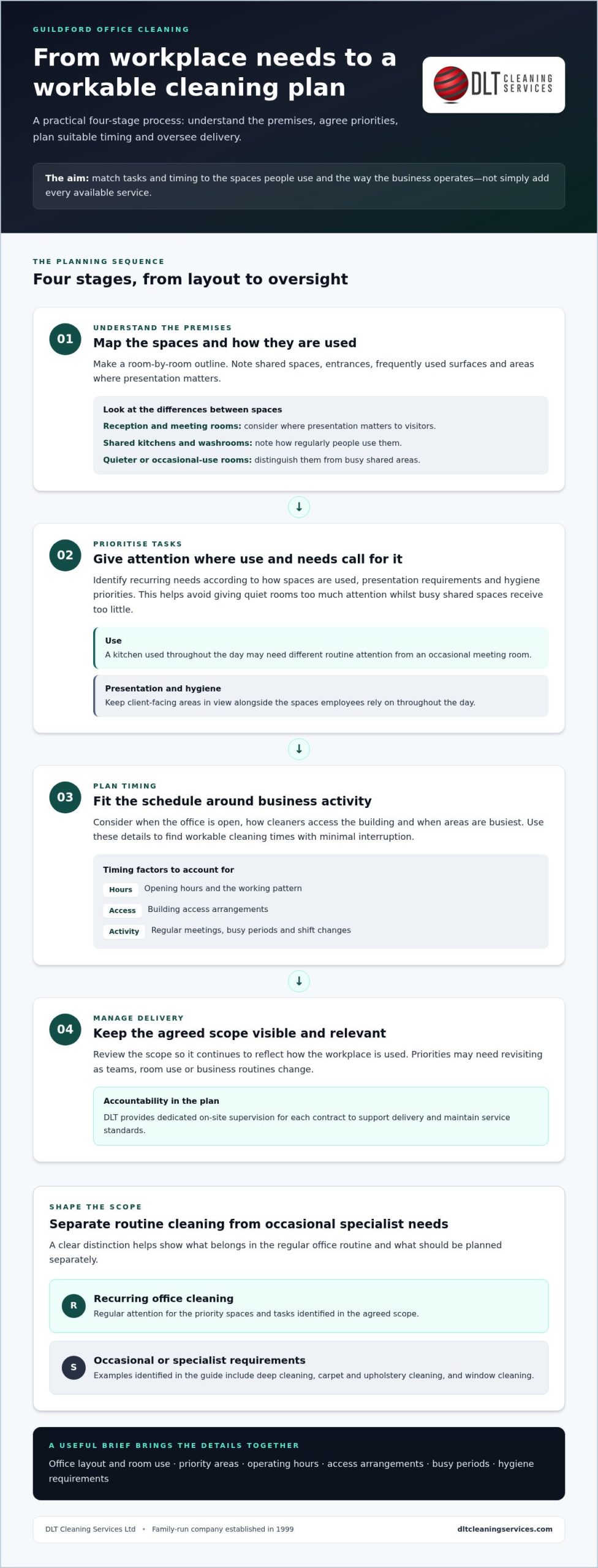
To plan a tailored office cleaning package, assess the premises, agree priorities, organise the timing and oversee the work. This gives managers a clear way to explain what matters and turns day-to-day needs into a practical scope.
- Understand the premises. Map rooms, shared spaces and entrances, noting how staff and visitors use them.
- Prioritise tasks. Identify recurring needs according to use, presentation and hygiene priorities.
- Plan timing. Consider opening hours, access arrangements and busy periods to find a workable schedule.
- Manage delivery. Keep the agreed scope under review so the service stays aligned with the workplace.
Start with the office layout, use and priorities
Make a room-by-room outline. Note shared spaces, frequently used surfaces and areas where presentation matters, such as reception or meeting rooms. Distinguish these from less-used rooms. A kitchen used throughout the day, for example, has different routine needs from an occasional meeting room. Opening hours, building access and scheduled activities also help determine what can be done and when.
Organise tasks and timing into a workable scope
Separate recurring office cleaning from occasional specialist requirements. This clarifies what belongs in the regular routine and which additional needs, such as deep cleaning or carpet and upholstery cleaning, should be treated separately. Plan the schedule around staff and business activity, taking account of access and periods when particular areas are busy.
For further guidance on workplace hygiene planning, DLT’s tailored office cleaning services guide explores how priorities can be organised around a workplace’s needs. You can also consider wider sanitation references in context: OSHA sanitation standards for workplaces are US standards, not UK requirements, but describe topics such as housekeeping and waste disposal.
Once the scope is agreed, consistent oversight matters. Each DLT contract receives dedicated on-site supervision, providing accountability for managing delivery and maintaining service standards. This keeps agreed priorities visible and gives the cleaning arrangement structure as workplace needs evolve. To explore DLT’s approach, visit DLT’s office cleaning services.
Which cleaning services belong in a Guildford office package?
A useful office package separates cleaning that supports day-to-day operations from services addressing specific hygiene or specialist needs. This makes it easier to decide what belongs in the regular scope and what is needed for particular areas or circumstances. With bespoke office cleaning packages Guildford businesses can prioritise services that suit their premises, rather than assuming every option belongs in the plan.
DLT provides Office Cleaning and Hygiene Services, alongside Carpet & Upholstery Cleaning, Window Cleaning and Deep Cleaning. The right combination depends on the workplace and its requirements. Use the table as a starting point for discussing the scope, not as a fixed list of package inclusions.
| Service area | How it may fit an office’s needs |
|---|---|
| Office Cleaning | The core service for maintaining office environments, with priorities shaped around the premises and agreed scope. |
| Commercial Janitorial Services | A workplace cleaning service to consider according to the spaces and tasks the business needs to address. |
| Hygiene Services | Addresses specific hygiene requirements, including Bathroom Deep Cleans and Janitorial Cleaning. |
| Specialist cleaning | Carpet & Upholstery Cleaning, Window Cleaning and Deep Cleaning can address distinct needs within the premises. |
Routine office cleaning and commercial janitorial support
Office Cleaning is the central service to consider when planning the upkeep of an office. Define which areas and priorities belong in the scope rather than assuming a standard set of tasks. Commercial Janitorial Services are also available for workplace cleaning needs. Discuss routine office requirements separately from additional services for particular parts of the premises.
For example, an office may focus its regular cleaning scope on the spaces staff use most, while treating a particular room or surface as a separate requirement. A clear plan sets out agreed priorities and boundaries instead of treating every service as an automatic inclusion.
Hygiene and specialist cleaning options
DLT’s Hygiene Services include Feminine Hygiene, Air Care, Bathroom Deep Cleans, Janitorial Cleaning, Nappy Bin Services and Soap Care Products. Consider the relevant options in relation to your facilities and workplace priorities. Carpet & Upholstery Cleaning and Window Cleaning are separate services for specific needs involving furnishings or windows. Deep Cleaning, including Coronavirus sanitisation, addresses needs beyond the regular office cleaning scope.
These are options to assess, not a bundle to take in full. Identify which services suit your premises, then keep the agreed scope focused. This helps office managers explain their priorities without assuming a particular frequency or set of inclusions.
How to brief a Guildford office cleaning package
A clear brief turns broad expectations into a practical cleaning scope. Before discussing bespoke office cleaning packages Guildford businesses can use, gather details about the premises and how it operates. This gives the planning conversation a useful starting point and separates regular work from occasional or specialist needs.
Prepare a clear office cleaning brief
Describe the type of premises and how its rooms are used. A short room-by-room outline makes priorities easier to explain, particularly where areas are shared or used more heavily than others. Note practical opening hours and access arrangements so proposed timing can reflect how the business runs.
A useful brief could include:
- Layout: the rooms, shared spaces and facilities within the office.
- Priority areas: spaces needing particular attention for everyday use or presentation.
- Operating hours and access: working patterns, entry arrangements and any activity that affects cleaning.
- Hygiene requirements: relevant washroom or janitorial needs.
- Task type: essential routine cleaning, separated from occasional specialist requirements.
Be specific where it helps. For example, identify a shared washroom as a priority and describe a separate deep-cleaning need independently, rather than combining both into a vague request for “full cleaning”. This makes the scope easier to understand and discuss.
Set expectations for oversight and communication
Once priorities are clear, agree what the scope covers and who is responsible for overseeing the service. Clear responsibilities help keep delivery aligned with the agreed work, particularly if the office’s use or priorities change. DLT provides dedicated on-site supervision for each contract, supporting contract management and attention to agreed standards.
Workplace requirements can also inform the brief, especially where hygiene needs affect particular facilities or tasks. DLT’s health and safety compliant cleaning manager’s guide offers wider context for considering workplace standards as part of cleaning arrangements.
A useful brief doesn’t need to predict every future requirement. It should describe the premises, the work that matters most and practical constraints around access and timing. With that foundation, DLT can shape the office cleaning scope around the workplace’s needs. Discuss an office cleaning scope with DLT as a practical next step.
Choose a bespoke office cleaning package with DLT in Guildford
A well-matched cleaning arrangement needs more than a list of tasks. It needs a scope that reflects how your office is used, with clear oversight of delivery. DLT Cleaning Services Ltd is a family-run company established in 1999, providing office cleaning and hygiene services in Guildford. Its approach gives office managers a practical basis for discussing what their workplace needs.
What working with DLT means for your office
DLT’s office cleaning and hygiene services can be shaped around your premises. The discussion can focus on your required scope, relevant hygiene needs and working arrangements, rather than assuming every office needs the same tasks or services.
Accountability also depends on who carries out and oversees the work. DLT’s cleaners are directly employed, carefully interviewed, DBS-checked and fully insured. Each contract also receives dedicated on-site supervision. Direct employment establishes a clear relationship with the cleaning team, while on-site supervision supports contract management and attention to agreed standards.
This gives managers a clear way to explain which areas and tasks matter. The agreed scope guides delivery, and if workplace needs change, it provides a useful reference point for reviewing priorities.
Take the next step towards a tailored package
Before arranging a discussion, bring together practical details: the layout and type of premises, priority areas, hygiene requirements, operating hours and access arrangements. It can also help to separate essential routine cleaning from occasional specialist needs. A concise brief keeps the conversation focused on your workplace rather than a generic package.
These details don’t need to form a complicated specification. A straightforward outline of how the office operates and what matters most is enough to begin shaping bespoke office cleaning packages Guildford businesses can use. The cleaning scope and working arrangements can then be discussed in relation to your premises and priorities.
For a practical next step, discuss a bespoke office cleaning package in Guildford with DLT. Share the essentials of your workplace and the cleaning priorities you want to address.
Make your cleaning plan work for your team
A cleaning arrangement should work in practice, not just look comprehensive on paper. As your office changes, keep priorities grounded in how people use the space and what helps the working day run smoothly. A clear brief turns uncertainty about tasks and timing into a focused conversation about the right scope for your workplace.
If you’re considering bespoke office cleaning packages Guildford businesses can shape around their needs, bring your priorities and preferred working arrangements to DLT. The team can discuss how office cleaning and hygiene services fit your premises.
Start a conversation about your office cleaning needs and take a considered first step towards a cleaner, well-supported workplace.
Frequently Asked Questions
What does a bespoke office cleaning package include?
It includes the office cleaning tasks agreed for your premises, with the scope shaped around your workplace rather than a standard bundle. For bespoke office cleaning packages Guildford businesses can tailor, that may mean different priorities for staff areas, meeting rooms and visitor spaces. Relevant hygiene or specialist services can be discussed separately, so the plan reflects what your office needs without assuming every available service is included.
Can office cleaning be scheduled around business hours?
Yes, the cleaning schedule can take your business hours and access arrangements into account. Share when the office is busiest, which areas are in use throughout the day and any access restrictions. For instance, a regularly booked meeting room may need different timing from a space that is usually unoccupied. The schedule should reflect these practical details rather than assume one standard timetable.
How do I decide which areas of my office need regular cleaning?
Note how each area is used and what changes through a typical working week. Consider staff feedback, visible build-up and which spaces visitors use. A simple floor plan marked with busy, occasional and seldom-used areas can help clarify priorities. Review it if the team moves, room use changes or a new shared space is introduced.
Does a bespoke office cleaning package include bathroom hygiene?
Bathroom hygiene can be addressed through DLT’s Hygiene Services, which include Bathroom Deep Cleans and Janitorial Cleaning. The scope depends on the requirements agreed for your workplace, so bathroom services aren’t automatically part of every office cleaning package. Note the facilities your premises has and any particular hygiene needs when setting priorities. This helps distinguish routine office cleaning from relevant hygiene support.
Are DLT’s office cleaners directly employed and DBS-checked?
Yes. DLT’s cleaners are directly employed, carefully interviewed, DBS-checked and fully insured. These details give office managers useful context about the team working on their premises. DLT also provides dedicated on-site supervision for each contract, supporting oversight of the agreed cleaning scope.
Does DLT provide office cleaning in Guildford?
Yes, DLT Cleaning Services Ltd provides office cleaning in Guildford, alongside hygiene services for workplaces. You can outline the type of office, its main cleaning priorities and any access considerations to help shape a suitable scope. The discussion can focus on the areas and arrangements relevant to your workplace.
Can I add carpet or window cleaning to an office cleaning plan?
Yes, Carpet & Upholstery Cleaning and Window Cleaning are available as separate services to consider alongside office cleaning. They may suit workplaces with specific needs involving floor coverings, furnishings or windows. For example, you might identify a carpeted area needing focused attention or glazing that affects the appearance of reception. Discuss these as distinct requirements rather than assuming they’re included in routine office cleaning.