A washroom can look clean at a glance and still let a workplace down: floors show grime, dispensers run empty or deeper cleaning gets missed. The commercial washroom cleaning services Guildford businesses arrange need to cover more than a quick surface tidy. A clear plan should bring routine hygiene tasks, supplies and floor-care considerations together.
It’s understandable to want dependable standards without taking on another list of tasks. This guide explains what to compare when planning routine washroom cleaning, bathroom deep cleans, janitorial product supply and hard-floor maintenance. It also looks at how premises use and foot traffic shape a cleaning plan, and why clear oversight matters. DLT Cleaning Services Ltd is a family-run cleaning and hygiene company established in 1999. It provides office cleaning, bathroom deep cleans and janitorial products, with dedicated on-site supervision. The practical guidance below can help you plan a consistently maintained workplace in Guildford.
Key Takeaways
- Map washrooms and assess how they’re used to shape a practical cleaning plan around your premises.
- Compare commercial washroom cleaning services Guildford by the tasks covered, supply responsibilities and how standards are overseen.
- Separate routine hygiene tasks from bathroom deep cleans, then consider hard-floor care in relation to the surface type and condition.
- Set clear responsibilities and review them regularly to help keep washrooms tidy and essential supplies available.
- DLT’s office cleaning, bathroom deep cleans, janitorial products and on-site supervision can support a managed workplace approach.
What commercial washroom cleaning services in Guildford need to cover
Commercial washroom cleaning is best understood as a managed hygiene service for business premises, not a one-off tidy. It brings together regular cleaning, attention to frequently touched areas, floor-care considerations and the replenishment of essential products. Each element affects how staff and visitors experience the space. A polished mirror won’t make up for an empty soap dispenser, and a clean basin won’t make a floor feel cared for if dirt or moisture remains.
Guildford workplaces vary in size, layout and use. An office washroom used mainly by staff has different demands from facilities in a customer-facing workplace with a steady flow of visitors. Footfall, opening patterns, washroom layout and surface condition all help shape a suitable plan. That’s why commercial washroom cleaning services Guildford businesses arrange should reflect their premises, rather than apply the same checklist everywhere.
What belongs in a commercial washroom cleaning scope?
A useful scope names the areas and tasks instead of relying on a broad phrase such as “washroom clean”. It might cover toilets, sinks, taps, mirrors, dispensers and frequently touched points such as door handles. It should also say who replenishes products and who handles any agreed supply tasks. For a general overview of typical duties, see Commercial cleaning.
Routine cleaning keeps the space presentable and addresses everyday use. A bathroom deep clean is more thorough, giving attention to areas that routine upkeep may not fully address. Keeping these tasks distinct makes it easier to understand what happens during regular visits and what is planned separately. The scope can then reflect the premises, rather than assume every site needs the same frequency.
Why include washroom floors in the service discussion?
Floors are part of the washroom, not an optional afterthought. Their care should account for the material and finish, foot traffic and whether moisture is commonly present. Dirt can collect at edges and in corners, while dampness can affect how safely people move through the space. A plan that accounts for these conditions is more practical than treating every floor as if it were the same.
Before agreeing floor-maintenance tasks, note the floor finish and its condition. Manufacturer guidance can help inform suitable care, and site-specific risk controls matter when planning work around a shared area. Don’t assume one product or technique suits every surface. If the finish is uncertain, identify it first to help avoid care that could damage its appearance.
A clear written scope brings these details together: areas included, routine tasks, deep-clean responsibilities, floor-care considerations and supply arrangements. It also gives managers a basis for reviewing whether the service still reflects changing site use. DLT Cleaning Services Ltd provides office cleaning, bathroom deep cleans and janitorial product supply, supported by dedicated on-site supervision. Together, these services can form part of a managed approach suited to a Guildford workplace.
How washroom hygiene, deep cleaning and hard-floor care work together
A well-kept washroom depends on several kinds of upkeep working together. Routine cleaning addresses everyday use, a bathroom deep clean gives additional attention to areas that need more work, and product supply helps keep essentials available. Floor maintenance sits alongside these tasks, with care shaped by the surface and conditions on site. Coordinating the elements makes responsibilities clearer and helps prevent a gap between a freshly cleaned room and the next busy period.
Routine cleaning and bathroom deep cleans serve different needs
Routine cleaning supports day-to-day hygiene and appearance; deep cleaning gives more intensive attention to areas that need additional work. Regular tasks can include cleaning frequently touched points and sanitary fittings. A deep clean may address build-up or less accessible areas that everyday upkeep doesn’t tackle in the same way. The two approaches complement each other.
Consumables have a separate but connected role. Cleaning a dispenser doesn’t replenish it, so the service plan should explain how products such as soap and hand-drying supplies are managed. HSE guidance on workplace facilities covers washroom provision and essentials. Its HSE guidelines for workplace washrooms can help managers understand the wider context.
There’s no single frequency that suits every premises. How often routine work or a deep clean is appropriate depends on washroom use, visible condition and the agreed scope. For instance, a facility with changing levels of staff or visitor use may need its plan reviewed as those patterns shift, rather than relying indefinitely on a fixed assumption.
Match hard-floor maintenance to the surface and workplace
Washroom floors face a different mix of conditions from other surfaces. Footfall, tracked-in soil and moisture can all influence the care needed. Tiled floors, vinyl finishes and stone surfaces can each have different requirements. These are examples of materials found in workplaces, not an indication that one treatment or product suits every floor.
Before setting floor tasks, consider the known finish, its current condition and how the area is used. Manufacturer advice can inform suitable care, while site-specific risk controls help shape work in a shared space. Avoid choosing products or techniques by appearance alone: an approach suitable for one surface may be inappropriate for another. The aim is a sensible maintenance plan, not an unsupported promise to restore or transform the floor.
When routine cleaning, deep-clean work, supply and floor-care considerations are planned together, managers can see what each part contributes and where responsibilities sit. DLT Cleaning Services Ltd provides office cleaning, bathroom deep cleans and janitorial product supply as part of a managed workplace approach. For businesses considering office cleaning and hygiene support, this coordinated view connects everyday washroom needs with the wider premises plan.
How to compare commercial washroom cleaning services in Guildford
A headline such as “complete washroom cleaning” doesn’t explain what happens in your premises. To compare commercial washroom cleaning services Guildford businesses may consider, use written scopes that spell out tasks, supply responsibilities and oversight. This makes it easier to spot gaps, compare like with like and understand how the service fits your workplace.
Compare scope, supplies and supervision
Start with the areas covered and the work assigned to each visit. Then distinguish cleaning duties from product supply: cleaning a dispenser and keeping it stocked are separate responsibilities. Dedicated on-site supervision provides oversight of the contract and its standards. DLT uses this hands-on approach to support service management.
| What to compare | What a clear scope explains | DLT’s approach |
|---|---|---|
| Cleaning scope | Which washroom areas and tasks are included, and how routine work is distinguished from deeper cleaning. | Office cleaning and bathroom deep cleans form part of a managed workplace cleaning approach. |
| Deep-clean provision | What additional work a deep clean covers and how it relates to the agreed routine scope. | Bathroom deep cleans support more thorough attention to washroom upkeep. |
| Janitorial products | Which supplies are included, who monitors stock and who is responsible for replenishment. | Janitorial product supply can be coordinated with cleaning needs. |
| Supervision | How standards are overseen and how responsibilities are managed across the premises. | Dedicated on-site supervision supports oversight of contracts and standards. |
Use the same headings when reviewing each written scope. If a description says “washroom maintenance” but doesn’t explain which areas, tasks or supplies that covers, it’s harder to judge whether it meets your needs. Clear responsibilities also help your own team understand what is included and what they still manage.
Compare service fit for your Guildford premises
A suitable plan reflects the actual workplace. Consider the number and layout of washrooms, staff and visitor use, changes in footfall and the premises’ operating patterns. A smaller office with staff-only facilities may have different priorities from a busy customer-facing site. The point is to shape the scope around how the building is used, rather than assume one pattern.
Local coverage matters when cleaning is part of ongoing site management. DLT serves businesses in Guildford and across Surrey, with an approach tailored to office environments. For wider workplace considerations, the Guildford office cleaning manager’s guide offers related guidance on professional standards.
Compare responsibilities rather than headline descriptions alone. A practical scope should make clear what cleaning, deep-clean work, supplies and supervision cover, and how these elements fit the needs of your premises.
Plan a practical washroom cleaning and floor-maintenance routine
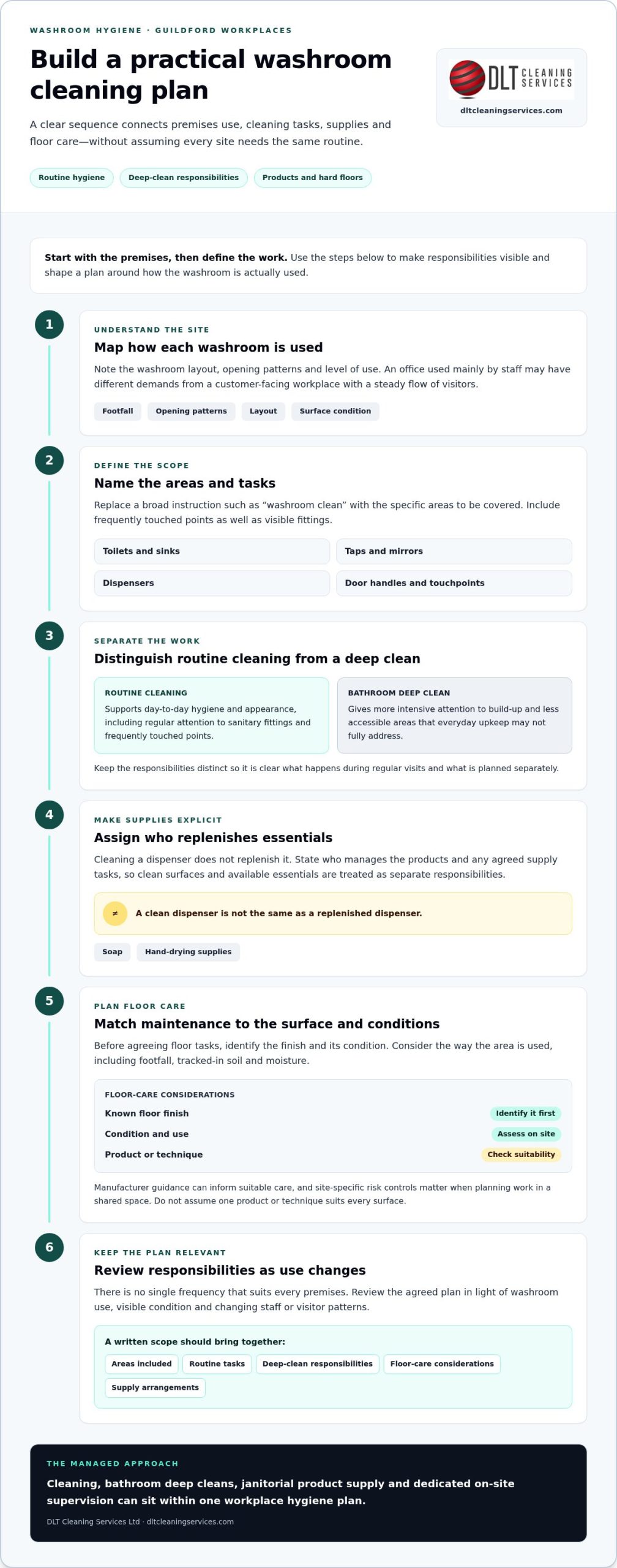
A workable routine starts with the site, not a generic timetable. Mapping each washroom and noting how it is used helps managers set priorities, agree responsibilities and oversee supply arrangements. This gives commercial washroom cleaning services Guildford businesses use a clear basis for matching tasks to workplace conditions and reviewing the plan as those conditions change.
Set priorities from a washroom site assessment
Walk through the premises and record where washrooms are, what surfaces they contain and who uses them. Note busy periods, visitor access and recurring issues, such as floors becoming damp, supplies running low or particular areas needing extra attention. These observations help shape an agreed task schedule without assuming every location needs the same frequency.
Use your findings to turn general expectations into practical responsibilities. A site plan can identify routine tasks, what needs separate deep-clean attention, how products are managed and how floor care reflects each surface. Cleaning frequency should follow actual use, condition and operational needs, with room to review the plan if these change.
Review standards, safety and supply needs
Agree who reports concerns, who checks that tasks have been completed and how supply gaps are raised. A brief review can catch recurring issues before they become accepted as part of the routine. For example, managers can record whether the same area repeatedly needs attention, whether a floor’s condition is changing and whether soap or hand-drying products are available as expected.
Cleaning substances also need to be part of the planning. COSHH requires workplace risks from hazardous substances to be assessed and exposure controlled. Relevant procedures should cover safe handling, storage and staff information or training. HSE guidance can help inform how workplace risks are managed. DLT’s health and safety cleaning guide offers further context for managers.
A simple review checklist keeps the routine focused:
- Are agreed cleaning tasks being completed across each washroom?
- Are recurring cleanliness or access issues being recorded and addressed?
- Do floors show changes in condition, soil or moisture that call for a review?
- Are agreed products available, with clear responsibility for replenishment?
- Do task arrangements and risk controls still suit how the premises are used?
Keep the checklist practical and assign responsibility for acting on what it reveals. Dedicated on-site supervision can support contract oversight, while a tailored plan connects office cleaning, bathroom deep cleans and janitorial product supply to the needs of the workplace. Arrange workplace cleaning support that brings these requirements into one managed approach.
Choose DLT for managed washroom hygiene services in Guildford
Choosing a cleaning partner is about more than completing a task list. Managers need an approach that fits the premises, makes responsibilities clear and keeps standards under oversight. DLT Cleaning Services Ltd is a family-run cleaning and hygiene company established in 1999, serving businesses across Surrey, including Guildford. Its workplace cleaning and hygiene services support a considered, hands-on approach to washroom needs.
A hands-on local partner for workplace hygiene
DLT brings together office cleaning, bathroom deep cleans and janitorial product supply, helping businesses connect washroom upkeep with the wider workplace environment. Dedicated on-site supervision provides oversight of contracts and standards, giving managers a clear point of accountability in the service arrangement. As a family-run independent company, DLT offers a personal working relationship and an approach tailored to the premises.
That matters when a workplace has particular priorities, such as several washrooms, changing levels of use or a need to coordinate cleaning and supplies. DLT serves Guildford and the wider Surrey area, so its commercial washroom cleaning services Guildford businesses need can be planned around the site and agreed scope. Managers looking at broader workplace requirements can also explore this tailored office cleaning services guide.
Take the next step towards a cleaner washroom
A useful starting point is to outline your premises, how the washrooms are used and the issues you want the service to address. You might want to coordinate bathroom deep cleans with office cleaning, arrange janitorial product supply or bring greater clarity to how standards are overseen. These details help shape a workplace cleaning approach around practical needs, rather than relying on a generic description of what a service includes.
DLT tailors its approach to your workplace and the agreed scope for the premises. Discussing the site and its priorities helps establish which elements of cleaning and hygiene support are most relevant, giving your team a clearer service plan and oversight.
Discuss your Guildford workplace cleaning needs and take the next step towards a managed washroom hygiene approach.
Make your washroom plan work for the future
A washroom plan works best when it can evolve with the workplace. Changes in occupancy, layout or visitor use can shift priorities, so treat the agreed scope as a working reference rather than a document to file away. Reviewing it as part of facilities planning can help identify what still fits and where responsibilities need clarification.
This forward-looking approach makes commercial washroom cleaning services Guildford businesses rely on easier to manage. Expectations stay visible, emerging issues have somewhere to be raised and adjustments can be considered before small snags become routine frustrations. You don’t need to redesign the whole arrangement each time. A clear conversation about what has changed can guide practical refinements to your hygiene plan.
To take the next step, bring together your current priorities, recurring concerns and anticipated changes at your premises. DLT can shape a workplace hygiene approach around your requirements. Discuss a tailored workplace hygiene service with DLT and move towards a plan that feels clear, manageable and right for your team.
Frequently Asked Questions
How often should commercial washrooms be cleaned?
There’s no single cleaning frequency that suits every workplace. For commercial washroom cleaning services Guildford businesses arrange, use actual conditions to guide the plan. Consider how many people use the facilities, visitor patterns and whether issues arise at particular times. A rise in occupancy or a change in how the premises operates can be a prompt to review the arrangement. Keep a simple record of recurring concerns to inform adjustments.
What is the difference between routine washroom cleaning and a deep clean?
Routine cleaning is planned upkeep that addresses everyday use; a deep clean gives more thorough attention to areas needing additional work. For example, a manager might note that a seldom-used corner or hard-to-reach area needs attention beyond regular tasks. A useful brief describes each type of work separately, so staff know what falls within the day-to-day plan and what is treated as deeper cleaning.
Can washroom cleaning be combined with office cleaning?
Yes. Coordinating washroom hygiene with office cleaning can bring workplace tasks under one managed approach, rather than leaving managers to organise separate routines. DLT Cleaning Services Ltd provides office cleaning alongside hygiene services, including bathroom deep cleans. A combined plan can set out how shared areas and washrooms fit into the wider premises requirements, with clear responsibilities so teams understand which parts of the workplace are covered.
Who supplies washroom hygiene and janitorial products?
Supply arrangements should be explicit in the cleaning brief, including who provides products and who monitors stock. DLT supplies janitorial products as part of its hygiene services. For a practical starting point, list the items your premises relies on, such as soap and hand-drying supplies, and record who is responsible for ordering or replenishing them. This makes it easier to identify where a supply gap has occurred.
What should a business include in a washroom cleaning brief?
Include washroom locations, areas to be covered, routine tasks, any deeper-clean requirements and how product supply is handled. Note relevant site conditions too, such as periods of heavier visitor use or a floor surface that needs specific care. Name who reports issues and who oversees the agreed work. A clear brief gives everyone a shared reference, making it easier to discuss changes if premises use or priorities shift.
How should hard floors in commercial washrooms be maintained?
Base floor care on the surface finish, its condition and the way the washroom is used. Check available manufacturer guidance before choosing products or techniques, as a method suitable for one material may not suit another. Regularly note visible changes, such as persistent soil, moisture or deterioration, and consider whether the agreed care still fits the floor. If the surface is unknown, identify it before planning maintenance.