An office refresh needn’t bring business to a halt. An office spring clean service Guildford businesses plan around their working patterns can give overlooked areas extra attention without repeating the tasks already covered by routine cleaning.
Where should a seasonal clean begin, and how much should it add to day-to-day maintenance? Start with the condition of the workplace and how it is used. A practical scope targets areas that need extra attention, while choosing a quieter period can help limit disruption to staff and operations.
This guide explains how a spring clean differs from routine office cleaning, which areas may need attention and how to plan a scope that suits your office. DLT Cleaning Services supports Guildford workplaces with tailored office cleaning and hygiene services, backed by dedicated on-site supervision. With a clear plan, you can focus on a clean, presentable office and consistent standards without adding unnecessary tasks to the usual schedule.
Key Takeaways
- Use visible build-up, heavily used areas and changes in workplace needs to decide when a seasonal refresh would be useful.
- Shape an office spring clean service Guildford around your priorities, rather than assuming every workplace needs the same checklist.
- Distinguish routine upkeep, a targeted seasonal refresh and a deeper clean by the areas that need attention and the purpose of the work.
- Plan access, timing and staff communication in advance to help limit disruption, particularly around occupied spaces and sensitive equipment.
- DLT’s dedicated on-site supervision supports consistent cleaning standards and attention to health and safety in Guildford workplaces.
When does a Guildford office need a spring clean rather than routine cleaning?
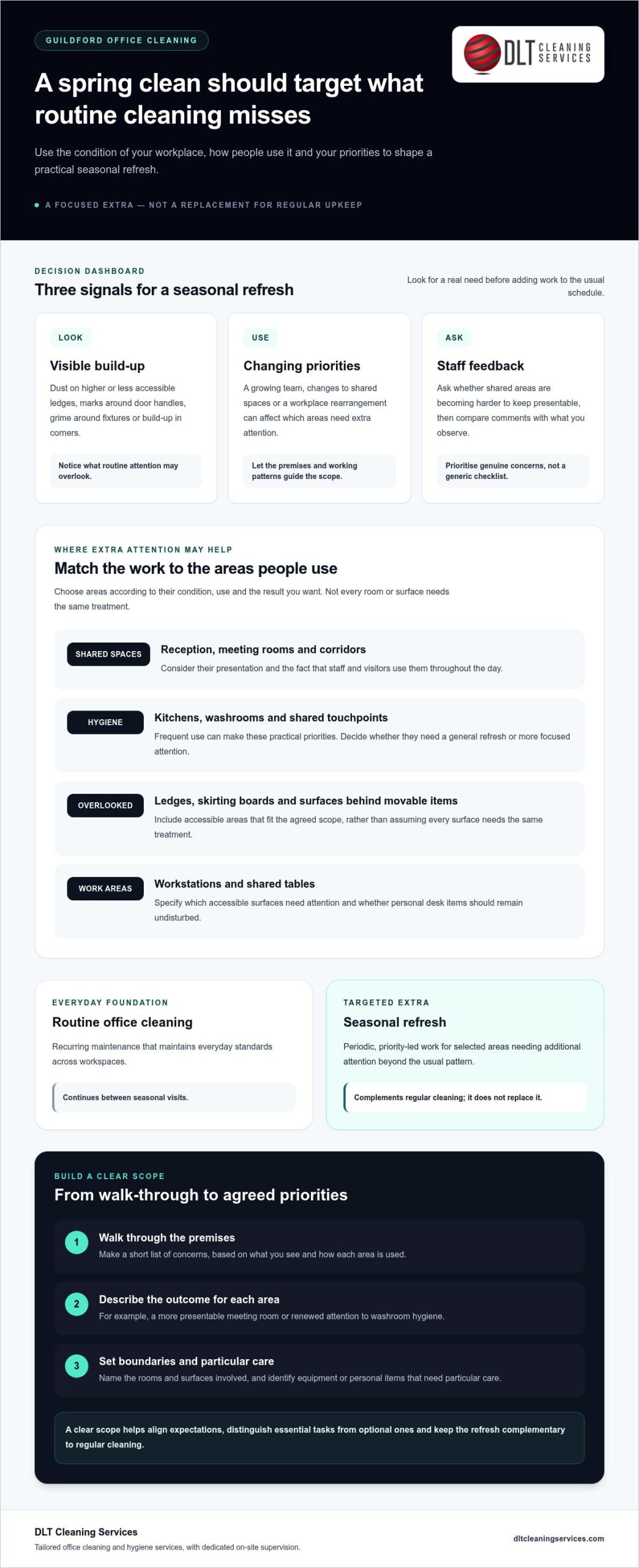
A seasonal spring clean should complement routine office cleaning, not replace it. Regular cleaning maintains everyday standards; a planned refresh gives extra attention to areas that gradually build up or fall outside the usual schedule. It is a focused workplace reset for places that need more attention than routine maintenance provides.
Use what you can see and how the workplace is used to guide the decision. Dust on ledges, marks on less frequently cleaned surfaces or grime around fixtures may signal that particular areas need attention. A growing team, changes to shared spaces or a workplace rearrangement can also shift priorities. The right scope depends on the office, its usage and your priorities, rather than a fixed seasonal checklist.
What signs suggest your office needs a seasonal refresh?
Look beyond the most visible floor and desk surfaces. Dust on higher or less accessible ledges, marks around door handles and build-up in corners can become more noticeable over time. Kitchens, washrooms and shared touchpoints see frequent use, so they may also benefit from renewed attention.
Staff feedback can reveal issues a walk-through misses. Ask whether particular shared areas are becoming harder to keep presentable, then compare those comments with your own observations. This helps you prioritise work that addresses a real need instead of adding tasks simply because they are common on spring-clean checklists.
How is a spring clean different from routine office cleaning?
Routine office cleaning is recurring maintenance for everyday workspaces. A spring clean is periodic and priority-led, focusing on selected areas that need additional attention. Depending on the office, this might mean addressing accumulated dust on overlooked surfaces or refreshing a shared area more thoroughly. It does not mean every room automatically needs an intensive clean.
Think of routine cleaning as the foundation and a seasonal refresh as a targeted extra. Regular upkeep continues between spring cleans, while the additional work addresses priorities outside the usual pattern. For a broader overview of commercial cleaning and the work it can involve, see the Commercial Cleaning Overview.
For managers reviewing their wider approach, office cleaning standards in Surrey provide useful context for considering how regular maintenance and periodic priorities fit together. A clear distinction helps you define what needs extra attention and plan a practical office spring clean service Guildford businesses can shape around their workplace.
What should an office spring clean service in Guildford include?
There is no single checklist for every workplace. Build a useful scope around the areas that need attention, how staff use them and the result you want. A spring-clean scope should reflect the premises and their use, not apply a standard list to every office.
One business may prioritise shared spaces that visitors see first; another may focus on a kitchen or washroom used heavily every day. An office spring clean service Guildford businesses arrange should set out those priorities clearly, with tasks chosen for the premises rather than assumed in advance.
Which office areas are commonly prioritised?
Workstations may need attention to accessible surfaces, while meeting rooms, reception areas and corridors often matter because staff and visitors use them throughout the day. Kitchens and washrooms are practical hygiene priorities. Consider their condition and how often they are used, then decide whether they need a general refresh or more focused attention.
Less frequently addressed areas can also be included where they fit the agreed scope. Examples might include accessible ledges, skirting boards or surfaces behind movable items. The aim is to identify genuine priorities, not assume every surface or room needs the same treatment.
How should managers define the scope of work?
Walk through the premises before arranging a clean and make a short list of concerns. For each area, note the outcome you want, such as a more presentable meeting room or renewed attention to washroom hygiene. This gives planning a practical focus and helps separate essential tasks from optional ones.
DLT tailors office cleaning to the workplace and its requirements, so the scope can reflect the premises and working patterns. Hygiene services, including bathroom deep cleans, can complement office cleaning where washrooms need focused attention. The Health and Safety Executive’s UK Health and Safety Executive Guidelines provide workplace health and safety information to consider when planning cleaning activity and access.
When agreeing priorities, specify the rooms involved and any surfaces or equipment that need particular care. For example, you may want shared tables refreshed while personal desk items remain undisturbed. Clear boundaries align expectations and make it easier to assess whether the finished work addresses the original concerns.
A considered scope also supports continuity: it complements regular cleaning arrangements instead of treating a seasonal visit as a substitute. If you’re planning a workplace refresh in Guildford, explore Guildford office cleaning and hygiene services from DLT, a family-run company established in 1999. A clear list of priorities is a practical starting point for shaping the work around your office.
Spring clean or deep clean: which Guildford office service suits your needs?
A spring clean does not automatically mean a full deep clean. The right approach depends on what needs attention, how widespread the concern is and whether routine cleaning is meeting everyday needs. An office spring clean service Guildford businesses arrange can provide a focused refresh, while a deeper clean may suit concerns that affect more areas or persist despite routine maintenance.
Use the comparison below as a starting point, not a fixed specification. Every office has different requirements, so set the scope and timing around the premises and the outcome you want.
| Service | Purpose | Typical trigger | Planning approach |
|---|---|---|---|
| Routine office cleaning | Maintain everyday cleanliness | Ongoing workplace use | Set a regular schedule around the office’s needs |
| Seasonal refresh | Address selected priorities | A specific area needs renewed attention, or office use has changed | Agree a focused scope alongside regular cleaning |
| Deeper clean | Respond to broader or persistent concerns | Issues extend beyond a few targeted areas | Assess the premises and define a more thorough scope |
When is a targeted seasonal clean enough?
A targeted refresh may suit an office where regular cleaning is working well but a few areas need extra attention. For example, a meeting room used more often after a team change may become a priority. Keep the existing routine in place and agree a seasonal scope around the affected areas, rather than treating the whole office as if it needs the same level of work.
When might an office need a deeper clean?
If concerns persist or affect a wider part of the premises, a more thorough assessment may be appropriate. The distinction is the breadth of the issue, not simply the time of year. A spring clean is often a planned, selective refresh; a deeper clean responds to wider needs identified across the workplace. Base the scope on the condition and use of the office rather than an assumed task list.
It is also helpful to distinguish cleaning from disinfecting. The US Environmental Protection Agency’s EPA Guidance on Cleaning and Disinfecting Workplaces discusses these as separate considerations. Use it as supplementary information, not as UK-specific guidance or a substitute for planning around your premises.
Before deciding, note whether the concern is limited to particular areas or repeated across the workplace. That distinction helps you choose a proportionate approach and keep routine cleaning aligned with day-to-day needs.
How can Guildford businesses plan a spring clean with minimal disruption?
Preparation helps a spring clean fit around normal office activity. Decide what needs attention, agree which areas cleaners can access, plan suitable timings and tell relevant staff what to expect. A clear plan gives the cleaning team a defined scope and helps employees work around spaces that may be temporarily affected.
Before cleaning begins, note the priorities, agree access, plan the timing and brief staff. Keep the process practical and adjust it to your premises and working patterns.
- Note priorities. Identify the rooms or surfaces that need attention and the outcome you want. Separate essential concerns from tasks that can wait to keep the scope focused.
- Agree access. Confirm which areas can be entered, any access arrangements and how staff should secure personal or sensitive items.
- Plan timing. Discuss suitable timings for your workplace, including busy periods, meetings and quieter days. Consider whether the work should be sequenced by area.
- Brief relevant staff. Explain which spaces will be addressed and when, and tell teams what preparation is needed.
How should you prepare the office before the clean?
Invite teams to flag priority areas, then ask staff to clear personal belongings from workspaces included in the agreed scope. Identify rooms with particular access arrangements and note sensitive equipment or surfaces that require care. A brief staff message can explain which areas are involved, what needs to be moved and how people can continue using other parts of the office.
Be specific about boundaries. Distinguish shared desks from personal workstations, for instance, or flag a room booked for a meeting. Clear instructions align expectations and help avoid unnecessary interruption.
How can cleaning fit around your working hours?
Consider the office’s normal rhythm when planning the work. If a meeting room is busy in the morning but quieter later, that can help determine the order of tasks. If several areas are included, arranging them in stages may leave other parts of the workplace available to staff. The right approach depends on occupancy, access and the agreed priorities.
Consider how cleaners will enter the building and reach the agreed rooms, especially if access is restricted or staff need to be present. An office spring clean service Guildford businesses plan around these details is easier to coordinate with day-to-day operations. DLT shapes office cleaning around the workplace and its requirements, with dedicated on-site supervision supporting consistent standards and attention to health and safety.
See office cleaning with DLT for information about the service.
Choosing an office spring clean service in Guildford: how DLT supports your workplace
Once you’ve identified which parts of the office need attention, choose a local cleaning partner that can shape the work around your premises. DLT Cleaning Services provides office cleaning and hygiene services for Guildford workplaces. The scope can reflect your priorities rather than relying on a one-size-fits-all checklist.
What makes DLT a considered local choice?
DLT is a family-run company serving Guildford and the wider Surrey area, established in 1999. Its experience provides a practical basis for discussing workplace needs, from the areas requiring extra attention to how cleaning can fit alongside usual routines. Businesses looking for family-run office cleaning in Surrey can work with a local company focused on commercial workplaces.
Dedicated on-site supervision supports consistent standards across cleaning contracts and attention to health and safety. It also provides an additional layer of oversight, which can be useful when a planned refresh involves several areas or needs to fit around staff using the premises. Office cleaning and hygiene services can be considered together, with the scope guided by the condition and use of your workplace.
What happens when you arrange a tailored spring clean?
Start with a clear account of what you want to achieve. You might identify a shared area that needs a refreshed appearance, a washroom requiring focused attention or spaces affected by a change in how the office is used. Note the rooms, desired outcomes and any access or timing considerations. These details provide a useful basis for planning.
DLT shapes office cleaning around the premises and its requirements, helping you distinguish priority areas from work already covered by routine cleaning. This makes it easier to plan a proportionate refresh and set clear expectations about which parts of the workplace are included. Where hygiene needs form part of the brief, DLT’s hygiene services can complement office cleaning.
An office spring clean service Guildford businesses arrange should support a cleaner, more presentable workplace while respecting how the premises are used. A tailored plan begins with those practical requirements, then organises the cleaning scope around them. DLT’s family-run approach and dedicated supervision provide a clear point of accountability as the work is planned and carried out.
Find out more about DLT office cleaning.
Make your next workplace refresh a considered step
A spring clean can be more than a one-off response to visible build-up. Use it to set clearer priorities for the workplace: note which areas need extra attention, what a refreshed space should achieve and how the plan can fit alongside regular cleaning. This gives you a practical reference point for future decisions about the office.
With those priorities in mind, an office spring clean service Guildford businesses arrange can reflect how the premises are used instead of following a generic checklist. DLT’s office cleaning and hygiene services, dedicated on-site supervision and experience supporting Guildford workplaces provide a basis for planning a manageable, purposeful refresh.
Share the areas you want to address and the outcomes you have in mind. Discuss a tailored office spring clean with DLT and plan a refresh around your Guildford workplace.
Frequently Asked Questions
What does an office spring clean usually include?
An office spring clean usually focuses on agreed areas that need extra attention beyond the regular cleaning arrangement. A business might prioritise reception surfaces before a client event, refresh a meeting room used more frequently or address a shared kitchen. Set out the rooms and surfaces included so expectations are clear. An office spring clean service Guildford businesses arrange can be tailored to their workplace needs.
How is a spring clean different from an office deep clean?
A spring clean is often a planned refresh of selected areas, while a deeper clean may be more appropriate if concerns extend across the premises or persist over time. If one underused room needs attention, for example, prioritise that space rather than assuming a broader clean is needed. The terms can overlap, so describe the office’s condition and the result you want when discussing the scope with DLT.
Can an office spring clean be arranged around working hours?
Yes. Plan the work around the workplace’s operating pattern by agreeing suitable timings and access arrangements in advance. Consider when staff use shared rooms, whether meetings are scheduled and which areas need to remain available. If a room is occupied for much of the day, account for that when deciding the order of work. Agreeing these details helps cleaning fit more smoothly with normal operations.
How often should a Guildford office have a spring clean?
There is no single frequency that suits every Guildford office. Consider how quickly particular areas become soiled, how intensively staff use shared spaces and whether workplace changes have created new priorities. You might review requirements after a layout change or when staff flag an area that routine cleaning does not address. Keep everyday office cleaning in place and plan a seasonal refresh when observations show it would be useful.
Does an office spring clean include bathroom cleaning?
Bathroom cleaning can form part of an agreed spring-clean scope. DLT provides hygiene services, including bathroom deep cleans, for workplace environments. Which areas to prioritise depends on the washroom’s condition and use, as well as the result you want. For instance, you might focus on a washroom used by visitors or one that sees heavier staff use. State the priority clearly so the scope reflects the premises.
How can I prepare my office for a spring clean?
Help the cleaning team work efficiently by clearing access to the agreed areas and securing confidential paperwork or valuable personal items. Let staff know which rooms are included and identify any equipment that should not be moved or handled. For example, teams can leave monitors and other desk equipment in place unless your internal arrangements say otherwise. A short preparation note helps staff understand what to do before the cleaning.
Why use a supervised office cleaning service?
On-site supervision provides oversight of cleaning work and supports consistent standards and attention to health and safety. It also gives the cleaning arrangements a clear point of coordination, which can be valuable when priorities vary between areas. DLT Cleaning Services Ltd includes dedicated on-site supervision in its office cleaning contracts. This helps keep agreed requirements visible as cleaning is carried out across the workplace.