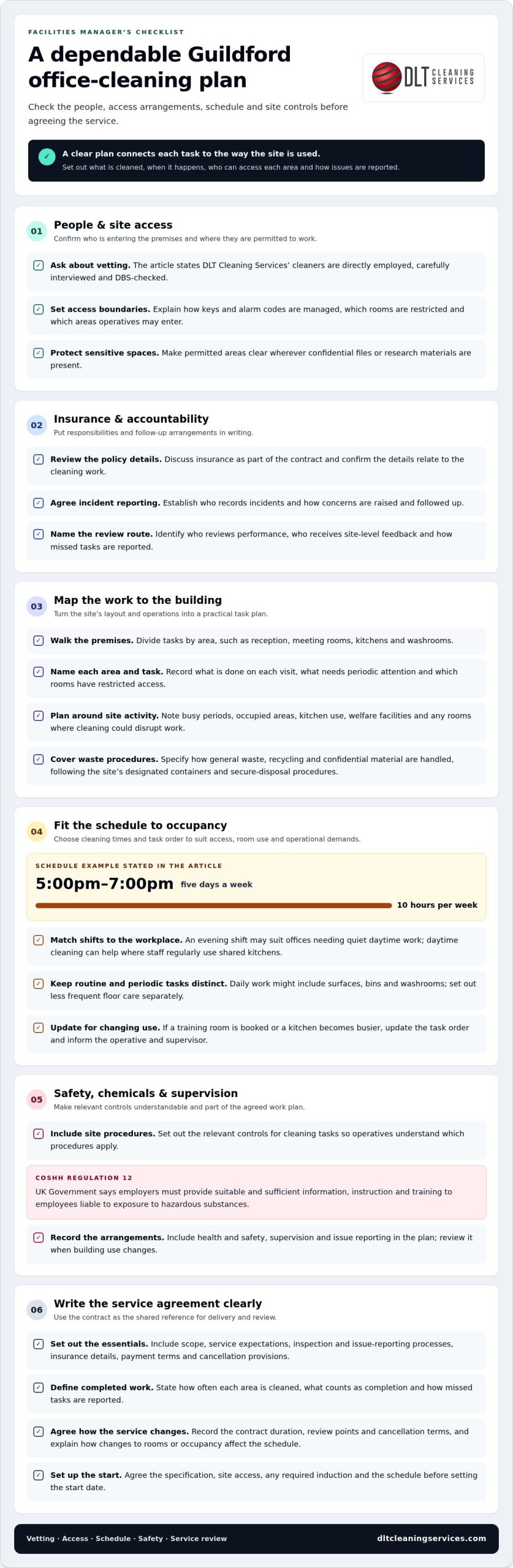
A clean finish is only part of a dependable cleaning arrangement. Guildford office cleaning for facilities managers should be assessed on clear arrangements for operative vetting, insurance, training and supervision, with work suited to the site’s kitchens, welfare facilities and research activity. UK Government says COSHH regulation 12 requires employers to provide suitable and sufficient information, instruction and training to employees liable to exposure to hazardous substances.
Facilities managers looking for Guildford office cleaning need to consider more than appearance. Cleaning must fit around staff, visitors and the way each workplace operates. This guide covers operative vetting, insurance, training and supervision, along with practical planning for research centres, kitchens and welfare facilities in Guildford. Use these points to assess your site’s needs and agree clear service arrangements.
Key Takeaways
- Assess whether operative vetting, training, insurance and supervision are clearly addressed before agreeing a cleaning arrangement.
- Match the cleaning schedule to your site’s daily use, including the needs of kitchens and welfare facilities.
- For research-centre environments, consider how cleaning tasks can fit around site activity and specific operational needs.
- Compare contractors by the clarity of their service plans, supervision arrangements and approach to maintaining consistent standards.
Do you cover Surrey Research Park in Guildford?
A Guildford office cleaning plan can be tailored to a site at Surrey Research Park. Set the schedule around occupied areas, kitchen use, welfare facilities, access arrangements and rooms with restricted entry.
Daily commercial cleaning contracts work best when they distinguish routine tasks from periodic work. Daily tasks might include cleaning work surfaces, emptying bins and cleaning washrooms, while a separate schedule sets out less frequent floor care. The contract should name each area, state how often it is cleaned and explain how missed tasks are reported. This gives facilities managers a practical basis for reviewing the service.
Bespoke office cleaning contracts should reflect how the building operates, rather than rely on a generic checklist. Map the site, note busy periods and identify where cleaning could disrupt work. Then agree the scope, cleaning times, access process and reporting route. The contract should also state its duration, review points and cancellation terms.
For cleaning chemicals, UK Government says COSHH regulation 12 requires employers to provide suitable and sufficient information, instruction and training to employees liable to exposure to hazardous substances. Include the relevant site procedures in the cleaning plan, so operatives understand which controls apply to their tasks.
For waste and recycling at a Guildford office, align cleaning tasks with the building’s designated containers and collection arrangements. Specify how general waste, recycling and confidential material should be handled, following the site’s own procedures for secure disposal.
A useful office cleaning contract sets out the scope, service expectations, inspection and issue-reporting process, insurance details, payment terms and cancellation provisions. Define what counts as completed work, who reviews performance and how changes to rooms or occupancy affect the schedule.
Starting a cleaning contract involves agreeing the specification, arranging site access, completing any required induction and preparing the schedule. Set the start date once responsibilities and access arrangements are clear. That way, the daily routine can begin without unresolved operational details.
Are your cleaning operatives fully vetted and insured?
For Guildford office cleaning, operative vetting and insurance are key considerations for facilities managers assessing site access. DLT Cleaning Services’ cleaners are directly employed, carefully interviewed, DBS-checked and fully insured. For your premises, clarify how keys, alarm codes and restricted rooms are managed. Clear instructions about permitted areas are especially important where confidential files or research materials are present.
Discuss insurance as part of the contract, rather than making assumptions. Review the policy details and confirm they relate to the cleaning work. Establish who records incidents and how concerns are reported. Written responsibilities give facilities managers a clear route for following up issues.
A bespoke cleaning plan turns site requirements into a practical schedule. Walk the premises and divide tasks by area, such as reception, meeting rooms, kitchens and washrooms. Record the tasks for each visit, what needs periodic attention and which rooms have restricted access. This makes the agreed scope easier to brief and review.
Choose shifts around occupancy and operational demands. An evening shift may suit offices that need quiet daytime work, while daytime cleaning can help where staff regularly use shared kitchens. The right schedule depends on access, room use and the tasks required. A Guildford office-cleaning role is scheduled from 5:00pm to 7:00pm, five days a week, for a total of 10 hours per week.
Guildford office cleaning should also account for changes in how the site is used. If a training room is booked or a kitchen becomes busier, update the task order and tell the operative and supervisor. In schools and mixed-use premises, identify occupied zones before work begins. Record schedule changes, health and safety arrangements, supervision and issue reporting in the plan, then review it when building use changes.
Cleaners should be carefully interviewed and DBS-checked, with clear instructions on site access and permitted areas. The site plan should also set out health and safety arrangements, supervision and how to report issues.
Which commercial office cleaning companies serve Guildford and nearby Surrey areas?
Guildford businesses can arrange commercial cleaning for offices and professional workplaces. For facilities managers, a key consideration is whether the cleaning team can work around the building’s size, access arrangements and agreed scope. Accountancy practices and law firms, for example, may need cleaning planned around client meetings and restricted areas.
Start by listing the locations your contract needs to cover. Note each Guildford building, its entrance arrangements and any satellite premises elsewhere in Surrey. Compare the proposed service area with your actual sites, rather than relying on a broad regional label. Coverage should work in practice for every address in the contract.
For a larger office, consider how the team and supervisor will coordinate work across different zones. A practical coverage discussion should address:
- Which Guildford and Surrey addresses are included in the service scope.
- How operative numbers and task allocation suit the building layout.
- Who supervises the work and receives site-level feedback.
- How changes to access or occupancy are communicated.
Accountancy practices may need cleaning arranged around client meetings and confidential work areas. Law firms may also have restricted rooms and changing occupancy. In both cases, a written site plan helps cleaners understand permitted areas, priority tasks and access procedures. It also gives the facilities manager a clear reference for reviewing performance.
Discuss how the Guildford site will be set up for cleaning: agree the scope, map the premises, arrange access, brief the team and establish supervision. For multiple Surrey locations, clarify whether each address has its own schedule and reporting route. These details show how the contract will be managed day to day, beyond confirming that the site is within the service area.
How can facilities managers compare Guildford office cleaning contractors and service levels
Compare written proposals against the same Guildford site brief. Include reception, offices, kitchens, welfare facilities and restricted rooms. This helps you judge whether each proposal reflects the building, rather than comparing different scopes. Note what is included, how often tasks are scheduled and which areas are excluded.
Next, check how service levels are defined. A useful specification describes observable results, such as empty bins, clean touchpoints and replenished hygiene supplies where agreed. It should explain how inspections work, who records missed tasks and how issues are followed up. For example, a washroom checklist is more actionable when a recorded issue identifies the location and next step.
Review supervision and communication alongside the task list. Identify who handles site feedback, how cleaners receive updates and how the facilities manager reviews performance. In a building with several departments, make sure feedback from reception, office teams and welfare areas reaches the same management contact. Clear responsibility makes recurring problems easier to identify.
Use these points to assess each proposal:
- Scope: Are Guildford premises and individual areas listed clearly?
- Schedule: Do task frequencies reflect actual room use?
- Quality checks: Are inspection records and issue follow-up explained?
- People and cover: Are supervision, operative changes and site access addressed?
- Contract terms: Are insurance information, review arrangements and cancellation terms written down?
Finally, compare mobilisation as a sequence, not an unsupported start-date promise. Check that site familiarisation, access, task instructions and reporting arrangements are covered before work begins. A proposal that explains these handovers gives you a clearer picture of service delivery than a broad statement about standards. For a practical discussion of your Guildford site requirements, get in touch about office cleaning.
DLT Cleaning Services: Office Cleaning
DLT Cleaning Services Ltd supports Guildford facilities managers with planned office cleaning and workplace hygiene. Office Cleaning can help maintain the shared areas and workspaces in your agreed scope, while Hygiene Services address essential workplace needs.
Turn to DLT Cleaning Services Ltd when reviewing cleaning arrangements for a Guildford office, including its kitchens and welfare facilities. Each contract is managed with dedicated on-site supervision, helping organise tasks and keep health and safety requirements in view. Discuss your premises, priority areas and preferred schedule to shape arrangements around how your workplace operates.
Contact DLT Cleaning Services Ltd to discuss your Guildford office cleaning needs and the schedule that suits your workplace.
Make your next cleaning review count
At your next contract review, consider how the workplace may change, not just how it operates today. Guildford office cleaning for facilities managers should adapt as teams, room use and operational priorities evolve. Review what is working, what needs attention and who owns each decision to keep arrangements relevant without adding unnecessary complexity.
DLT Cleaning Services Ltd provides a helpful next step for facilities managers planning workplace cleaning. Bring your priorities for the premises and the outcomes you want the service to support, then discuss a suitable approach. Contact DLT Cleaning Services Ltd today to start the conversation. With clear priorities and a considered plan, you can move towards a workplace routine that supports your people and premises.
Frequently Asked Questions
Do you offer free on-site surveys in Guildford?
Don’t assume an on-site survey is free as part of a Guildford cleaning enquiry. Start by outlining the premises, priority areas and cleaning requirements so the proposed scope is clear. For example, note whether the brief includes shared kitchens, washrooms or meeting rooms. Clarifying the survey arrangements separately helps you understand what the initial discussion covers before settling the service details.
What office cleaning services do Guildford facilities managers typically need?
Guildford facilities managers commonly need routine office cleaning alongside hygiene support for shared facilities. A practical scope might cover workspaces and communal areas, with separate attention to washrooms and agreed janitorial products. DLT Cleaning Services offers Office Cleaning and Hygiene Services, including bathroom deep cleans and janitorial products. The right combination depends on the premises and the facilities used by staff and visitors.
How often should offices in Guildford schedule daily, weekly and periodic cleaning?
Set cleaning frequency according to occupancy, footfall and how quickly each area gets soiled. Shared kitchens and washrooms may need daily attention, while lower-use meeting rooms may need less frequent cleaning. Periodic work can address needs that routine visits miss, such as dirt in overlooked areas. Review the schedule when occupancy or room use changes, and adjust priorities using staff feedback and inspection notes.
What cleaning methods and products are suitable for offices with different floor types and shared facilities?
Choose cleaning methods to suit the floor material and how each shared space is used. Carpeted areas need a different approach from hard flooring, while kitchen surfaces and washroom fixtures call for methods suited to their use. Identify floor finishes and follow the manufacturer’s care guidance before selecting products. Keep products labelled and stored appropriately, and make sure instructions distinguish between surfaces to avoid unsuitable treatment or residue.