Reliable office cleaning starts before the first shift. A thorough Guildford office cleaning staff vetting process includes identity and right-to-work checks, verified references and a DBS check at the level appropriate to the role. The Disclosure and Barring Service explains which roles qualify for each level. A Basic DBS check shows only unspent convictions.
Giving someone access to your workplace calls for more than a polished interview. References are useful, but should be part of a structured process rather than the sole basis for a decision. Checks should reflect the role’s responsibilities, including the cleaner’s access to staff, visitors and different workplace areas.
This guide explains what to check during recruitment, when an Enhanced DBS check may be relevant, and how to verify references and claimed training. It also covers how to assess a candidate’s approach to office cleaning, so you can make a considered decision based on evidence and your Guildford workplace’s needs.
Key Takeaways
- Validate claimed qualifications and safety training directly with the awarding body, rather than relying on a certificate alone.
- Consider whether an enhanced DBS check is appropriate for roles involving children, vulnerable adults or lone working.
- A paid trial shift can show how a candidate approaches office-cleaning tasks in practice.
- Take two references, speak to the referees by phone and validate their employment details as part of a wider vetting process.
1. What should I check before hiring an office cleaner?
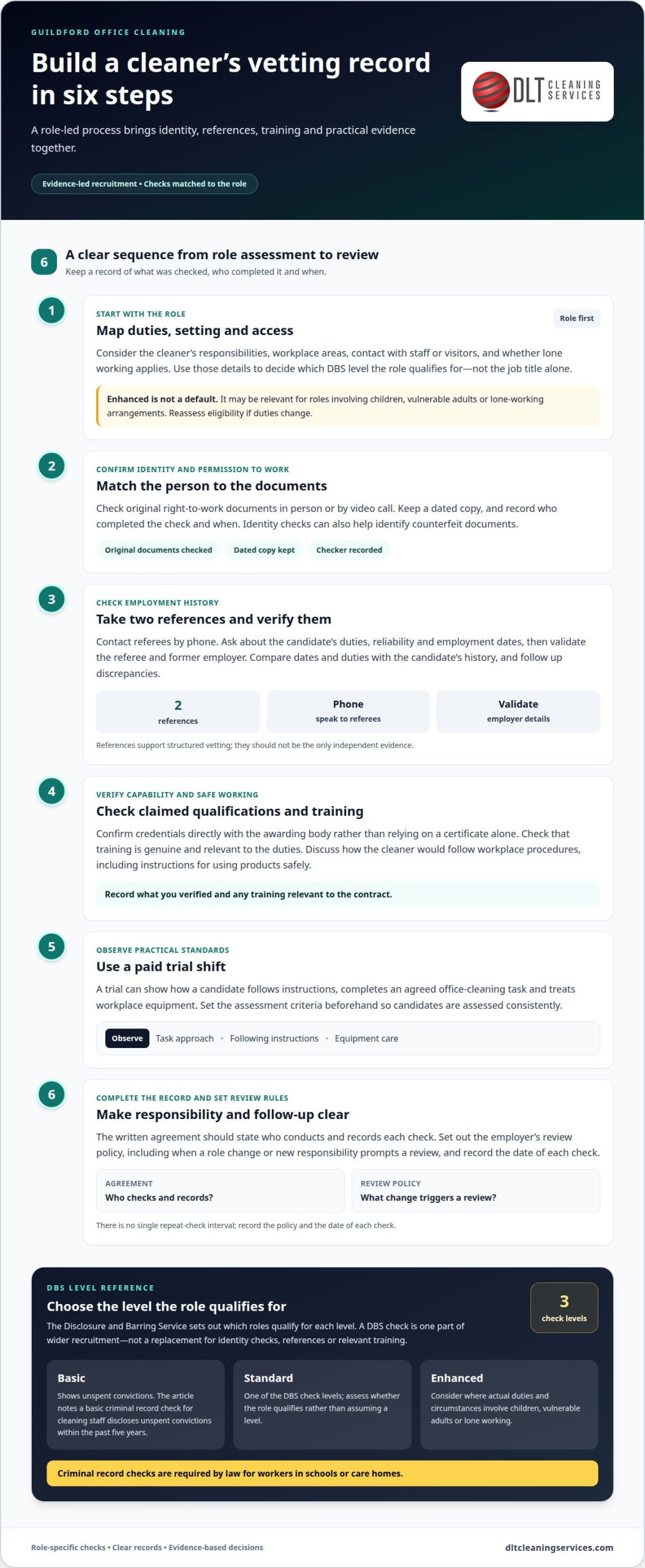
For a Guildford office, match each cleaner’s identity to their right-to-work documents. Employers can check original documents in person or by video call and keep a dated copy. Identity checks can also help identify counterfeit documents. Record who completed each check and when, so the recruitment file shows the steps taken. A consistent Guildford office cleaning staff vetting process makes these records part of the hiring decision.
The Disclosure and Barring Service sets out which roles qualify for each check level. Its three levels are Basic, Standard and Enhanced. According to the UK Government, a Basic DBS check shows only unspent convictions. A basic criminal record check for cleaning staff discloses unspent convictions within the past five years. Criminal record checks are required by law for workers in schools or care homes. For other offices, check which level the role qualifies for rather than assuming Enhanced is needed.
Ask candidates about relevant qualifications and safety training, then verify claimed credentials with the awarding body. For example, confirm that a named training certificate is genuine and relevant to the duties. Discuss how the cleaner would follow workplace procedures, including instructions for using products safely. Record what you checked and any training relevant to the contract. This gives the Guildford office cleaning staff vetting process practical evidence to support a hiring decision.
Cleaning employers are advised to take two references and contact referees by phone. Ask about the candidate’s duties, reliability and employment dates, then validate the referee and former employer. This helps reduce the risk of relying on a reference from a non-existent employer. References should support structured vetting, not act as the only independent evidence.
Who is liable if a cleaning company’s vetting is inadequate? Responsibility depends on who employed the cleaner, the contract and the circumstances. The written agreement should make clear who conducts and records each check.
There is no single repeat-check interval. Set out the employer’s policy, including when a role change or new responsibility prompts a review, and record the date of each check. Ask how the company verifies references, which checks it completes and how it decides when a review is needed.
2. Enhanced DBS clearance
An Enhanced DBS check is not a default requirement for every office cleaner. The Disclosure and Barring Service (DBS) explains which roles qualify for each check level. Consider the duties, setting, access and people the cleaner may encounter before deciding which level is appropriate. A job title alone may not capture the role’s responsibilities.
Enhanced checks are usually expected for office roles involving vulnerable adults, children or lone-working arrangements. For example, consider whether a cleaner will work alone in a setting where children or vulnerable adults are present. The question is whether the actual duties and circumstances make that level of check relevant, not simply whether the workplace is an office.
Ask the employer how it assesses role eligibility and which cleaning posts require an Enhanced check. A clear explanation should link the decision to the duties, setting and contact involved. It should distinguish roles that qualify from those that do not, rather than applying the same assumption to every member of a cleaning team.
For a clear recruitment record, note the role assessed, why an Enhanced check was requested and who made the decision. If duties change, review eligibility against the new responsibilities. For example, a move from cleaning an unoccupied office to working around vulnerable people may warrant reassessing the role.
Ask how the employer tracks the check level for each post and records completion. A DBS check is part of wider recruitment, not a replacement for identity checks, references or relevant training. Keep the discussion focused on the role: its tasks, who may be present, whether lone working applies and why the selected level is appropriate.
3. Staff vetting and recruitment
Vetting practices can differ between Guildford cleaning companies, so compare the process, not just its summary. A clear recruitment procedure explains who checks each applicant, what evidence is reviewed and how decisions are recorded. Ask how the company handles identity, employment history, qualifications and role-specific DBS eligibility. These details show whether checks are consistent or informal.
Identity checks should connect the applicant to the records used during recruitment. Employers can inspect original right-to-work documents in person or by video call and keep a dated copy. These checks can also help detect counterfeit documents. Recording the date and the person responsible makes the recruitment file easier to follow.
Employment history needs context, not just a list of previous workplaces. Compare dates and duties with information from referees, then follow up any discrepancies. Validate references, since an invented employer makes an unchecked reference unreliable. Verify claimed qualifications and safety training with the awarding body rather than treating a document alone as proof.
Recruitment should also assess practical cleaning standards. A paid trial shift lets an employer see how a candidate follows instructions, completes an agreed task and treats workplace equipment. For example, the assessment could cover a routine office-cleaning task and compliance with site procedures. Set the criteria beforehand so each candidate is assessed consistently.
Enhanced DBS checks are usually expected for roles involving vulnerable adults, children or lone-working arrangements. The duties and setting should guide the decision, not a blanket rule for all office cleaners. A managed cleaning provider may keep trained, vetted staff who can provide same-day replacement cover. Ask how replacement staff are screened and whether their checks match the responsibilities of the post. Clear answers help Guildford businesses understand how recruitment, vetting and cover fit together.
4. Taking and verifying references
References are more useful when checked against the candidate’s employment history. Employers are advised to take two references and contact referees by phone. Ask each referee to confirm their role, the candidate’s duties and employment dates, then record who provided the information and when.
Validate the referee as well as the reference. Confirm that they worked with the candidate in the capacity they describe and that the named organisation is a genuine former employer. This helps reduce the risk of relying on a reference from a non-existent employer. Keep a dated note of the call and details discussed.
Use consistent questions for both referees. Ask for a practical example of the candidate’s reliability, attention to detail and ability to follow instructions. For an office-cleaning role, ask how they handled routine tasks and responded to feedback. Specific examples provide more context than a general statement that the person was a good employee.
Compare the answers with the candidate’s application and interview. If employment dates differ, duties seem inconsistent or a referee cannot explain their relationship to the applicant, record the discrepancy and follow up before deciding. A clear note helps distinguish a simple misunderstanding from information that needs further consideration.
References should support, not replace, a structured recruitment process. Consider them alongside identity checks, employment history, qualifications and any DBS check appropriate to the role. This gives each source a defined purpose: a referee can describe past work, while other checks address identity or role eligibility. For a considered approach to staffing and workplace cleaning, discuss your office requirements.
DLT Cleaning Services: Office Cleaning
DLT Cleaning Services Ltd provides office cleaning and hygiene services for workplaces that need consistent upkeep. If your Guildford office needs a professionally managed cleaning arrangement, these services can support a clean, hygienic working environment. Each contract has dedicated on-site supervision to help maintain standards and health and safety compliance. The right plan depends on your workplace, priorities and routine needs. Share the areas that need attention and your priorities, such as well-maintained shared spaces or washroom hygiene. Contact DLT Cleaning Services Ltd to discuss your office cleaning needs and request a free quote.
Set up a cleaning arrangement that fits your workplace
Decide what support will make your workplace easier to manage. Consider your premises, the areas requiring regular attention and how cleaning should fit around your team’s working patterns. A clear brief gives the conversation a practical focus and helps shape an arrangement around your business rather than a one-size-fits-all approach.
DLT Cleaning Services provides office cleaning and hygiene services for workplaces seeking professional support with day-to-day upkeep. The Guildford office cleaning staff vetting process can also help you frame questions about how a cleaning arrangement will work. Share your priorities and the areas you want maintained, then discuss an approach suited to your office.
For a considered next step, contact DLT Cleaning Services today to discuss your office cleaning needs. A clear conversation can help you move towards a cleaner, more welcoming workplace with confidence.
Frequently Asked Questions
How do I hire reliable cleaning staff for an office?
Decide which areas need cleaning, which tasks matter most and how staff will access the premises. If you use a cleaning service, make sure the arrangement fits your office routine and clearly assigns responsibility for the work. Discussing priorities, site access and communication helps set expectations before cleaning begins, rather than leaving key details until the first visit.
What should I check before hiring an office cleaner?
Check that recruitment covers identity, right to work, relevant experience and references, then consider whether the role qualifies for a DBS check. For example, a cleaner entering a restricted office area needs clear site instructions about access and confidentiality. Ask how responsibilities are recorded and how cleaners are briefed on your premises, including whom to contact if an issue arises during routine work.
How do Guildford office cleaning companies vet staff before hiring?
DLT Cleaning Services Ltd directly employs its cleaners, who are individually interviewed and selected. All staff undergo DBS background checks, and the cleaning team is fully insured. This gives Guildford businesses clear information about the employment arrangement and screening. It is also useful to agree how site-specific instructions are shared, including access arrangements and areas that should remain undisturbed.
Do office cleaners in Guildford undergo DBS checks, and what level is required?
DLT Cleaning Services Ltd states that all its staff undergo DBS background checks, but the appropriate DBS level depends on the role. The Disclosure and Barring Service sets out which roles qualify for each level, and Enhanced checks are usually expected for roles involving children, vulnerable adults or lone working. A Guildford office role shouldn’t be assumed to need the same level as every other post.
What safeguarding and data-protection training do office cleaners receive?
Safeguarding and data-protection instructions should reflect the workplace and the cleaner’s duties. An office induction can explain how to respond if a visitor needs help, where confidential documents must remain and how to report an unattended file. Clear site procedures also help cleaners avoid viewing or moving paperwork unnecessarily. DLT Cleaning Services Ltd carries out DBS checks on all staff as an additional part of recruitment screening.
How do Guildford cleaning firms vet temporary, subcontracted and agency staff?
DLT Cleaning Services Ltd directly employs its cleaners, so its staffing model does not rely on subcontracted or agency cleaners. Its staff are individually interviewed and selected, undergo DBS background checks, and the cleaning team is fully insured. For a Guildford business arranging office cleaning, it’s helpful to understand who will attend and how site instructions will be communicated if the people assigned to the work change.