For office cleaning for listed buildings in Guildford, the price depends on the site and cleaning scope, and is provided after a quote request. Key factors include the building’s size and layout, cleaning frequency, staffing, consumables, specialist equipment and access requirements. In a listed property, the cleaning plan also needs to take account of historic materials and features.
It’s understandable to want a clear cost without risking damage to a building’s character. Some work may require consent if it could affect that character or remove coatings, so the proposed methods and scope matter alongside the time involved.
This guide explains how a site survey and tailored cleaning plan can help define the work, what to consider when assessing a provider’s quality, environmental and health and safety processes, and how heritage-conscious methods support historic interiors and original fixtures. You’ll also learn which details influence a quote, so you can make a more informed decision for your Guildford office.
Key Takeaways
- Learn what to look for in evidence of quality, environmental and health and safety management when assessing a cleaning service.
- See why cleaning plans for listed properties should account for historic materials and whether work could affect the building’s character.
- Understand how unsuitable routine methods can harm stonework, original fixtures and historic interiors, and what a careful approach considers.
- Find out how a site survey can shape a tailored cleaning plan and help you assess whether a Guildford or Surrey supplier suits your building.
Quality, environmental and health and safety accreditations
Accreditations can indicate that a cleaning operation follows documented processes, but their scope matters. For office cleaning in a historic property, check whether the quality, environmental and health and safety systems cover the work, materials and site risks involved. A certificate alone doesn’t explain how cleaners will protect original surfaces. Compare its stated scope with the cleaning plan, then consider how staff record completed tasks and report damage or hazards.
For chemical use, review the site-specific COSHH assessments, product information and storage arrangements. These should explain safe handling, dilution, protective equipment and what to do after a spill. A product suitable for modern flooring, for example, may not suit a heritage finish. The assessment should guide product selection and the cleaning method, rather than leaving staff to make substitutions on site.
Staff competence matters in practice, too. Look for an induction process covering access, alarms, fragile features and areas that must remain untouched. Training records should relate to assigned tasks, such as using equipment safely or handling products. A supervisor can document instructions and check that agreed methods are followed, especially where rooms have different surfaces or restrictions.
Medical and healthcare cleaning involves distinct protocols, so routine office cleaning shouldn’t be treated as equivalent. If a building includes a clinical room, identify its use and cleaning requirements separately in the work schedule. Insurance documents should also reflect the activities and premises involved. Review the policy scope, including relevant cover for staff and accidental damage, alongside the cleaning method and site risks.
- Compare accreditation scope with the actual tasks and historic materials.
- Use COSHH assessments to guide products, handling and storage.
- Keep staff induction, task training and insurance evidence relevant to the site.
Cleaning protected and listed buildings
A listed office needs a cleaning plan that treats historic finishes as part of the building, not obstacles to remove. Cleaning may require consent if it could affect the building’s character or remove coatings. The task matters: dusting desks differs from stripping an old finish or washing a protected exterior. Identify the surfaces, intended result and method before work begins.
Start with a room-by-room survey. Record features such as painted panelling, stone floors, decorative plaster, timber doors and original ironmongery. Note existing wear and any areas where moisture, friction or chemical residue could cause problems. A written schedule can separate routine tasks from specialist work, identify surfaces that need dry methods and prevent a standard product being applied throughout without consideration.
Exterior cleaning needs particular care. Low-pressure, non-abrasive systems are described for sensitive building fabric, but the method still needs to suit the material and its condition. Washing should not be the default for stone, brick or historic coatings. If exterior cleaning could alter character or remove a coating, establish whether consent is needed before work starts. Keep this work separate from everyday office maintenance in the cleaning plan.
For historic buildings, cleaning frequency depends on exposure to pollutants, weather and organic growth. Exterior cleaning may be planned annually or bi-annually where conditions support it, rather than set as an automatic routine. Inside, use the survey to set practical tasks: dry-dust delicate ledges, use minimal moisture on vulnerable finishes and reserve specialist treatment for identified needs. A clear written scope helps staff follow methods consistently.
- List significant surfaces and features before setting tasks.
- Separate routine cleaning from work that could affect historic fabric.
- Choose methods and frequency according to material, condition and exposure.
Consent may be needed if cleaning could affect the building’s character or remove coatings. Check whether consent is required before starting such work, especially exterior cleaning or treatment of historic finishes.
What risks can routine cleaning pose to historic interiors, stonework and original fixtures?
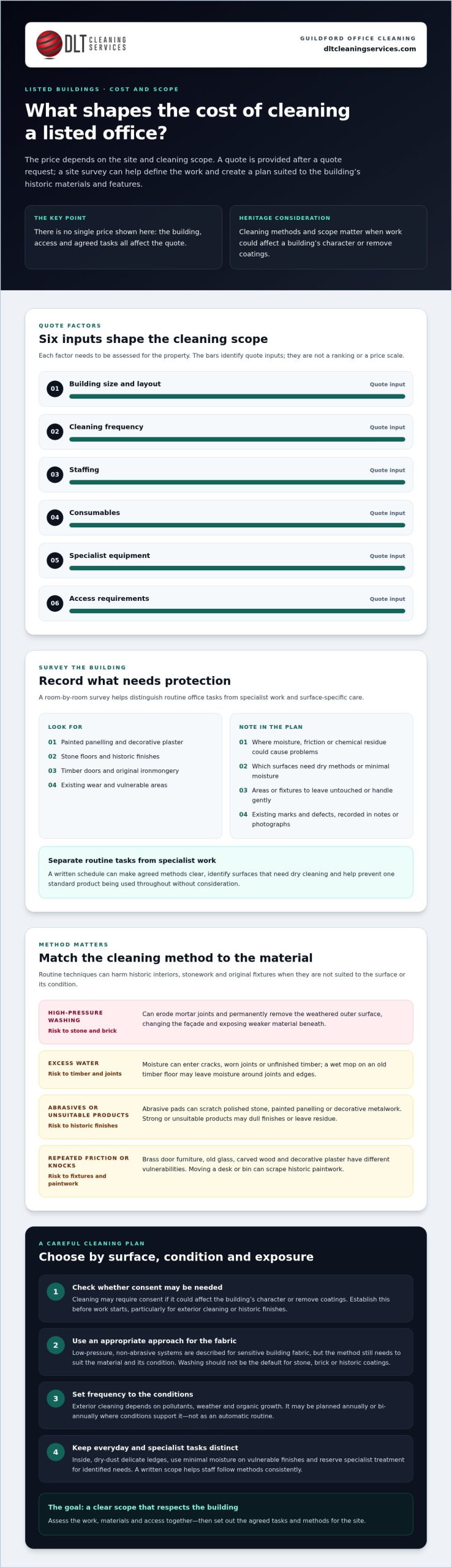
Routine methods can cause lasting damage when they ignore a building’s materials. According to Astound, high-pressure washing can erode mortar joints and permanently remove the weathered outer surface of stone and brick. This can change a façade’s appearance and expose weaker material beneath. A pressure washer suitable for a modern surface is not automatically appropriate for historic masonry.
Inside, excess water can enter cracks, worn joints or unfinished timber. A wet mop on an old timber floor, for example, may leave moisture around joints and edges. Abrasive pads can scratch polished stone, painted panelling or decorative metalwork. Strong or unsuitable products may also dull finishes or leave residue. The risk depends on the material, its condition and the method used.
Original fixtures need careful handling, too. Brass door furniture, old glass, carved wood and decorative plaster each have different vulnerabilities. Repeated friction can wear a surface, while a damp cloth can affect a fragile finish. Moving a desk or bin against a skirting board may scrape historic paintwork. A room-by-room task list can identify fixtures to avoid, dust gently or clean using an agreed method.
Before work starts, record existing marks and defects in notes or photographs. Identify the surface, proposed product and cleaning method, then test a discreet area where appropriate. Stop if the finish changes, colour transfers to the cloth or moisture remains on the surface. Staff should report these signs rather than repeat the same action across the room.
- Keep high-pressure washing away from historic stonework and mortar.
- Match moisture, tools and products to each surface and fixture.
- Record existing condition and report unexpected changes promptly.
Are there Guildford or Surrey suppliers with experience in conservation-grade cleaning?
Some cleaning services may be able to work in listed buildings, but suitability depends on the property’s materials and condition. This gives Guildford offices a starting point, but the building’s materials and condition still matter. A service’s stated suitability should be reflected in a practical plan for the specific property, not just a general claim of heritage experience. A site survey should record rooms, surfaces, access and sensitive features.
Use the survey to establish a clear scope. Distinguish routine desk and floor cleaning from work near historic panelling, decorative plaster or original fittings. The written plan should explain which methods apply to each area, what staff must avoid, and how changes or damage are reported. This makes the service easier to manage and gives cleaners consistent instructions across the site.
Conservation-conscious cleaning does not mean every task needs specialist treatment. It means choosing methods according to the surface and the risk. Dry dusting may suit a fragile feature, while a robust modern surface may tolerate a different routine. Exterior work needs separate consideration, particularly if washing could affect the building’s character or remove coatings. Establish the proposed work and consent position before exterior cleaning begins.
When assessing a Guildford or Surrey supplier, focus on evidence of process. Review the survey findings, task schedule, staff instructions, product controls and supervision arrangements together. Consider how the plan separates ordinary office areas from heritage-sensitive features and how cleaners record completed work. A useful explanation describes practical steps, such as identifying vulnerable finishes and documenting approved methods, rather than relying only on broad claims.
- Look for stated suitability for Grade I and Grade II properties.
- Use a site survey to connect the cleaning plan to real materials and features.
- Assess the documented methods, staff instructions and reporting process.
DLT Cleaning Services: Office Cleaning
DLT Cleaning Services Ltd provides office cleaning for workplaces, with routines suited to each premises. If your Guildford office is in a listed building, share its cleaning priorities, sensitive areas and access arrangements when discussing the work. This helps establish a clear scope for day-to-day office needs without treating historic features as ordinary surfaces.
DLT Cleaning Services Ltd manages each contract with dedicated on-site supervision and attention to health and safety compliance. Hygiene services can also support workplace hygiene alongside office cleaning. To get started, describe your building and the tasks your team needs covered, so the discussion can focus on your workplace requirements.
Contact DLT Cleaning Services Ltd to discuss office cleaning for your Guildford workplace.
Plan the right next step for your Guildford office
Before requesting a quote, bring your knowledge of the building into one clear brief. Note the rooms in use, cleaning priorities, access arrangements and any surfaces or features that need particular care. This gives the discussion a practical starting point and helps align the proposed work with how your office operates.
The price depends on the premises and cleaning scope, and is provided after a quote request. Building size, cleaning frequency, access and required tasks all shape the assessment. A considered brief can make the proposed schedule and costs easier to understand.
For office cleaning for listed buildings in Guildford, DLT Cleaning Services offers Office Cleaning and Hygiene Services. Share your workplace requirements and discuss a suitable approach with the team. Contact DLT Cleaning Services to take the next step towards a well-managed workplace, with your building’s character in mind.
Frequently Asked Questions
Which office cleaning companies in Guildford specialise in listed buildings?
DLT Cleaning Services Ltd provides office cleaning in Guildford. For office cleaning for listed buildings in Guildford, include the building’s specific needs in the proposed plan. Share its grade, room use and any features that need careful handling. A site survey and written schedule can distinguish everyday office tasks from work near historic fabric, so the routine reflects the premises rather than a standard template.
What cleaning products and methods are safe for historic materials in listed buildings?
Choose products and methods according to the material, its condition and finish. A product intended for modern flooring, for example, shouldn’t automatically be used on an old timber floor or painted panelling. Record the product and method for each sensitive area, then test an inconspicuous spot where appropriate. Stop and report colour transfer, surface changes or lingering moisture instead of repeating the treatment.
How much does office cleaning cost in Guildford, including listed-building care?
The price depends on the premises and cleaning scope, and is provided after a quote request. Cost factors include building size and layout, cleaning frequency, staffing, consumables, specialist equipment and access requirements. For a listed office, describe the rooms and sensitive features so the work can be assessed accurately. A site survey helps define the tasks behind the quote.
What office cleaning services and frequencies are available in Guildford?
Office cleaning is commonly scheduled daily or several times a week, depending on staff numbers and footfall. A smaller office with limited shared use can have different priorities from a busy workplace with frequent visitors. DLT Cleaning Services provides Office Cleaning and Hygiene Services. List the areas needing attention, such as workspaces, shared kitchens and washrooms, then match the schedule to how the building is used.
How can a business check a Guildford office cleaner’s insurance, training and references?
Review insurance documentation, staff training records and references relevant to similar premises. DLT Cleaning Services’ cleaners are directly employed, carefully interviewed, DBS-checked and fully insured. Look for details relevant to the work, such as induction procedures for building access and instructions for handling cleaning products. References from comparable workplaces can help show how a service manages communication, consistency and site-specific requirements.
How should a cleaning plan be agreed with a listed-building owner or conservation officer?
Agree the scope in writing with the building owner, including the conservation officer where relevant. List the rooms, surfaces, proposed methods and areas cleaners must avoid. Separate routine internal tasks from exterior cleaning or work that could affect the building’s character or remove coatings. Establish whether consent is required before that work begins, then share the agreed plan with everyone responsible for the site.