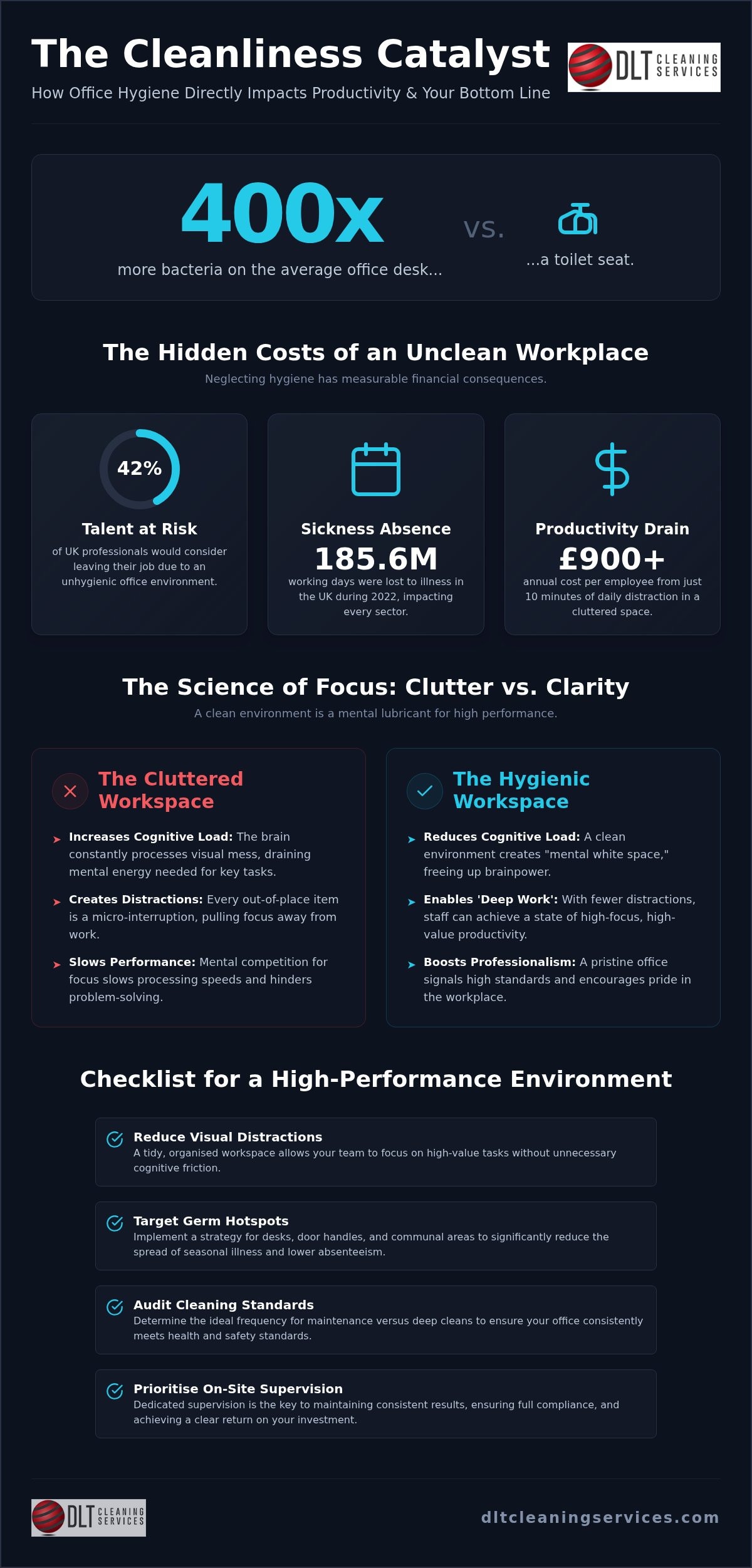
Did you know that the average office desk harbours 400 times more bacteria than a toilet seat? For many managers in Guildford, a cluttered or dusty workspace is often viewed as a minor aesthetic issue rather than a genuine threat to the bottom line. However, the scientific link between office cleanliness and employee productivity is undeniable. When your team works in an environment that feels neglected, their cognitive load increases and their ability to focus on complex tasks begins to dwindle.
You probably agree that a tidy office makes for a more pleasant day, yet finding reliable, supervised contractors who actually deliver on their promises remains a common challenge for businesses in Guildford. In this article, DLT Cleaning Services Ltd will help you discover how a professionally maintained workplace reduces cognitive load, slashes absenteeism, and serves as a catalyst for peak staff performance. We will explore the latest UK health data and explain how consistent hygiene standards help you attract top talent whilst providing a clear ROI on your facility management budget.
Key Takeaways
- Understand how a tidy workspace reduces visual distraction and allows your team to focus on high-value tasks without unnecessary cognitive friction.
- Learn the scientific connection between office cleanliness and employee productivity, including how a hygienic environment acts as a mental lubricant for staff.
- Identify common germ hotspots that contribute to seasonal illness and discover strategies to reduce absenteeism through targeted hygiene services.
- Utilise a practical manager’s checklist to audit your current cleaning standards and determine the ideal frequency for maintenance versus deep cleans.
- Discover why dedicated on-site supervision is the key to maintaining consistent standards and ensuring full health and safety compliance.
The Hidden Link Between Office Cleanliness and Employee Productivity
The connection between your physical surroundings and your mental clarity is more than just a feeling; it’s a measurable business metric. When we discuss office cleanliness and employee productivity, we’re looking at how a well-maintained environment signals to your team that their work is valued. Think of the “broken window” theory applied to a corporate setting. In an urban environment, one unrepaired window suggests that no one cares, which often leads to further neglect. In a Surrey office, a layer of dust on a monitor or a stained carpet sends the same subtle message. It tells staff that standards are slipping, which can quickly lead to a dip in their own professional output.
Research suggests this isn’t merely about aesthetics. A 2022 survey found that 42% of UK professionals would consider leaving their job due to an unhygienic office. If nearly half of your talent pool is looking at the exit because of the state of the bins or the desks, the link between hygiene and retention is clear. Cleanliness acts as a non-verbal cue of company culture. It shows that the leadership team prioritises the health and comfort of their staff, fostering a sense of mutual respect that is essential for high performance.
The Perception of Professionalism
A productive day starts at the front door. When employees walk into a polished entrance hall at 9:00 AM, it fosters immediate “buy-in.” It sets a tone of order and discipline that carries through the working hours. This isn’t just for the benefit of existing staff. First impressions are vital for visiting clients and during the recruitment process. A pristine environment encourages “discretionary effort”, which is that extra bit of energy employees give when they take genuine pride in their workplace centre. When the office is spotless, it’s easier for everyone to stay organised and focused on their primary objectives.
The Financial Impact of Neglect
Neglecting hygiene carries a heavy price tag that often remains hidden in the accounts. UK businesses lost a staggering 185.6 million working days to sickness absence in 2022. With the average UK salary now around £35,000, every sick day has a direct impact on your bottom line. Surface cleaning isn’t enough for high-growth firms anymore. You need a strategy that removes the invisible barriers to focus, such as allergens and bacteria. Consider that a cluttered workspace increases cognitive load. For an employee on an average salary, just 10 minutes wasted each day searching for items or dealing with distractions can cost a business over £900 annually per person. Investing in supervised office cleaning and hygiene services provides a clear ROI by keeping your team healthy and reducing these avoidable frictions.
Reducing Cognitive Load: How Clutter Impacts Mental Performance
Your brain is a highly efficient processor, yet it has finite limits. Even when you’re deeply immersed in a complex report, your subconscious mind is busy cataloguing the surrounding environment. It notices the smudge on the window, the dust on the skirting boards, and the pile of unwashed mugs in the communal sink. This constant background processing creates a significant drain on mental energy. The relationship between office cleanliness and employee productivity is built on the concept of “mental white space.” By removing visual and sensory distractions, you allow your team to operate at their full cognitive capacity without their surroundings constantly pulling at their attention.
Visual Clutter and Task Completion
Visual clutter acts as a persistent “to-do” list for the brain. Every item out of place represents a task that needs finishing or a problem that needs solving, which forces the mind to compete for focus. This competition slows down processing speeds and makes it significantly harder to reach a state of “Deep Work.” In the context of office aesthetics, cognitive load is the mental effort required to filter out environmental mess whilst trying to focus on productive tasks. When surfaces are clear and organised, the brain can dedicate its full power to the project at hand.
We must also consider the impact of air quality and sensory overload. Accumulated dust and stale odours are more than just unpleasant; they are physical stressors that can lead to lethargy and reduced concentration. Distinguishing between a “lived-in” desk and an “unhygienic” environment is crucial for any manager. A few active files are a sign of work in progress, but ingrained grime and neglected corners signal a lack of care that eventually erodes employee morale and mental clarity.
The Psychological Safety of a Sanitised Space
Modern workplace culture has evolved to prioritise health as much as output. Post-pandemic, many employees experience a heightened awareness of their surroundings, often referred to as hygiene anxiety. Visible routines, such as seeing a dedicated team perform regular office cleaning, provides a psychological safety net. It reassures staff that the business takes their wellbeing seriously, which in turn reduces background stress levels. When communal areas like kitchens and breakrooms are kept to a high standard, it fosters a sense of collective respect and encourages better social behaviour. People are naturally more likely to keep a space tidy if it’s already pristine, creating a self-sustaining cycle of order and professional pride.
The High Cost of Absenteeism: Germ Control as a Business Strategy
“Sick Building Syndrome” is a term that often feels abstract until a seasonal flu sweeps through your department, leaving desks empty and deadlines missed. When considering office cleanliness and employee productivity, it’s essential to view germ control as a defensive business strategy. In 2023, the average UK worker took 7.8 sick days. This figure represents a significant disruption to project timelines and team momentum. By identifying and sanitising physical hotspots, you’re not just “cleaning”; you’re actively protecting your most valuable assets.
While many managers focus on keyboards, the real culprits of cross-contamination are often found in high-traffic communal zones. Think of the office kitchen. Shared fridge handles, kettle buttons, and microwave dials are touched by dozens of people every morning. Lifts and bathrooms present similar challenges. Without professional intervention, these surfaces become vectors for illness. Professional-grade janitorial supplies are designed to kill pathogens that domestic products often miss, ensuring that “clean” actually means “hygienic.”
Targeting Office Germ Hotspots
Deep-cleaning IT equipment is another critical area that requires a delicate touch. Dust and skin cells accumulate in keyboards and vents, but these delicate tools require specialised care to avoid damage. A supervised cleaning team, or specialists like Do Pure Cleaning, understand these nuances, providing a level of detail that generic services often overlook. Using the right products on the right surfaces ensures longevity for your hardware whilst maintaining a sterile environment for your staff.
Presenteeism vs. Productivity
Presenteeism, where employees attend work whilst unwell, is a secondary threat to your operations. It costs the UK economy billions in lost output because an unwell team member is rarely a productive one. They work slower, make more mistakes, and risk spreading illness to the rest of the group. A healthy, sanitised environment encourages a more energetic workforce and reduces the “R” rate of common office illnesses. By investing in comprehensive workplace hygiene services, you’re choosing a proactive approach to health protection.
The ROI of this approach is straightforward. Fewer sick days translate to higher annual output and a more resilient business structure. It transforms facility management from a simple overhead into a genuine productivity driver. Consistency in your cleaning schedule ensures that these standards never slip, keeping your team focused on their work rather than their health.
Creating a Productivity-First Cleaning Schedule for Your Workplace
Implementing a strategy that supports office cleanliness and employee productivity starts with a rigorous audit of your current environment. A manager’s checklist should go beyond visible surfaces; it needs to account for the daily flow of your team. You don’t want cleaning staff disrupting peak focus times. Scheduling maintenance during low-occupancy hours ensures your team arrives to a fresh desk without the distraction of equipment noise or the smell of cleaning agents. Balancing these hours with your office’s peak activity is a hallmark of a well-managed facility.
Integrating hygiene supplies directly into the daily office workflow also encourages a culture of shared responsibility. When sanitising wipes and hand gels are easily accessible, staff can maintain their immediate personal space between professional visits. This proactive approach ensures that standards remain high throughout the day, rather than just in the hours following a clean.
The Daily Maintenance Essentials
High-touch point sanitisation is a non-negotiable requirement for 2026. Every door handle, printer button, and light switch needs attention daily to break the chain of infection. Effective waste management is equally vital. Overflowing bins don’t just look unprofessional; they degrade office air quality and introduce unpleasant odours that kill concentration. Particular attention must be paid to the breakout room, often the true centre of the office. This communal space is where ideas are exchanged, and its hygiene level directly reflects your company’s internal standards.
When to Schedule a Professional Deep Clean
Even with meticulous daily care, workspaces eventually show signs of “cleaning fatigue.” This is when carpets begin to look dull and upholstery loses its vibrance, often holding onto dust that daily vacuuming can’t reach. Quarterly refreshes for soft furnishings are essential for maintaining a premium atmosphere that attracts top talent. For those looking to implement these high standards, our Surrey manager’s guide to professional standards provides a comprehensive roadmap for local businesses.
If you’re ready to transition from a basic vendor to a partner who takes ownership of your environment, we are on hand to help. A structured, supervised programme of office cleaning ensures that your facility remains a catalyst for peak staff performance rather than a distraction. By delegating this responsibility to experts, you free up your management team to focus on core operations whilst we ensure your workplace remains pristine and compliant.
Beyond the Surface: Why Supervised Managed Services Drive Results
Many managers find that the initial shine of a new cleaning contract often fades after the first few months. This decline usually happens because of a lack of oversight. To maintain a genuine link between office cleanliness and employee productivity, the service must be managed with the same discipline as your core business operations. It isn’t enough to simply hire a vendor; you need a partner who takes ownership of the environment. This ensures that standards remain high from the first month through to the fifth year of the contract.
Customising a cleaning programme is essential for modern firms. A small SME in Woking has different requirements than a large multi-storey facility in Guildford. We focus on providing tailored solutions that address your specific footfall and office layout. By standardising high-quality hygiene practices, we help you create a stable, predictable environment where your team can thrive; for a broader look at how industry veterans manage such bespoke requirements, you can discover Sani-Tech Victoria and their long-standing commitment to cleaning excellence.
This commitment to professional property care is shared by other industry specialists; for instance, MACLAIR Painting provides the high-standard interior and exterior finishes that are essential for maintaining a truly first-class commercial environment.
In a similar vein, Cleanit Maintenance Systems sets a high bar for commercial janitorial services, ensuring that the physical workspace remains a healthy and inviting place for employees to perform at their best.
The Importance of On-Site Supervision
Accountability is the foundation of a reliable cleaning service. Our dedicated on-site supervisors ensure that “hidden” areas, such as the dust behind monitors or the grime on partition tops, are never missed. This hands-on approach is also the key to consistent Health and Safety compliance. We take responsibility for risk assessments and COSHH regulations, protecting your business from potential liability and ensuring a safe workplace for everyone. By letting us take ownership of the environment, you significantly reduce your own management burden. You won’t need to spend time checking bins or reporting missed spots; our team is already on top of it.
This level of rigorous oversight is a standard upheld by top-tier firms across the industry; for example, the professional approach of TOPSERVICE Dienstleistungen illustrates how dedicated building cleaning services can significantly enhance the operational efficiency of any workplace.
Your Productivity Partner in the South East
DLT Cleaning Services Ltd was established in 1999, and we bring over 25 years of local experience to the Surrey, Hampshire, and Berkshire areas. As a family-run enterprise, we combine corporate reliability with a personal investment in our clients’ success. We aren’t a faceless national chain. We are local experts who take pride in maintaining the professional standards that Guildford and Woking businesses expect. Our amicable and dedicated team is always on hand to ensure your facility remains a catalyst for peak staff performance.
Investing in a supervised service means you are prioritising the long-term health and focus of your workforce. When the relationship between office cleanliness and employee productivity is managed by seasoned professionals, the ROI becomes visible in your team’s energy and output. Contact DLT Cleaning Services Ltd for a tailored productivity-boosting quote and discover the peace of mind that comes with a truly managed hygiene solution.
Investing in a High-Performance Workspace
A pristine office is more than just a professional requirement; it’s a strategic tool for business growth. By addressing the invisible barriers to focus, such as cognitive load and germ transmission, you create an environment where your staff can truly excel. We’ve explored how the link between office cleanliness and employee productivity is backed by science, proving that a hygienic workplace directly impacts your bottom line. Reducing absenteeism and fostering workplace pride are essential steps for any manager looking to attract and retain top talent in the South East.
DLT Cleaning Services Ltd has been a family-run specialist since 1999. With over 25 years of expertise across Surrey, we understand the nuances of commercial maintenance and strict UK Health and Safety compliance. Our dedicated on-site supervision ensures that your standards never waver, letting you focus on your operations whilst we take ownership of your environment. It’s time to move beyond basic cleaning and choose a partner committed to your team’s wellbeing. Request a tailored office cleaning quote to boost your team’s productivity and take the first step towards a healthier, more focused workplace. We look forward to helping your business thrive.
Frequently Asked Questions
How exactly does office cleanliness improve employee productivity?
A clean environment reduces the visual distractions that drain mental energy. When surfaces are clear, the brain can focus on primary tasks without subconsciously processing clutter. This link between office cleanliness and employee productivity is rooted in cognitive load theory, where a tidy space allows for deeper concentration. It also boosts morale, as staff feel valued in a well-maintained setting, leading to higher levels of discretionary effort throughout the working day.
What are the most important areas to clean in an office to reduce sick days?
Focus on high-traffic communal zones rather than just individual desks. Key areas include kitchen unit handles, kettle buttons, microwave dials, and lift buttons. These are primary vectors for cross-contamination. Bathrooms also require rigorous attention to break the chain of infection. By sanitising these hotspots with professional-grade products, you significantly lower the risk of seasonal illnesses spreading through your team and causing avoidable absences that disrupt your operations.
How often should a professional office deep clean be carried out?
Most Surrey businesses benefit from a professional deep clean every quarter. Whilst daily maintenance handles surface dust and waste, a periodic deep clean addresses ingrained grime in carpets and upholstery. This frequency prevents cleaning fatigue where an office begins to look permanently dull. High-growth firms often schedule these sessions to coincide with seasonal shifts, ensuring the environment remains vibrant and healthy for both staff and visiting clients throughout the year.
Can a clean office really help with staff retention in Surrey?
Absolutely. A 2022 survey revealed that 42% of UK professionals would consider leaving a role if the office environment was unhygienic. In competitive markets like Guildford and Woking, the state of your workplace is a direct reflection of your company culture. Providing a pristine, well-managed space shows that you prioritise employee wellbeing. This fosters loyalty and makes your business more attractive to top talent looking for a professional and stable employer.
What should I look for in a professional office cleaning contract?
Look for a contract that includes dedicated on-site supervision and clear accountability. A reliable partner should provide evidence of UK Health and Safety compliance and COSHH assessments. It’s also beneficial to choose a specialist with local experience in the South East, as they understand the needs of regional SMEs. Avoid generic agreements; instead, ensure the contract is tailored to your specific office layout and peak occupancy hours to avoid operational disruption.
Is on-site supervision necessary for office cleaning services?
Supervision is the only way to guarantee consistent results over the long term. Without a dedicated supervisor on hand, standards often slip as the initial novelty of a new contract wears off. A supervisor takes ownership of the environment, checking hidden areas and ensuring the team follows all safety protocols. This hands-on approach reduces the management burden on your own staff, as you won’t need to monitor the cleaning quality yourself.
How do hygiene services differ from standard office cleaning?
Standard cleaning focuses on the visual appearance of the office, such as vacuuming and dusting. Hygiene services go deeper by targeting the invisible pathogens that cause illness. This includes high-level sanitisation of touchpoints and specialised germ control in communal areas. Whilst standard cleaning keeps the office looking professional, dedicated hygiene services are specifically designed to protect employee health and reduce the spread of seasonal viruses within the workplace.
What is the cost of poor office hygiene to a UK business?
Poor hygiene carries a heavy financial burden. UK businesses lost 185.6 million working days to sickness in 2022. Beyond direct absence, there’s the cost of presenteeism, where unwell staff work at a much lower capacity. For an employee on an average UK salary of £35,000, just ten minutes of daily distraction caused by a messy or unhygienic environment can cost your business over £900 per year in lost output.