What if your office’s busiest day, rather than its busiest season, is the real test of your cleaning routine? In Guildford, hybrid schedules and seasonal peaks can bring more people into shared spaces at once. Guildford office cleaning for busy seasons means planning around how your workplace is actually used. Kitchens, meeting rooms and washrooms may need more attention just when staff and visitors need them most.
If your usual schedule isn’t keeping pace with changing numbers, a targeted adjustment can help without adding unnecessary work or disruption. Start by identifying the areas under the most pressure, then fit cleaning tasks around how your team uses the building.
This practical checklist explains how to prioritise high-use spaces, adjust routines for busier days and keep standards clear as activity changes. It also covers how tailored office cleaning and dedicated on-site supervision support consistency. DLT Cleaning Services is a family-run business serving Guildford and Surrey, established in 1999, with office cleaning and hygiene services to help keep your workplace presentable and ready for the day ahead.
Key Takeaways
- Define your busy period by how your workplace is used, rather than assuming every Guildford business follows the same seasonal pattern.
- Map entrances, meeting rooms, kitchens and washrooms to identify where increased footfall may call for extra attention.
- Compare routine cleaning, selected task adjustments and targeted deep cleaning to choose a proportionate uplift.
- Keep temporary changes clear and consistent, with an agreed point of oversight supported by DLT’s dedicated on-site supervision.
- Plan Guildford office cleaning for busy seasons by noting your peak period, workplace layout and main pressure points.
Guildford office cleaning for busy seasons: spot pressure points early
A routine that works well during quieter weeks can come under pressure when office use changes. More staff on site, a run of client meetings or a temporary project can mean more use of shared surfaces and kitchens, as well as more visitors passing through reception. In Guildford, a busy period may follow your business’s own timetable, so there’s no single seasonal calendar for every workplace.
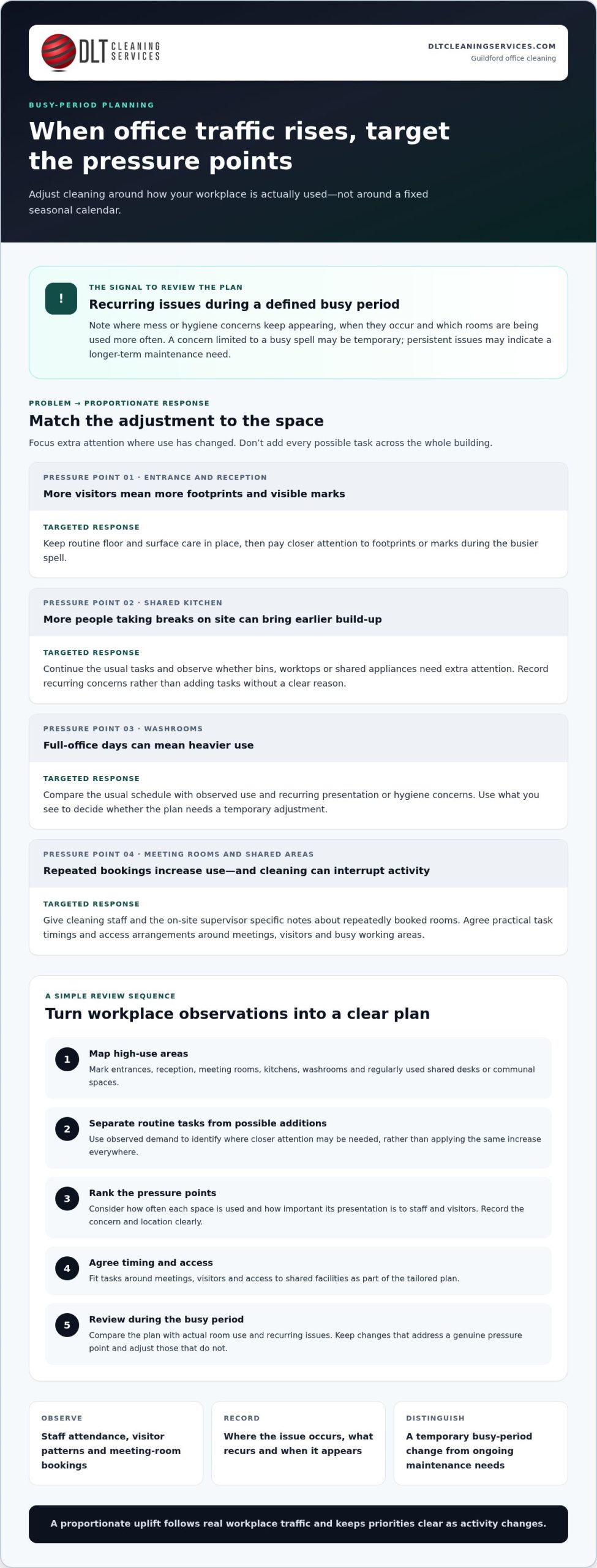
Look for recurring patterns rather than reacting to one untidy day. Reception may collect more footprints and marks as visitor numbers rise. A shared kitchen may need attention sooner when more people take breaks on site, while washrooms may see heavier use on full-office days. These are signals to review the plan, not reasons to add every possible task.
A busy-season cleaning uplift is a targeted adjustment to routine tasks, based on where and when workplace use increases. The aim is to maintain agreed standards and keep the office presentable without creating unnecessary work or interrupting daily operations. Focus effort where it can make a practical difference. For an overview of the wider scope and methods involved, see these commercial cleaning practices.
Which signs show your office needs a seasonal cleaning adjustment?
Keep a brief record of recurring issues in shared spaces, such as overflowing bins, visible marks on frequently used surfaces or washrooms needing attention earlier than expected. Compare your observations with the current cleaning schedule and note which rooms are being used more often. If a concern appears only during a defined busy period, it may be temporary. Persistent issues may point to a longer-term maintenance need.
What changes in office activity should shape the plan?
Consider staff attendance, visitor patterns and meeting-room bookings during the period you’re planning for. Use your own workplace observations rather than assumptions about when your sector or business gets busy. Note where increased use could affect presentation or hygiene, then match those pressure points to your agreed cleaning priorities. This gives you a clear starting point for Guildford office cleaning for busy seasons.
Use any broader guidance alongside your own workplace requirements. Keep the review practical by recording:
- Which areas are used more often than usual.
- What recurring mess or hygiene concerns appear, and when.
- Whether the pressure is temporary or part of an ongoing maintenance need.
These notes help distinguish a short-term change in activity from a lasting change in how the office is used. That makes it easier to plan a proportionate adjustment rather than add tasks indiscriminately.
Build a Guildford busy-season office cleaning checklist around workplace traffic
A useful checklist turns your observations into clear priorities. Instead of adding the same tasks across the whole building, map how people move through your workplace. Record what needs to stay in place, what may need closer attention and when to review the plan. This makes Guildford office cleaning for busy seasons responsive to actual use and keeps cleaning proportionate.
Cleaning priorities should follow workplace traffic, because the spaces people use most often are usually the first to show a change in demand. Adapt this ordered checklist to your layout and agreed cleaning arrangements:
- Map the high-use areas. Mark entrances, reception, meeting rooms, kitchens and washrooms. Include shared desks or other communal spaces if staff use them regularly.
- Separate routine tasks from possible additions. At entrances, maintain floors and visible surfaces, then pay closer attention to footprints or marks during a busier spell. In kitchens, keep up the usual tasks and note whether bins, worktops or shared appliances need extra attention. For washrooms, compare the usual schedule with observed use and recurring presentation or hygiene concerns.
- Rank the pressure points. Consider how often each space is used and how important its presentation is to staff and visitors. Give cleaning staff and the on-site supervisor specific notes, such as which meeting rooms have repeated bookings or where an issue keeps returning.
- Agree timing and access. Identify rooms where cleaning could interrupt a meeting, visitor or busy working area. Set practical task timings and access arrangements within the tailored plan so the uplift supports the working day.
- Set a review point. During the busy period, compare the plan with actual room use and recurring issues. Keep changes that address a genuine pressure point and adjust those that don’t.
How should managers prioritise rooms and shared touchpoints?
Use a workplace-specific list rather than applying a generic frequency to every room. A reception used throughout the day may need different attention from an occasional meeting room; a kitchen shared by several teams may have different pressure points again. Record the concern and location clearly, then share it with cleaning staff and the on-site supervisor so priorities remain understood as activity changes.
How can you fit cleaning around a busy working day?
Consider when visitors arrive, meetings take place and staff need access to shared facilities. Agree suitable task timings and access arrangements as part of the tailored plan. Clear communication about cleaning products matters too. OSHA’s hazard communication standards are a US reference, not UK requirements. DLT provides tailored office cleaning to suit workplace needs.
Choose the right Guildford seasonal cleaning uplift without adding unnecessary work
A busier spell doesn’t automatically call for a complete change to your cleaning arrangements. The right uplift depends on what you’ve observed, how your workplace is laid out and the pressure point you’re addressing. A meeting room used more often may need a selected task adjusted, while a specific bathroom hygiene concern could call for a focused response.
Use this comparison to choose the level of support that fits the need. It’s a decision guide, not a fixed package or schedule.
| Approach | May suit when | Planning consideration |
|---|---|---|
| Maintain the routine | Observed use remains broadly in line with the agreed plan, and the usual standards are being maintained. | Monitor recurring concerns so you can consider a change if demand shifts. |
| Adjust selected tasks | Pressure is concentrated in particular rooms or shared areas, rather than across the whole workplace. | Identify the specific tasks and locations needing extra attention while regular office maintenance continues. |
| Arrange a targeted deep clean | A particular area has a focused hygiene or presentation need that routine cleaning alone may not address. | Define the area and concern clearly so the work is tailored to the workplace and its requirements. |
To choose between these approaches, compare observed use with the current plan. Consider the layout too: a compact office with shared facilities may experience pressure differently from a larger workplace with several kitchens or washrooms. Then identify whether the issue is general wear from increased activity, a recurring task that needs adjustment or a specific concern requiring more focused attention.
For Guildford office cleaning for busy seasons, a proportionate change can maintain agreed standards without adding tasks indiscriminately. DLT Cleaning Services tailors office cleaning to workplace needs, with dedicated on-site supervision for office cleaning contracts. Share your pressure points and priorities to shape a practical plan around how your office is used.
When is a targeted change to routine cleaning more suitable?
Consider selected task adjustments when pressure is localised, such as in a frequently booked meeting room or a shared kitchen used more heavily during a particular period. Tasks can be tailored to the workplace rather than chosen from a fixed package. Regular office maintenance can continue alongside that temporary priority, keeping the wider plan steady while attention shifts where it’s needed.
When might a deep clean or hygiene support be relevant?
A bathroom deep clean can address a specific hygiene or presentation concern. It can sit alongside wider office cleaning rather than replace routine maintenance. DLT’s hygiene services also include janitorial products for shared workplaces, supporting practical day-to-day needs. Managers reviewing washroom priorities can use focused office bathroom hygiene guidance to consider what their facilities require.
Keep Guildford office cleaning consistent as seasonal demand changes
When workplace activity rises or shifts, cleaning priorities may need to change temporarily. Without a clear point of oversight, updated tasks can be misunderstood, concerns may be repeated without resolution and the original standards can become less clear to the office team. Keep communication focused on what has changed, where it matters and who needs to know.
For Guildford office cleaning for busy seasons, dedicated on-site supervision provides a practical point of coordination within the cleaning contract. DLT includes this supervision in its office cleaning contracts, supporting clear communication as workplace priorities change. It helps keep agreed expectations in view without assuming a particular inspection routine or adding unnecessary management steps.
How does on-site supervision support agreed cleaning standards?
A dedicated on-site supervisor helps keep communication about priorities clear between the workplace and cleaning team. If a temporary change affects a shared area or task, managers have a clear point of oversight for discussing how it fits with the agreed plan. This supports consistency as needs evolve. DLT’s dedicated on-site supervision is part of its approach to managing office cleaning contracts.
For more detail, read DLT’s article on dedicated on-site supervision. Keep any seasonal adjustment specific: identify the area, describe the concern and explain whether it is temporary or ongoing. Clear notes reduce ambiguity for everyone involved.
How can managers review the seasonal plan without adding complexity?
A brief check-in can show whether the original pressure points remain, whether a selected adjustment is still useful and whether new concerns have appeared. Keep a simple record rather than creating a separate reporting process. Note the issue, its location and any agreed change, then share the relevant information with the people responsible for the workplace and cleaning plan.
A useful review loop is simple:
- Note: Record recurring concerns and where they occur.
- Discuss: Compare those observations with current priorities and workplace activity.
- Adjust: Agree whether to retain, refine or remove a temporary change.
Keep responsibilities clear for the office team. Staff should know how to raise a recurring concern and who will pass it on, while cleaning priorities remain documented in a way the relevant people can follow. This helps the plan respond to workplace experience rather than assumptions.
Health and safety considerations also matter when tasks or products change. Keep relevant information about cleaning products accessible to the people who need it, and ensure agreed working arrangements are understood. This is practical oversight, not a substitute for your organisation’s own health and safety processes.
If your workplace’s activity has changed, DLT can tailor a cleaning plan around your pressure points and priorities. Read more about DLT office cleaning.
Plan busy-season office cleaning in Guildford with DLT
A useful service conversation starts with a clear picture of your workplace, not a long list of assumptions. Before planning a cleaning uplift, gather the practical details that show how your office is used and where extra attention may help. This gives DLT a sound basis for tailoring office cleaning and hygiene support to your needs while keeping the focus on agreed standards and day-to-day operations.
What information helps shape a tailored office cleaning plan?
Summarise the busy period, the parts of the building in use and any expected changes in staff attendance, visitor activity or room bookings. You don’t need to predict every fluctuation. An overview of how the workplace typically operates during the period can help identify where a tailored plan may be useful.
Before the conversation, note:
- Workplace layout: the main areas in use, such as reception, meeting rooms, kitchens and washrooms.
- Activity changes: when the office is likely to be busier and which spaces will see more use.
- Recurring concerns: specific presentation or hygiene issues, where they occur and whether they’re temporary or ongoing.
- Working arrangements: any access or timing considerations that could affect cleaning during the working day.
- Existing priorities: the standards and regular tasks you want to maintain as activity changes.
Keep this information practical and focused on spaces, tasks and workplace activity. There’s no need to share sensitive employee details. Clear, relevant notes help keep the discussion useful and distinguish a targeted adjustment from a broader maintenance need.
What can Guildford businesses expect from working with DLT?
DLT Cleaning Services is a family-run office cleaning and hygiene company established in 1999, serving Guildford and the wider Surrey area. Its tailored office maintenance is supported by dedicated on-site supervision for office cleaning contracts. This provides a clear point of oversight as agreed priorities are discussed and adapted to changing workplace use, without treating every busy period as the same.
For Guildford office cleaning for busy seasons, the aim is to build a practical plan around your workplace rather than add tasks without a clear reason. Sharing your layout, anticipated activity and main pressure points helps shape office cleaning and hygiene support around the needs of your shared workplace.
To plan for a busier period, discuss your Guildford office cleaning requirements with DLT and the priorities that matter to your team.
Set your next cleaning plan in motion
Your next busy period can also make future planning easier. Keep a short record of which adjustments proved useful, what no longer needs extra attention and any changes in how the workplace was used. As activity settles, these notes can help you return to your agreed routine or shape the next uplift without starting from scratch. A simple record gives managers a practical reference point that can evolve as business needs change.
Guildford office cleaning for busy seasons should support the way your workplace operates, not create another layer of administration. A focused conversation about your requirements can turn observed pressure points into a considered plan, with priorities that make sense for your team and working environment.
Note the changes your workplace is preparing for and the support it needs. Discuss a tailored Guildford office cleaning plan with DLT to put clear priorities in place for your next busy spell.
Frequently Asked Questions
How far ahead should I plan busy-season office cleaning in Guildford?
Start planning as soon as you have a reasonable idea of when office activity may change. There’s no single lead time that suits every workplace, so share the expected period and any known changes in building use with DLT. Allow time to describe your priorities and consider how they fit with existing cleaning. If plans shift, keep communication open so you can review the approach.
Can office cleaning be adjusted when staff or visitor numbers change?
Yes. Cleaning priorities can be tailored to reflect changes in how your Guildford workplace is used. A one-off increase in client appointments may put more pressure on reception and meeting spaces, while a temporary project team could make shared facilities busier. Explain what has changed and where it is having an effect to shape a proportionate adjustment, rather than applying the same uplift across every room.
What areas should receive extra attention during a busy office period?
Prioritise areas where increased use is most likely to affect cleanliness or presentation. Alongside shared kitchens and washrooms, consider desk-sharing points, door handles, printer areas and reception flooring. The right focus depends on your office layout and how people use it. Look for recurring concerns in specific places, then identify them clearly in your cleaning priorities so attention goes to practical pressure points, not simply the most visible parts of the building.
Does busy-season office cleaning include hygiene products?
DLT provides janitorial products as part of its hygiene services. These are a practical consideration for shared workplaces, particularly where staff and visitors rely on common facilities. When planning Guildford office cleaning, note which facilities require supplies and what your workplace uses. This keeps the discussion specific to your hygiene requirements rather than assuming every office needs the same products or arrangement.
Can a busy-season cleaning plan include a bathroom deep clean?
Yes. A bathroom deep clean can form part of a tailored hygiene plan when a facility needs focused attention. Identify the washroom and the concern, such as a recurring presentation issue or a need for more thorough cleaning than routine maintenance provides. This distinguishes a targeted deep clean from ongoing upkeep and gives the plan a clear, workplace-specific starting point.
How does DLT help maintain office cleaning standards during busier periods?
DLT’s dedicated on-site supervision gives each office cleaning contract a point of oversight as priorities are discussed. Managers can raise a specific concern, clarify the standard they want maintained and communicate changes in how an area is being used. Keeping those points clear helps align the cleaning plan with workplace needs. If activity changes again, managers can raise the new circumstances and review priorities with DLT.