What if a checklist that looks complete still leaves important cleaning tasks missed or duplicated? In offices with changing occupancy, shared kitchens and busy meeting rooms, generic daily, weekly and monthly lists can quickly lose touch with how each space is used. An office cleaning schedule template should do more than divide jobs by day: it should connect each task to a location, frequency, owner and completion record.
A clear routine makes ownership easier to understand, especially when staff and cleaning teams share responsibility. It can also help keep standards consistent without assigning tasks your workplace doesn’t need. Start with the rooms people use, then build the schedule around actual routines rather than copying a generic list.
In this guide, you’ll learn how to build a flexible 2026 schedule around occupancy, shared areas and workplace routines. We’ll cover what to include in your template, how to assign tasks and frequencies, and how to track completion. You’ll also see how regular reviews can help you adjust the plan when office use changes, so the schedule remains useful rather than becoming another checklist no one follows.
Key Takeaways
- Use an office cleaning schedule template to link each task with its location, frequency, owner and completion record.
- Group tasks by office zone, then set frequencies to reflect how often each area is used.
- Assign clear responsibilities to the cleaning team or an agreed in-house role, so shared tasks don’t fall between the cracks.
- Introduce the schedule with clear wording, then use completion records and staff feedback to spot what needs adjusting.
- Review the plan as workplace routines change, keeping it practical and relevant rather than relying on a fixed generic list.
Why an Office Cleaning Schedule Template Needs More Than a Task List
A list of cleaning jobs can look thorough yet still leave a shared kitchen untouched, repeat a task unnecessarily or give nobody clear responsibility for checking it. A dependable plan connects work to the rooms and routines of the workplace, then makes it possible to see what has been completed and what needs attention.
An office cleaning schedule is a planned record of cleaning tasks, their locations and frequencies, the people responsible, and when completion is recorded or reviewed. It differs from a one-off checklist, which helps someone work through jobs on a particular occasion but may not say who owns them next time. A written cleaning policy sets out broader expectations and procedures; the schedule turns relevant expectations into recurring, assigned work.
The distinction matters in practice. A task such as “clean kitchen” may be too vague to guide consistent work: does it mean wiping worktops, cleaning the sink, attending to appliance exteriors or cleaning the floor? Naming the specific action and location makes expectations easier to follow. For general context on cleaning methods and their purpose, see this overview of the principles of cleaning.
When does an office need a written cleaning schedule?
A written schedule is especially useful when several people or teams share responsibility for spaces such as kitchens, washrooms, meeting rooms and reception areas. These areas serve different users throughout the day, so tasks can be missed if everyone assumes someone else will handle them. Recording a responsible role or team against each task helps prevent gaps and duplicated effort.
Consider a Guildford office where staff use meeting rooms for client visits, while colleagues also share a kitchen and reception area. Its cleaning needs may differ from those of a nearby workplace with fewer visitors or different room-use patterns. A written plan can reflect those routines instead of relying on a generic list that treats every office alike.
What makes a cleaning schedule practical to use?
Keep entries brief and specific. Use familiar room names and readable task descriptions, such as “wipe kitchen worktops” rather than “clean kitchen”. Set achievable frequencies that suit how an area is used instead of copying tasks from a standard daily, weekly or monthly list. The next section explains how to assess those frequencies.
Each entry should also identify an owner, a way to record completion and a review date. Ownership clarifies who is accountable for delivery; completion tracking helps reveal missed tasks or repeated snags. If responsibility is shared, record which role handles each part rather than leaving the division open to interpretation.
Choose a format that cleaning teams and relevant staff can access during normal operations, whether that’s a printed sheet in an appropriate workplace location or a shared digital document. Keep the current version easy to find, and make the wording clear enough to follow without informal explanations. A schedule should support consistent office cleaning, not become another document that people struggle to use.
Office Cleaning Schedule Template: The Fields and Task Groups to Include
A useful office cleaning schedule template brings the details together in one place, rather than splitting tasks, ownership and sign-off across separate lists. ISSA’s overview of commercial cleaning standards and best practices offers wider context; your schedule should translate your workplace’s actual requirements into clear, trackable actions.
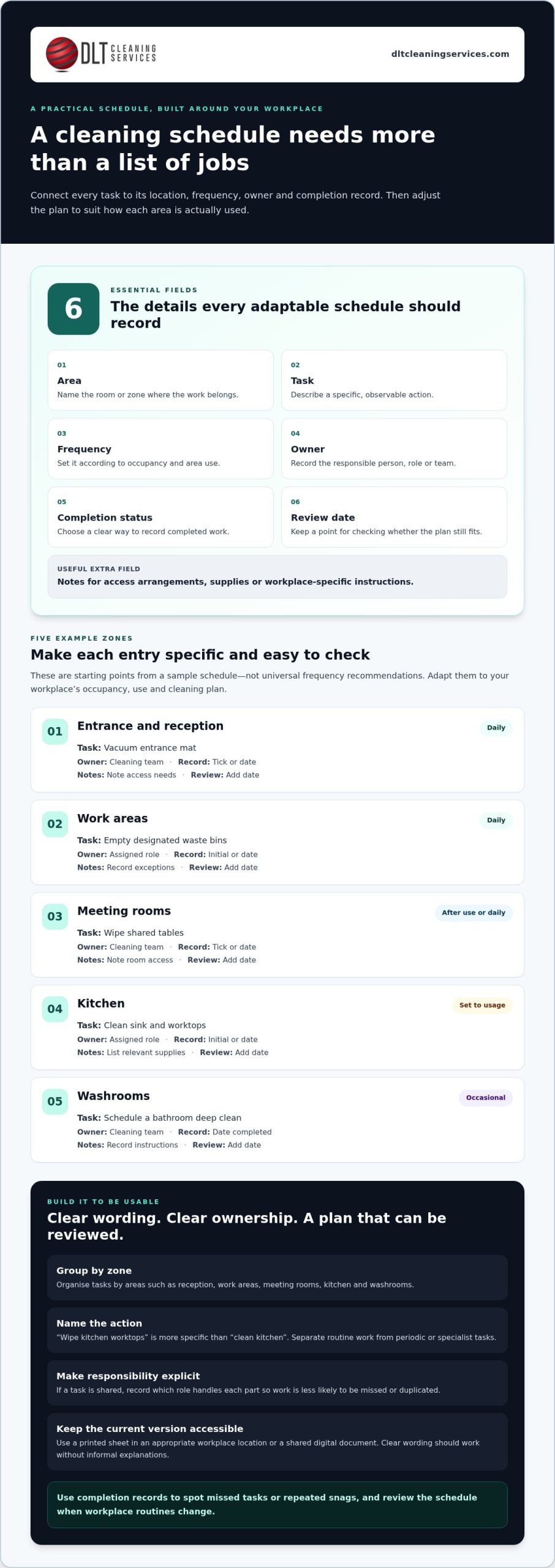
Every adaptable schedule should record the area, task, frequency, owner, completion status and review date. Add a notes field for access arrangements, supplies or workplace-specific instructions. The examples below are starting points, not universal frequency recommendations. Adjust them to suit occupancy, use and the cleaning plan for your workplace.
| Area | Task | Frequency | Owner | Completion | Review date | Notes |
|---|---|---|---|---|---|---|
| Entrance and reception | Vacuum entrance mat | Daily | Cleaning team | Tick or date | Add date | Note access needs |
| Work areas | Empty designated waste bins | Daily | Assigned role | Initial or date | Add date | Record exceptions |
| Meeting rooms | Wipe shared tables | After use or daily | Cleaning team | Tick or date | Add date | Note room access |
| Kitchen | Clean sink and worktops | Set to usage | Assigned role | Initial or date | Add date | List relevant supplies |
| Washrooms | Schedule a bathroom deep clean | Occasional | Cleaning team | Date completed | Add date | Record instructions |
How should the template organise office areas and tasks?
Group entries by zone, such as entrance and reception, work areas, meeting rooms, kitchen and washrooms. Then describe each job as an observable action: “wipe meeting-room tables” is clearer than “leave room clean”. Separate routine office cleaning from periodic or specialist work, such as a bathroom deep clean, so the schedule doesn’t blur different tasks or expectations. Use the notes field for practical details without crowding the task description.
Frequency labels such as daily, weekly, monthly or occasional make a plan easy to scan, but choose them for the specific space and task. Some jobs may be triggered by use, such as resetting a meeting room after it’s booked, rather than being assigned a fixed daily repetition.
How can a printable or digital schedule track completion?
A printed sheet can be easy to see and mark during a shift; a shared digital document can keep updates and review dates together. Either can work if the relevant people can access it during normal operations. Use simple initials, ticks or dated entries to show completion, and leave enough room to flag a missed task or access issue.
Keep the layout uncluttered: one task per row, familiar area names and a clear place to record progress. For support putting a consistent workplace plan into practice, explore office cleaning and hygiene services.
How to Set Cleaning Frequencies Around Office Use
Daily, weekly and monthly headings are useful ways to organise a plan, but they don’t determine what every workplace needs. A schedule that suits a busy reception may be excessive for a rarely used meeting room. Suitable cleaning frequency depends on how a space is used, who uses it and the workplace’s needs. Treat example frequencies as a starting point, then adjust them based on what you observe.
- Map the areas. List the spaces included in the cleaning plan, from entrances and washrooms to desks, kitchens and meeting rooms. Include shared areas that can be overlooked, and distinguish rooms with different uses.
- Assess how each area is used. Consider office attendance patterns, visitor access, shared-space use and visible condition. A reception that welcomes visitors throughout the day may need a different approach from a quiet room used occasionally.
- Set a starting frequency. Choose a practical initial interval for each task. For example, you might begin by reviewing a busy shared kitchen more often than a low-traffic meeting room. These are examples to test, not fixed rules for all offices.
- Assign ownership. Name the responsible cleaning team or agreed role for every task. If a task depends on a room being used, make the trigger clear, such as after a booked meeting, rather than leaving staff to guess.
- Review and adjust. Use completion records, feedback and the condition of each area to check whether the frequency is working. Change the plan when routines shift or tasks regularly prove unnecessary, overdue or difficult to complete.
Which workplace conditions should shape task frequency?
Look beyond room labels. A shared kitchen used by a full team may show signs of use faster than a small kitchenette used by a handful of people. A meeting room with frequent visitor access may need attention based on bookings, while a quieter room could follow a less frequent routine. Attendance patterns also matter: a hybrid office may have different busy days, and a space repurposed for regular meetings may need its schedule reconsidered.
Use observed condition alongside expected use. If an area repeatedly looks untidy before its next scheduled clean, consider a different interval or clearer instructions. Avoid treating a sample schedule as a legal requirement; set frequencies for the work and workplace rather than assuming one interval applies everywhere.
How should the schedule handle periodic and ad hoc tasks?
Keep planned periodic work in its own section, separate from recurring routine tasks. Record what needs scheduling, who owns it and when it is due, without implying that an occasional task belongs in a daily checklist. A separate notes or additional-needs record can capture an issue that arises between reviews, such as a change to room use or an area needing attention.
Use visible condition, workplace changes and planned maintenance as prompts to revisit the schedule. This keeps periodic tasks from disappearing among routine entries and helps the plan respond to how the office actually operates.
Assign Cleaning Responsibilities and Keep the Schedule Usable
A schedule only works when everyone can see where their responsibilities begin and end. Separate tasks assigned to the cleaning team from any agreed in-house tidying or reporting. Staff might be asked to clear personal items from desks or report a spill, for example, but that doesn’t mean every employee is responsible for cleaning shared kitchens or washrooms.
In your office cleaning schedule template, assign one accountable role or team to each recurring task. Avoid entries such as “staff” or “cleaner” if they leave people unsure who should act. Use role names that make sense in your workplace, such as “cleaning team”, “office manager” or “meeting-room contact”. This keeps the plan clear even when individual team members change.
How can managers make task ownership clear?
Consider the handovers as well as the task itself. If a shared room is used by several teams, specify whether the cleaning team handles the scheduled clean and which in-house role reports access issues or unusual mess. Where work spans shifts, record the point at which responsibility passes on, so an incomplete task isn’t mistaken for completed work.
Make expectations visible and review missed tasks calmly. Check whether the task was clear, access was available or the timing suited the way the space was being used. A pattern of missed entries may point to an impractical schedule or a handover gap, not an individual failing. Dedicated on-site supervision can help managers keep delivery and standards under review as part of a professional office cleaning arrangement.
How can managers keep records and instructions proportionate?
Use a simple system that records progress without creating unnecessary paperwork. A tick, initials or date can show completion. If a task couldn’t be done, add a short reason, such as “room occupied”, and note the follow-up action and who will take it. Keep any extra explanation brief and relevant.
Place task instructions where the people expected to follow them can access them during normal operations. Include practical details such as access arrangements, where relevant supplies are kept, and any workplace-specific steps. Make safe working practices visible in the instructions, and ensure they reflect the procedures that apply at your site without adding unverified legal claims.
Keep the schedule easy to scan. If staff have to search through long notes to find the task, owner or completion record, simplify it. Review the record with the people involved, including the cleaning team, to spot recurring access problems or unclear handovers. On-site supervision can provide a practical point of coordination and help keep assigned work and standards visible.
For a professional cleaning arrangement built around clear tasks and ownership, explore DLT office cleaning support.
Put the Office Cleaning Schedule into Practice and Review It
A template becomes useful when people can follow it as part of their normal working routine. Before launch, walk through the office cleaning schedule with the people who’ll use it. Check that room names are familiar, task wording describes a clear action and nobody has to guess who is responsible. If a task prompts questions during this trial, clarify the wording before sharing the final version.
What is a simple process for launching the schedule?
- Map the work areas. Confirm which rooms and shared spaces the plan covers, including areas that may be easy to overlook.
- Agree ownership. Assign each task to the cleaning team or an agreed in-house role, and clarify any handovers.
- Complete the template. Add the tasks, frequencies, completion method and relevant notes, then check that each entry is understandable.
- Share the final version. Make it accessible to the people expected to use it and explain how to record completion or flag an issue.
- Set a review date. Invite concise feedback from staff and the cleaning team, so you can see whether the plan works in practice.
Keep an earlier copy when you update the schedule. Comparing versions helps you understand what changed and why, such as a revised task frequency or a newly shared room. It also gives managers useful context when a recurring issue appears, without turning the record into a blame tool.
How should you review and refine the plan?
Look for patterns rather than treating each missed task as an isolated problem. Repeated incomplete entries may point to unclear wording, impractical timing, access difficulties or a missing handover. Feedback can reveal gaps that completion marks alone won’t show, such as a space that’s being used more often than expected.
Revisit the plan when office attendance changes, the workspace layout is altered or the way people use shared areas shifts. A room that becomes a regular meeting space may need different attention from one that is now rarely used. Use the review to adjust relevant tasks and ownership, keeping the schedule proportionate to current needs.
When can managed office cleaning support the plan?
Professional routine office cleaning can support consistent workplace maintenance by giving recurring cleaning tasks clear delivery and oversight. DLT Cleaning Services Ltd provides dedicated on-site supervision for office cleaning contracts, helping keep standards and scheduled work under review. This can be a practical part of coordinating cleaning responsibilities across a workplace.
For professional routine cleaning that can support your schedule, discuss office cleaning with DLT.
Make Your Cleaning Plan Work for Your Workplace
Your schedule doesn’t need to be perfect before it’s useful. Treat it as a working plan: put it into practice, listen to the people who rely on it and make considered changes as your workplace evolves. That feedback loop helps your office cleaning schedule template stay relevant, rather than becoming a document that no longer reflects daily routines.
DLT Cleaning Services Ltd is a family-run independent company established in 1999, providing office cleaning and hygiene services across Surrey, Hampshire and Berkshire. Its office cleaning contracts include dedicated on-site supervision, helping keep scheduled work and standards under review.
Discuss office cleaning with DLT Cleaning Services Ltd to plan a routine that fits your Guildford workplace.
Frequently Asked Questions
What is the difference between an office cleaning schedule and a checklist?
A schedule sets out the recurring cleaning arrangement, while a checklist helps someone work through and mark off specific jobs. For example, a schedule might assign a meeting-room clean to a role after bookings; a checklist can show the individual actions for that clean. Used together, the schedule keeps responsibilities and timing consistent, and the checklist makes each visit easier to complete and verify.
Can an office cleaning schedule template be used for a hybrid workplace?
Yes. An office cleaning schedule template can reflect changing attendance by identifying which shared spaces see heavier use on particular days. A Guildford office with a mix of home and office working might track meeting-room bookings or kitchen use, then review whether the plan still fits. Avoid relying only on a fixed headcount: visitor access, team events and changes to room bookings can also affect the work required.
Should an office cleaning schedule be displayed in the workplace?
Make the schedule easy for the people responsible for using it to access, but it doesn’t always need to be displayed publicly. A printed copy in an appropriate staff area may suit a team that records work by hand; a shared digital file may work better when managers update tasks centrally. Consider confidentiality and workplace routines, then make sure the current version is straightforward to find.
What should managers do when a scheduled cleaning task is missed?
Record the missed task and the reason, if known, then assign a clear follow-up action. For instance, if a room was unavailable, note who will arrange access and when the task should be revisited. If the same task is missed repeatedly, look for a pattern such as unclear instructions or a timing conflict. Treat the record as a way to improve the process, not to assign blame automatically.
Can one office cleaning schedule work across several locations?
One framework can help keep shared standards consistent, but each site needs entries that reflect its own layout, access arrangements and working patterns. A Guildford business with another office, for example, could use the same headings while recording site-specific rooms and responsibilities separately. A multi-site cleaning guide can help managers plan that wider structure, so local differences don’t disappear inside one generic checklist.
Is there a legally required cleaning frequency for every UK office?
Don’t assume there is one cleaning interval that applies to every UK office. The appropriate plan depends on the workplace, its activities and how spaces are used. If you need to establish whether a particular legal duty affects your premises, check current guidance from an authoritative UK source, such as the Health and Safety Executive, or seek qualified advice. Keep the schedule aligned with your actual workplace needs.
How often should an office cleaning schedule template be updated?
Review it whenever a change could make its instructions or assignments inaccurate. Examples include a refurbishment, a new team using a shared room, altered visitor arrangements or a change to how the office operates. You can also use staff feedback and recurring exceptions as prompts. Keep a dated copy when making revisions, so managers in Guildford can understand why a task or responsibility changed and share the correct version.